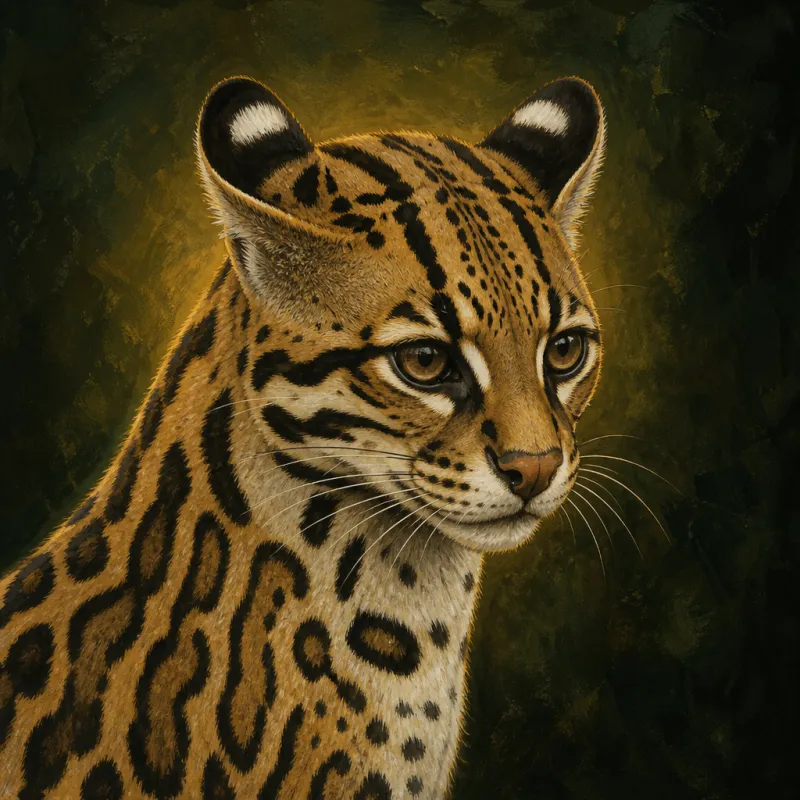
Ocelots are heavily patterned with chain-like rosettes that run in lines along the flanks, and no two individuals carry the same arrangement. That makes camera-trap identification straightforward and has produced some of the best density data available for any Neotropical cat.
Ecologists describe an "ocelot effect": where ocelots are abundant, margays, oncillas and other small cats occur at lower densities and shift their activity, apparently to avoid both competition and predation.
Size and measurements
| Head-body length | 22 in – 3 ft 3 in (55–100 cm) |
|---|---|
| Tail length | 10 in – 18 in (26–45 cm) |
| Shoulder height | 16 in – 20 in (40–50 cm) |
| Body weight | 15–40 lb (7–18 kg) — Males average roughly a third heavier than females. |
| Top recorded speed | Not reliably measured — Not measured in the field; ocelots hunt by slow searching, not pursuit. |
| Lifespan in the wild | 7–10 years |
| Lifespan under human care | 20–23 years |
Habitat and range
Dense cover is the constant requirement, from Amazon rainforest and flooded várzea to Texan thornscrub and coastal mangrove.
From south Texas and northern Mexico through Central America to northern Argentina. The United States population is confined to a few small areas of southern Texas.
Diet and hunting
Rodents, opossums, armadillos, iguanas, snakes, birds and fish; most prey items weigh under two pounds.
Hunting strategy — Slow ground search with short pounce. Ocelots walk slowly through cover, pausing frequently, and rely on hearing and smell as much as sight.
Behaviour and activity
Solitary and territorial. Adults hold defended ranges and travel long distances along established routes each night, often several miles.
Nocturnal and crepuscular. Predominantly night active, with some daytime movement during cool or wet weather.
Climbing and swimming
Climbing — Strong. Climbs and rests in trees but takes most prey on the forest floor.
Swimming — Strong. Comfortable in water, crossing rivers and hunting along flooded forest edges.
Conservation status
The Ocelot is currently listed as Least Concern on the IUCN Red List, with a population trend recorded as decreasing in the assessment published in 2015.
Secure at the species level across Amazonia, but the northern edge of the range is in serious trouble: the Texas population numbers only a few dozen animals and is federally listed as endangered in the United States.
Documented threats
- Deforestation and fragmentation
- Road mortality
- Retaliatory killing near poultry
- Historical fur trade legacy
- Isolation of border populations
Look up the current Red List assessment for Leopardus pardalis
Notable traits
- Hundreds of thousands of ocelot skins entered the international fur trade in the 1960s and 1970s before trade controls took effect.
- Highway underpasses in Texas were built specifically to reduce ocelot road deaths.
- Each animal's rosette pattern is unique, which underpins camera-trap population estimates.
Sources for this profile
- IUCN Red List of Threatened Species Global assessment categories, population trends and documented threats.
- IUCN SSC Cat Specialist Group Species accounts, distribution notes and Cat News reporting for every wild felid.
- U.S. Fish and Wildlife Service Federal listing status and recovery planning for cats occurring in the United States.
- Panthera Field research programmes and species profiles for big and small wild cats.
- Animal Diversity Web, University of Michigan Museum of Zoology Reviewed species accounts with morphometric ranges and reproductive data.