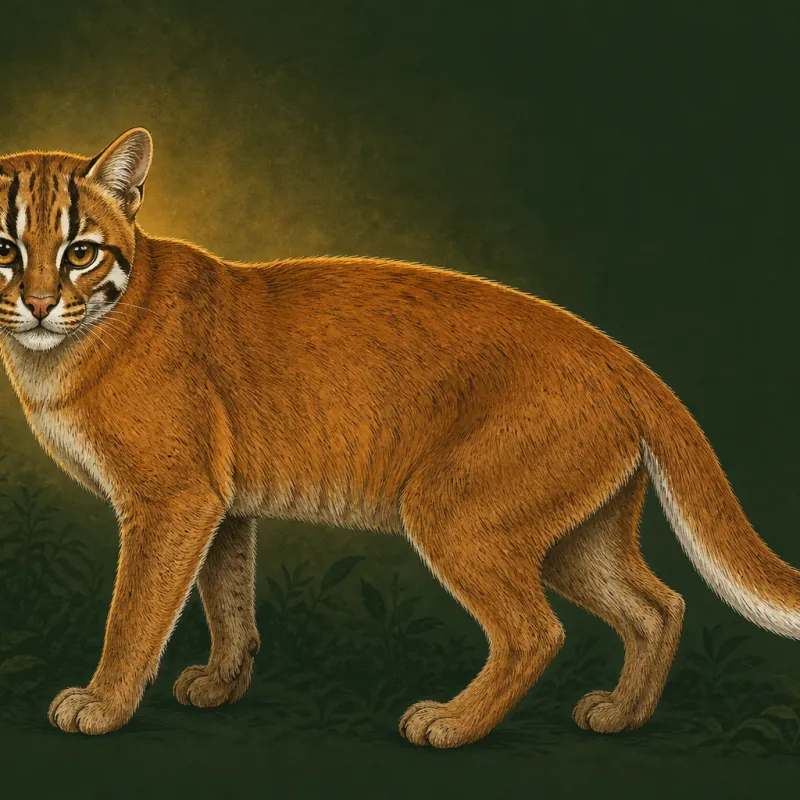
Roughly three times the weight of a domestic cat, the Asian golden cat has a solid build, a fairly short tail with a white underside, and distinctive white-and-black lines running across the cheeks and forehead.
Colour variation is exceptional. Alongside the typical golden-brown form, populations in China and the eastern Himalaya include grey, cinnamon, melanistic and boldly spotted morphs — the last resembling an ocelot.
Size and measurements
| Head-body length | 2 ft 2 in – 3 ft 5 in (66–105 cm) |
|---|---|
| Tail length | 16 in – 22 in (40–57 cm) |
| Shoulder height | 18 in – 22 in (45–56 cm) |
| Body weight | 20–35 lb (9–16 kg) — Males average heavier than females. |
| Top recorded speed | Not reliably measured — Not measured in the field. |
| Lifespan in the wild | 10–12 years |
| Lifespan under human care | 17–20 years |
Habitat and range
Evergreen and mixed forest from lowland to about 12,000 feet in the Himalaya, including bamboo, secondary growth and drier deciduous woodland.
From Nepal and north-east India through Bhutan, Myanmar, southern China, Thailand, Laos, Cambodia and Vietnam to peninsular Malaysia and Sumatra.
Diet and hunting
Rodents, hares, birds and reptiles, plus muntjac and young ungulates; the species is strong enough to take prey considerably larger than itself.
Hunting strategy — Ground stalking in forest. Hunts on the forest floor, using cover for a close approach before a short rush.
Behaviour and activity
Solitary. Mostly terrestrial and territorial. Field observations remain sparse despite the cat's relatively large size.
Crepuscular and partly diurnal. Camera-trap studies show more daytime activity than early accounts suggested, with peaks around dawn and dusk.
Climbing and swimming
Climbing — Strong. Climbs well and will follow prey into trees, though it hunts mainly on the ground.
Swimming — Limited. No strong association with water.
Conservation status
The Asian Golden Cat is currently listed as Near Threatened on the IUCN Red List, with a population trend recorded as decreasing in the assessment published in 2015.
Assessed as Near Threatened. Deforestation across South East Asia and pervasive snaring for the wild-meat and skin trade are the main pressures.
Documented threats
- Deforestation
- Indiscriminate snaring
- Trade in skins and bones
- Prey depletion
- Retaliatory killing near livestock
Look up the current Red List assessment for Catopuma temminckii
Notable traits
- At least six coat morphs have been recorded, an unusual level of variation for a wild cat.
- Local names in several range countries translate as "fire cat" or "rock cat".
- A spotted morph photographed in China initially confused researchers, who suspected a new species.
Sources for this profile
- IUCN Red List of Threatened Species Global assessment categories, population trends and documented threats.
- IUCN SSC Cat Specialist Group Species accounts, distribution notes and Cat News reporting for every wild felid.
- Small Wild Cat Conservation Foundation Dedicated research and field reporting on the lesser-known felids.
- Wildlife Conservation Society Field programmes, camera-trap surveys and population monitoring.
- Animal Diversity Web, University of Michigan Museum of Zoology Reviewed species accounts with morphometric ranges and reproductive data.