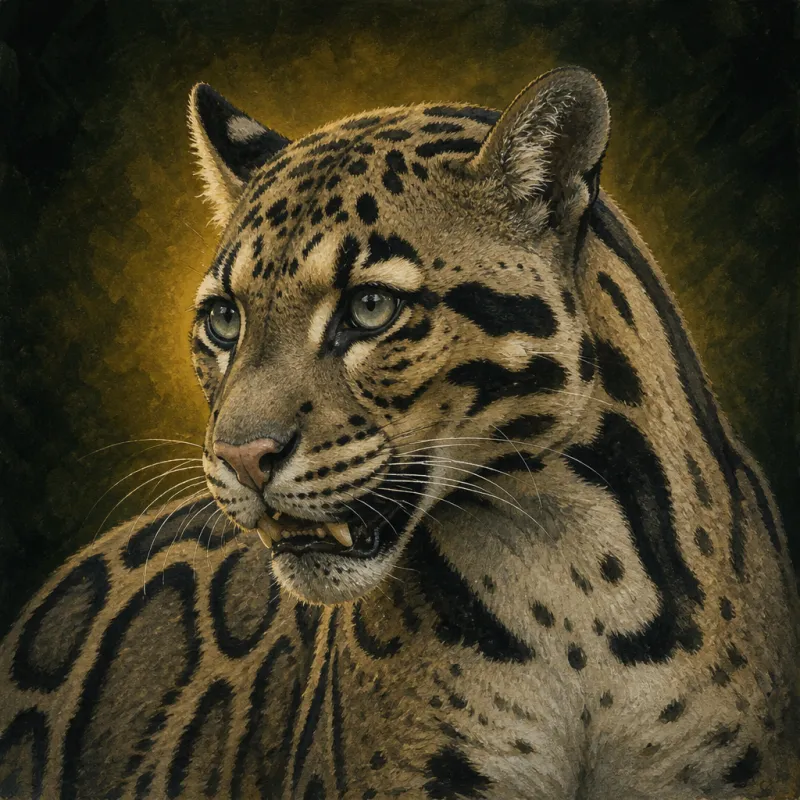
Clouded leopards sit between the small cats and the big cats in both size and anatomy. Their cloud-shaped blotches, short legs and very long tail are adaptations for moving through the canopy of dense evergreen forest.
Two skeletal traits stand out: exceptionally long upper canines set in a comparatively narrow skull, and highly flexible ankle joints that let the animal rotate its hind feet backwards and descend a trunk head first.
Size and measurements
| Head-body length | 2 ft 3 in – 3 ft 7 in (68–108 cm) |
|---|---|
| Tail length | 2 ft – 3 ft (61–91 cm) |
| Shoulder height | 20 in – 22 in (50–55 cm) |
| Body weight | 24–55 lb (11–25 kg) — Males are noticeably heavier than females. |
| Top recorded speed | Not reliably measured — No reliable field measurement exists for this species. |
| Lifespan in the wild | 10–12 years |
| Lifespan under human care | 13–17 years |
Habitat and range
Primarily closed-canopy evergreen forest, but also recorded in secondary growth, mangrove, dry woodland and, in the Himalaya, forest above 8,000 feet.
Mainland South East Asia and the eastern Himalaya: Nepal, north-east India, Bhutan, Myanmar, Thailand, Laos, Cambodia, Vietnam, Malaysia and southern China.
Diet and hunting
Gibbons, macaques, slow lorises, porcupines, squirrels, pheasants, small deer and pigs, taken both in trees and on the ground.
Hunting strategy — Arboreal and ground ambush. Prey is approached quietly and killed with a bite to the nape or skull, aided by unusually long canines.
Behaviour and activity
Solitary. Secretive and rarely observed directly; most ecological knowledge comes from camera trapping and a small number of radio-collared animals.
Nocturnal and crepuscular. Camera-trap records cluster at night and around dusk, with daytime resting in trees.
Climbing and swimming
Climbing — Exceptional. One of the most arboreal cats: it can hang from branches by its hind feet and climb down trunks head first.
Swimming — Capable. Recorded crossing rivers, though the species is not associated with wetlands.
Conservation status
The Clouded Leopard is currently listed as Vulnerable on the IUCN Red List, with a population trend recorded as decreasing in the assessment published in 2016.
Forest loss across South East Asia is the dominant pressure, compounded by intensive snaring that removes both the cat and its prey.
Documented threats
- Deforestation
- Indiscriminate snaring
- Trade in skins, teeth and bones
- Prey depletion
- Habitat fragmentation
Look up the current Red List assessment for Neofelis nebulosa
Notable traits
- Relative to skull length, its canines are the longest of any living cat, a proportion often compared with extinct sabre-toothed forms.
- Rotating hind ankles allow head-first descent, a trait shared with very few other cats.
- The tail can be as long as the head and body, acting as a balance beam in the canopy.
Sources for this profile
- IUCN Red List of Threatened Species Global assessment categories, population trends and documented threats.
- IUCN SSC Cat Specialist Group Species accounts, distribution notes and Cat News reporting for every wild felid.
- Smithsonian's National Zoo and Conservation Biology Institute Body measurements, longevity records and life-history notes.
- Wildlife Conservation Society Field programmes, camera-trap surveys and population monitoring.
- National Geographic — Animals General natural-history reference for behaviour, range and ecology.