Species comparison
Geoffroy's Cat vs Ocelot
A side-by-side look at Leopardus geoffroyi and Leopardus pardalis across body measurements, habitat, diet, behaviour and conservation status.
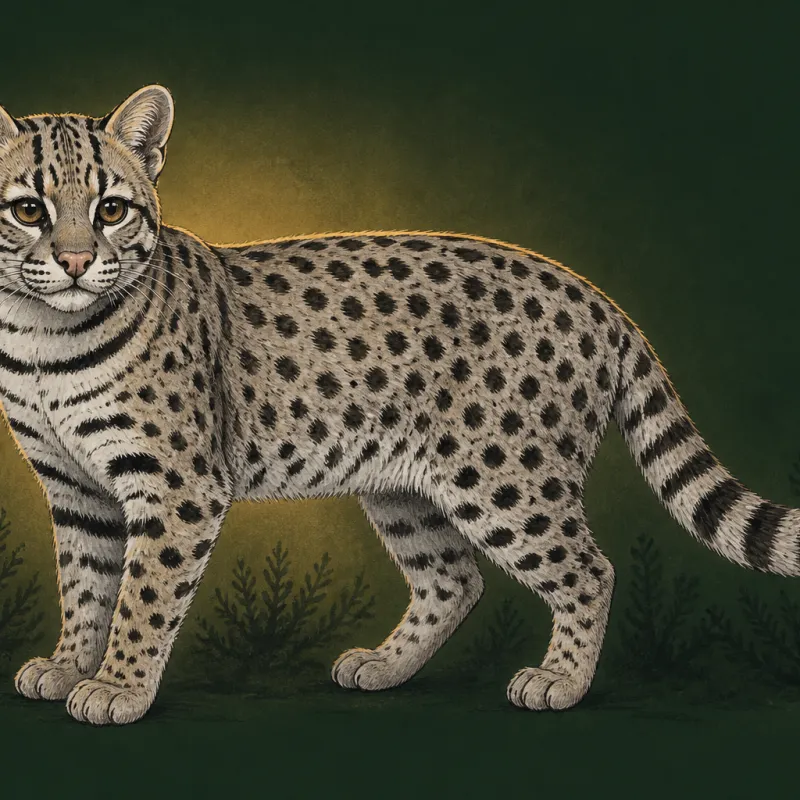
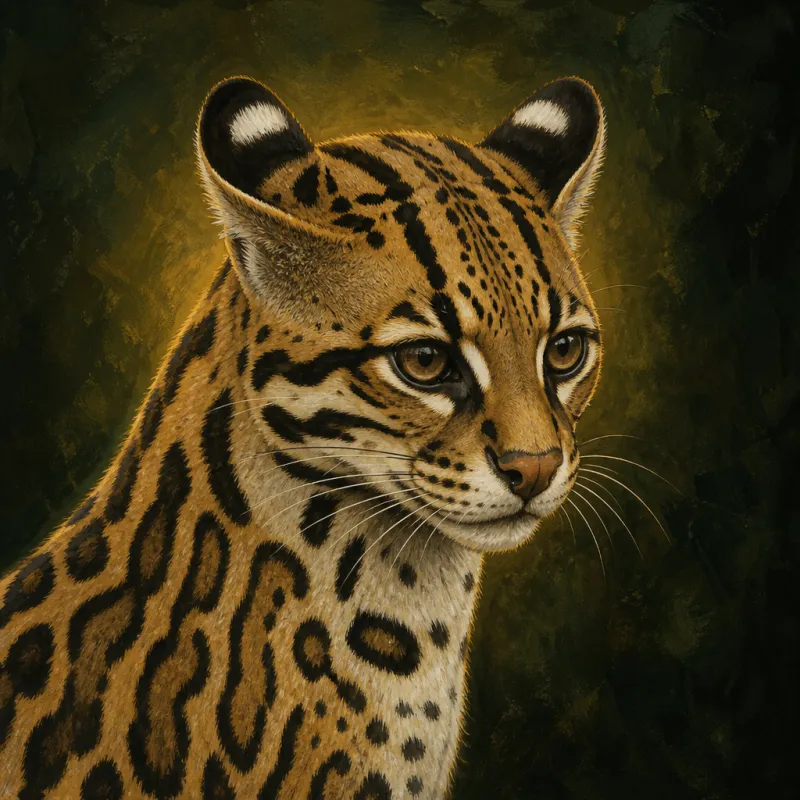
At a glance
- The ocelot averages about 2.6 times the body mass of the geoffroy's cat.
- Both species use semi-arid scrub and dry forest.
- Their ranges both include South America.
- Both are currently listed as Least Concern on the Red List.
Identification
How each species is named and classified.
Geoffroy's Cat
Leopardus geoffroyi
Ocelot
Leopardus pardalis
Geoffroy's Cat
Leopardus
Ocelot
Leopardus
Geoffroy's Cat
Ocelot lineage
Ocelot
Ocelot lineage
Geoffroy's Cat
Small cats
Ocelot
Medium-sized cats
Geoffroy's Cat
Gato montés
Ocelot
Painted leopard, Dwarf leopard
Body and movement
Published field measurements for adults. Ranges cover both sexes unless noted.
Geoffroy's Cat
17 in – 2 ft 2 in (42–66 cm)
Ocelot
22 in – 3 ft 3 in (55–100 cm) Longer
Geoffroy's Cat
9 in – 14 in (24–36 cm)
Ocelot
10 in – 18 in (26–45 cm) Longer
Geoffroy's Cat
10 in – 12 in (25–30 cm)
Ocelot
16 in – 20 in (40–50 cm) Taller
Geoffroy's Cat
4.4–17 lb (2–7.8 kg)
Most adults weigh 3–5 kg; animals in the south of the range are larger.
Ocelot
15–40 lb (7–18 kg) Heavier
Males average roughly a third heavier than females.
Geoffroy's Cat
Not reliably measured
Not measured in the field.
Ocelot
Not reliably measured
Not measured in the field; ocelots hunt by slow searching, not pursuit.
Life span
Typical adult longevity. Figures for managed care come from zoo and sanctuary records.
Geoffroy's Cat
10–14 years Longer
Ocelot
7–10 years
Geoffroy's Cat
14–18 years
Ocelot
20–23 years Longer
Habitat and range
Where each species lives and the conditions it tolerates.
Geoffroy's Cat
semi-arid scrub, grassland, dry forest, wetland, agricultural mosaic
Chaco thornscrub, pampas grassland, Patagonian steppe and riverside woodland; it also uses farmland with hedgerows and marsh edges.
Ocelot
tropical rainforest, dry forest, mangrove, semi-arid scrub, savanna, wetland
Dense cover is the constant requirement, from Amazon rainforest and flooded várzea to Texan thornscrub and coastal mangrove.
Geoffroy's Cat
South America
Bolivia, Paraguay, southern Brazil, Uruguay, Argentina and Chile, reaching the southern tip of the continent.
Ocelot
North America, South America
From south Texas and northern Mexico through Central America to northern Argentina. The United States population is confined to a few small areas of southern Texas.
Diet and behaviour
Feeding ecology, social organisation and hunting technique.
Geoffroy's Cat
small mammals, birds, fish, reptiles
Rodents and small birds dominate; fish, frogs and crustaceans are taken where wetlands are available.
Ocelot
small mammals, reptiles, birds, fish
Rodents, opossums, armadillos, iguanas, snakes, birds and fish; most prey items weigh under two pounds.
Geoffroy's Cat
Solitary
Occupies small home ranges at relatively high density where cover and rodents are plentiful.
Ocelot
Solitary and territorial
Adults hold defended ranges and travel long distances along established routes each night, often several miles.
Geoffroy's Cat
Nocturnal
Chiefly night active, with occasional crepuscular movement in undisturbed areas.
Ocelot
Nocturnal and crepuscular
Predominantly night active, with some daytime movement during cool or wet weather.
Geoffroy's Cat
Ground stalk with frequent climbing
Hunts along cover edges and will climb into low trees after birds, or wade in shallow water after fish.
Ocelot
Slow ground search with short pounce
Ocelots walk slowly through cover, pausing frequently, and rely on hearing and smell as much as sight.
Geoffroy's Cat
Strong
A capable climber that rests and dens in trees where they are available.
Ocelot
Strong
Climbs and rests in trees but takes most prey on the forest floor.
Geoffroy's Cat
Strong
One of the more water-tolerant small cats, entering streams and marsh to hunt.
Ocelot
Strong
Comfortable in water, crossing rivers and hunting along flooded forest edges.
Conservation
Red List category, population direction and the pressures documented for each species.
Geoffroy's Cat
LC — Least Concern
Assessed 2014
Ocelot
LC — Least Concern
Assessed 2015
Geoffroy's Cat
Stable
Ocelot
Decreasing
Geoffroy's Cat
Conversion of scrub and grassland to cropland, Road mortality, Killing near poultry, Dog predation, Legacy of intensive fur trapping
Currently secure, having recovered from very heavy fur-trade harvesting in the twentieth century. Habitat conversion and conflict with rural households remain the main local pressures.
Ocelot
Deforestation and fragmentation, Road mortality, Retaliatory killing near poultry, Historical fur trade legacy, Isolation of border populations
Secure at the species level across Amazonia, but the northern edge of the range is in serious trouble: the Texas population numbers only a few dozen animals and is federally listed as endangered in the United States.
Notable traits
Details that do not fit neatly into a measurement table.
Geoffroy's Cat
- Hundreds of thousands of skins were traded in the 1970s and 1980s before controls tightened.
- Melanistic individuals are frequent in some populations, particularly in wetter habitats.
- It is one of very few small cats regularly recorded fishing in shallow water.
Ocelot
- Hundreds of thousands of ocelot skins entered the international fur trade in the 1960s and 1970s before trade controls took effect.
- Highway underpasses in Texas were built specifically to reduce ocelot road deaths.
- Each animal's rosette pattern is unique, which underpins camera-trap population estimates.
Sources used for this comparison
- IUCN Red List of Threatened Species Global assessment categories, population trends and documented threats.
- IUCN SSC Cat Specialist Group Species accounts, distribution notes and Cat News reporting for every wild felid.
- Small Wild Cat Conservation Foundation Dedicated research and field reporting on the lesser-known felids.
- Animal Diversity Web, University of Michigan Museum of Zoology Reviewed species accounts with morphometric ranges and reproductive data.
- Wildlife Conservation Society Field programmes, camera-trap surveys and population monitoring.
- U.S. Fish and Wildlife Service Federal listing status and recovery planning for cats occurring in the United States.
- Panthera Field research programmes and species profiles for big and small wild cats.