Telling look-alikes apart
Jaguar vs Leopard
These two spotted cats are separated by an ocean and by a set of anatomical differences that follow directly from what each of them hunts.
At a glance
- The jaguar averages about 1.5 times the body mass of the leopard.
- The jaguar has the higher recorded top speed, at 50 mph (80 km/h).
- Both species use tropical rainforest and savanna.
- Their ranges do not overlap: Jaguar lives in North America and South America, Leopard in Africa and Asia.
- Red List categories differ: Jaguar is listed as Near Threatened, Leopard as Vulnerable.
Reading the coat
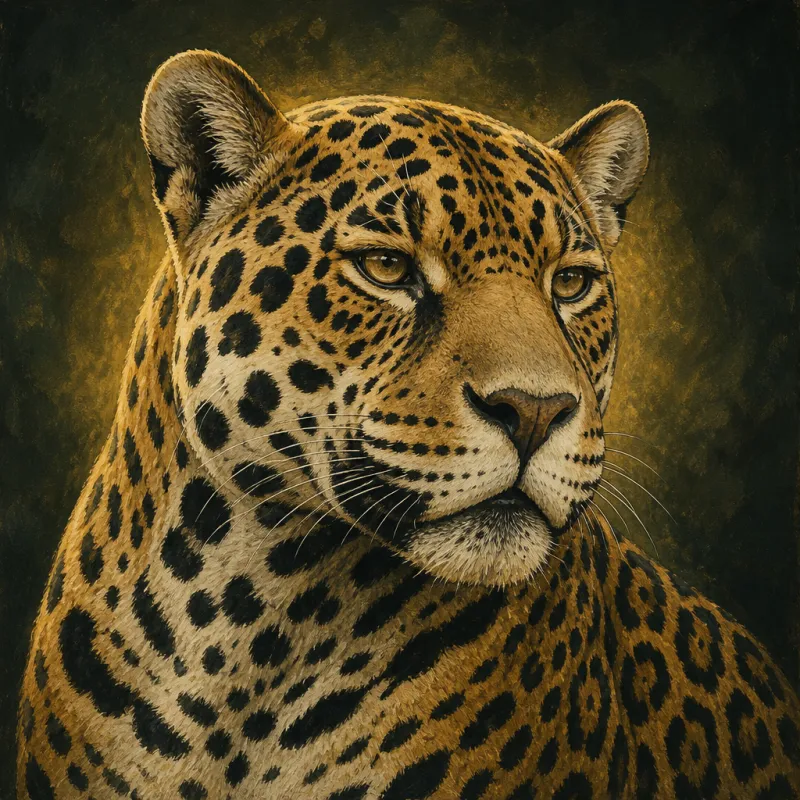
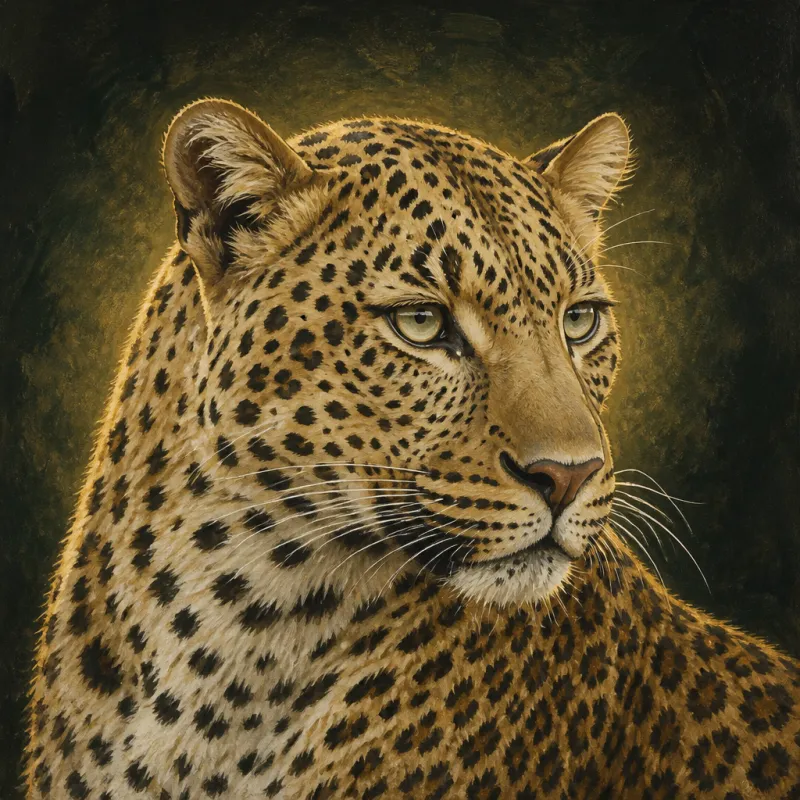
The quickest field distinction is the rosette. Jaguar rosettes are larger, fewer and usually enclose one or more small dark spots inside the ring. Leopard rosettes are smaller, more densely packed and empty in the centre. Both species produce melanistic individuals, and in both cases the underlying pattern remains visible in raking light.
Build differs just as clearly once you know what to look for. Jaguars are shorter-limbed and heavier through the chest and head; leopards are longer in the leg and sleeker, with a proportionally longer tail.
Two solutions to the problem of killing
Leopards kill in the way most large cats do, with a suffocating throat or muzzle bite. Jaguars frequently bite through the skull or the back of the neck instead, a technique that depends on an unusually robust jaw and short, powerful canines. It lets them exploit armoured prey — caiman, turtles, armadillos — that other cats of similar size cannot handle.
The leopard's answer to competition is vertical rather than mechanical. Where lions, hyaenas and dholes compete for carcasses, a leopard hoists its kill into a tree, which is why its shoulder and neck musculature is so pronounced.
Range and water
Jaguars are cats of the Americas and are closely tied to water: floodplain, river forest and swamp support the highest densities recorded. Leopards span Africa and Asia in almost every habitat available, including desert margins and mountain forest, and are far less dependent on wetland. The two species have no natural range overlap at all.
What to take away
- Spots inside the rosettes indicate a jaguar; empty rosettes indicate a leopard.
- Jaguars use a skull-piercing bite; leopards rely on a throat hold and tree caching.
- Their ranges are on separate continents and have never overlapped in modern times.
Identification
How each species is named and classified.
Jaguar
Panthera onca
Leopard
Panthera pardus
Jaguar
Panthera
Leopard
Panthera
Jaguar
Panthera lineage
Leopard
Panthera lineage
Jaguar
Big cats
Leopard
Big cats
Jaguar
El tigre, Onça-pintada
Leopard
African leopard, Amur leopard, Arabian leopard
Body and movement
Published field measurements for adults. Ranges cover both sexes unless noted.
Jaguar
3 ft 7 in – 6 ft 1 in (110–185 cm) Longer
Leopard
2 ft 11 in – 6 ft 3 in (90–190 cm)
Jaguar
18 in – 2 ft 6 in (45–75 cm)
Leopard
23 in – 3 ft 7 in (58–110 cm) Longer
Jaguar
2 ft 1 in – 2 ft 6 in (63–76 cm) Taller
Leopard
18 in – 2 ft 7 in (45–78 cm)
Jaguar
99–265 lb (45–120 kg) Heavier
Pantanal males are the heaviest; Central American animals are markedly smaller.
Leopard
37–198 lb (17–90 kg)
Arabian leopards from about 17 kg; large African and Persian males approach 90 kg.
Jaguar
50 mph (80 km/h) Faster
Brief sprints only; jaguars are ambush hunters in dense cover.
Leopard
36 mph (58 km/h)
Measured over short distances; leopards depend on stalking to within a few strides.
Life span
Typical adult longevity. Figures for managed care come from zoo and sanctuary records.
Jaguar
12–15 years
Leopard
12–15 years
Jaguar
20–23 years
Leopard
20–23 years
Habitat and range
Where each species lives and the conditions it tolerates.
Jaguar
tropical rainforest, wetland, dry forest, mangrove, savanna
Strongly associated with water: floodplains, riverine forest, seasonally flooded grassland and swamp forest support the highest densities recorded for the species.
Leopard
tropical rainforest, savanna, montane forest, semi-arid scrub, temperate forest, agricultural mosaic
From equatorial rainforest to the fringes of the Arabian and Kalahari deserts, and from sea level to above 15,000 feet in the Himalaya. Leopards persist in farmland and near cities where cover and small prey remain.
Jaguar
North America, South America
From northern Mexico — with occasional records in Arizona and New Mexico — through Central America to northern Argentina. The Amazon basin and the Pantanal hold the largest remaining populations.
Leopard
Africa, Asia
Widespread but fragmented across sub-Saharan Africa, with relict populations in North Africa, Arabia, the Caucasus, Central and South Asia, South East Asia, China and the Russian Far East.
Diet and behaviour
Feeding ecology, social organisation and hunting technique.
Jaguar
medium ungulates, reptiles, small mammals, fish
Capybara, peccary, caiman, giant anteater, armadillo, turtles and fish. More than eighty prey species have been recorded across the range.
Leopard
medium ungulates, small mammals, primates, birds, reptiles
Extremely catholic: impala, bushbuck, duiker, hyrax, hares, monkeys, birds, rodents and, in some landscapes, domestic dogs and goats.
Jaguar
Solitary
Adults hold overlapping home ranges and communicate through scrapes, scent marking and a sawing call. Extended male associations have been documented in the Pantanal, which is unusual for the species.
Leopard
Solitary and territorial
Adults maintain scent-marked ranges, with males overlapping several females. Leopards are notably tolerant of human presence when not persecuted, and often move unseen through settled country.
Jaguar
Cathemeral, peaking at dawn and dusk
Activity shifts with prey and disturbance; jaguars in undisturbed wetlands often hunt in daylight, while those near settlements become largely nocturnal.
Leopard
Nocturnal and crepuscular
Predominantly night active, especially near people, though forest populations with low disturbance also hunt in daylight.
Jaguar
Ambush with a skull-piercing bite
Jaguars stalk close, often from water or dense vegetation, and frequently attack from above or behind. Caiman and turtles are killed with a direct bite through bone or shell.
Leopard
Close stalk and pounce
Leopards use cover to approach within a few strides, then attack with a rush and a throat bite. Prey is often dragged to cover or hoisted into a tree.
Jaguar
Strong
Confident climbers that rest and ambush from branches, though they cache prey on the ground far more often than leopards do.
Leopard
Exceptional More developed
Among the strongest climbers of all large cats; leopards regularly lift carcasses of their own body mass into the canopy.
Jaguar
Exceptional More developed
Jaguars swim across major rivers, hunt in shallow water and have been filmed diving after caiman.
Leopard
Capable
Competent in water and willing to cross rivers, but far less aquatic than tigers or jaguars.
Conservation
Red List category, population direction and the pressures documented for each species.
Jaguar
NT — Near Threatened
Assessed 2017
Leopard
VU — Vulnerable
Assessed 2023
Jaguar
Decreasing
Leopard
Decreasing
Jaguar
Deforestation for pasture and soy, Retaliatory killing by ranchers, Trade in teeth and other parts, Prey depletion, Road and dam construction
Still widespread in Amazonia, but the species has been lost from roughly half its historical range, with severe fragmentation in Mexico, Central America, the Atlantic Forest and the Argentine Chaco.
Leopard
Habitat fragmentation, Prey depletion, Retaliatory and preventative killing, Illegal skin and bone trade, Poorly regulated hunting
Widespread persistence disguises steep regional losses. Several subspecies — notably the Amur, Arabian, Javan and Sri Lankan leopards — survive as very small, isolated populations.
Notable traits
Details that do not fit neatly into a measurement table.
Jaguar
- Melanistic jaguars — the so-called black panthers of the Americas — still carry rosettes, visible in raking light.
- The Pantanal supports some of the highest jaguar densities recorded anywhere, and its animals are the heaviest on average.
- Jaguars are one of the few cats known to prey routinely on large reptiles, including adult caiman.
Leopard
- Leopard rosettes lack the interior spots typical of jaguars, the most reliable field distinction between the two.
- The Amur leopard, restricted to the Russian-Chinese border forests, is among the rarest big cats on Earth.
- Melanism occurs most often in humid forest populations of South and South East Asia.
Sources used for this comparison
- IUCN Red List of Threatened Species Global assessment categories, population trends and documented threats.
- IUCN SSC Cat Specialist Group Species accounts, distribution notes and Cat News reporting for every wild felid.
- Panthera Field research programmes and species profiles for big and small wild cats.
- Wildlife Conservation Society Field programmes, camera-trap surveys and population monitoring.
- U.S. Fish and Wildlife Service Federal listing status and recovery planning for cats occurring in the United States.
- World Wildlife Fund Range descriptions, threat summaries and conservation programme reporting.
- Smithsonian's National Zoo and Conservation Biology Institute Body measurements, longevity records and life-history notes.