Species comparison
Marbled Cat vs Bay Cat
A side-by-side look at Pardofelis marmorata and Catopuma badia across body measurements, habitat, diet, behaviour and conservation status.
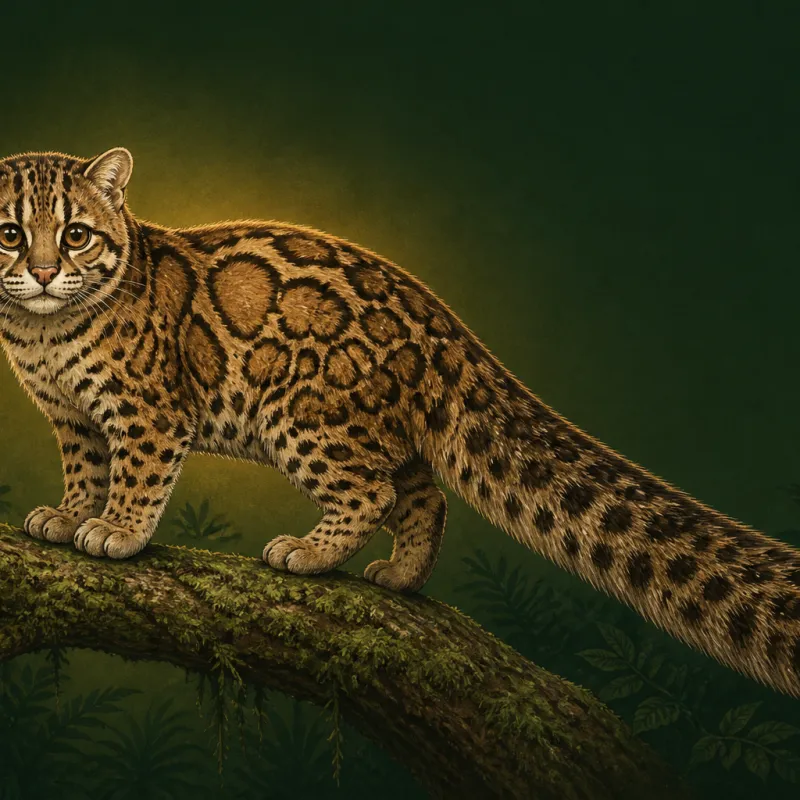
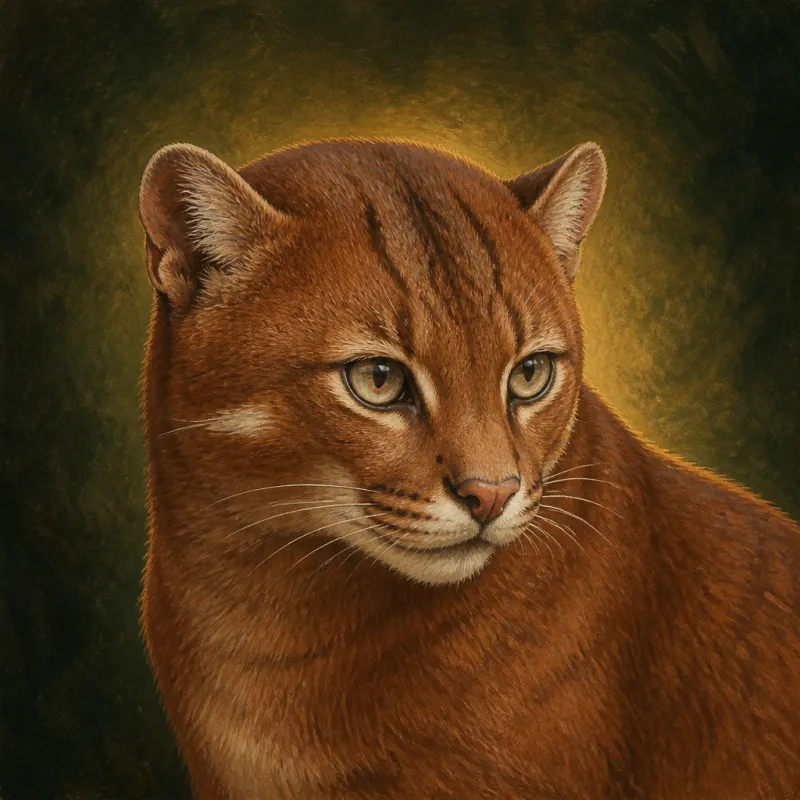
At a glance
- The marbled cat and the bay cat fall into a similar body-mass band.
- Both species use tropical rainforest and montane forest.
- Their ranges both include Asia.
- Red List categories differ: Marbled Cat is listed as Near Threatened, Bay Cat as Endangered.
Identification
How each species is named and classified.
Marbled Cat
Pardofelis marmorata
Bay Cat
Catopuma badia
Marbled Cat
Pardofelis
Bay Cat
Catopuma
Marbled Cat
Bay cat lineage
Bay Cat
Bay cat lineage
Marbled Cat
Small cats
Bay Cat
Small cats
Marbled Cat
—
Bay Cat
Bornean bay cat, Bornean red cat
Body and movement
Published field measurements for adults. Ranges cover both sexes unless noted.
Marbled Cat
18 in – 2 ft (45–62 cm)
Bay Cat
19 in – 2 ft 2 in (49–67 cm) Longer
Marbled Cat
14 in – 22 in (35–55 cm) Longer
Bay Cat
12 in – 16 in (30–40 cm)
Marbled Cat
10 in – 13 in (26–32 cm) Taller
Bay Cat
9 in – 12 in (24–30 cm)
Marbled Cat
4.4–11 lb (2–5 kg)
Few animals have been weighed; estimates rest on a small sample.
Bay Cat
6.6–9.9 lb (3–4.5 kg) Heavier
Known from a handful of measured specimens.
Marbled Cat
Not reliably measured
Not measured in the field.
Bay Cat
Not reliably measured
No measurement exists.
Life span
Typical adult longevity. Figures for managed care come from zoo and sanctuary records.
Marbled Cat
10–12 years Longer
Bay Cat
8–12 years
Marbled Cat
12–16 years Longer
Bay Cat
12–14 years
Habitat and range
Where each species lives and the conditions it tolerates.
Marbled Cat
tropical rainforest, montane forest
Moist evergreen forest with a closed canopy, from lowlands to about 9,000 feet; the species is also recorded from selectively logged and secondary forest.
Bay Cat
tropical rainforest, montane forest
Dense forest from lowland dipterocarp stands to hill and montane forest, including limestone terrain and swamp forest edge.
Marbled Cat
Asia
The eastern Himalaya and north-east India through Myanmar, Thailand, Laos, Vietnam and Malaysia to Borneo and Sumatra.
Bay Cat
Asia
Endemic to Borneo, with scattered records from Malaysian, Indonesian and Bruneian parts of the island.
Diet and behaviour
Feeding ecology, social organisation and hunting technique.
Marbled Cat
birds, small mammals, reptiles, insects
Squirrels, rats, birds, lizards and insects, taken largely in trees.
Bay Cat
small mammals, birds, reptiles
Inferred rather than observed: rodents, birds, small primates and carrion are all thought to be taken.
Marbled Cat
Solitary
Highly arboreal and rarely detected on the ground, which is one reason camera-trap records are so scarce.
Bay Cat
Solitary
Essentially unstudied in the wild. Detection rates are so low that even basic density estimates carry wide uncertainty.
Marbled Cat
Nocturnal and crepuscular
Mostly night active, though some studies report daytime movement in undisturbed forest.
Bay Cat
Cathemeral
The few camera-trap records span both day and night, with no clear pattern established.
Marbled Cat
Canopy pursuit
Hunts among branches, chasing squirrels and birds through the canopy rather than ambushing from the ground.
Bay Cat
Presumed ground and low-canopy hunting
Direct observations of hunting have not been published; body form suggests a forest-floor generalist.
Marbled Cat
Exceptional More developed
Among the most arboreal of the small cats, with a long tail used constantly for balance.
Bay Cat
Strong
Body proportions indicate a competent climber, though most records come from the ground.
Marbled Cat
Limited
No notable association with water.
Bay Cat
Limited
No documented swimming behaviour.
Conservation
Red List category, population direction and the pressures documented for each species.
Marbled Cat
NT — Near Threatened
Assessed 2015
Bay Cat
EN — Endangered
Assessed 2015
Marbled Cat
Decreasing
Bay Cat
Decreasing
Marbled Cat
Deforestation and canopy loss, Snaring, Habitat fragmentation, Trade in skins, Sparse population data
Assessed as Near Threatened. Loss of continuous canopy forest is the dominant threat, and the species is also caught incidentally in snares.
Bay Cat
Logging and forest conversion, Oil-palm expansion, Snaring, Collection for private trade, Almost no baseline ecological data
Assessed as Endangered on the basis of a small, declining population and heavy loss of Bornean lowland forest to logging and plantation conversion.
Notable traits
Details that do not fit neatly into a measurement table.
Marbled Cat
- Its tail can equal head-body length, one of the highest ratios among cats.
- Canine teeth are large relative to skull size, a trait shared with the clouded leopards.
- The coat pattern is a striking case of two unrelated forest cats converging on the same camouflage.
Bay Cat
- The first photographs of a living bay cat were obtained in the late 1990s, more than a century after the species was described.
- It occurs on one island only, the smallest range of any Asian cat.
- Two colour morphs are known: chestnut red and a rarer grey form.
Sources used for this comparison
- IUCN Red List of Threatened Species Global assessment categories, population trends and documented threats.
- IUCN SSC Cat Specialist Group Species accounts, distribution notes and Cat News reporting for every wild felid.
- Small Wild Cat Conservation Foundation Dedicated research and field reporting on the lesser-known felids.
- Wildlife Conservation Society Field programmes, camera-trap surveys and population monitoring.
- Animal Diversity Web, University of Michigan Museum of Zoology Reviewed species accounts with morphometric ranges and reproductive data.
- World Wildlife Fund Range descriptions, threat summaries and conservation programme reporting.