Species comparison
Southern Tiger Cat vs Margay
A side-by-side look at Leopardus guttulus and Leopardus wiedii across body measurements, habitat, diet, behaviour and conservation status.
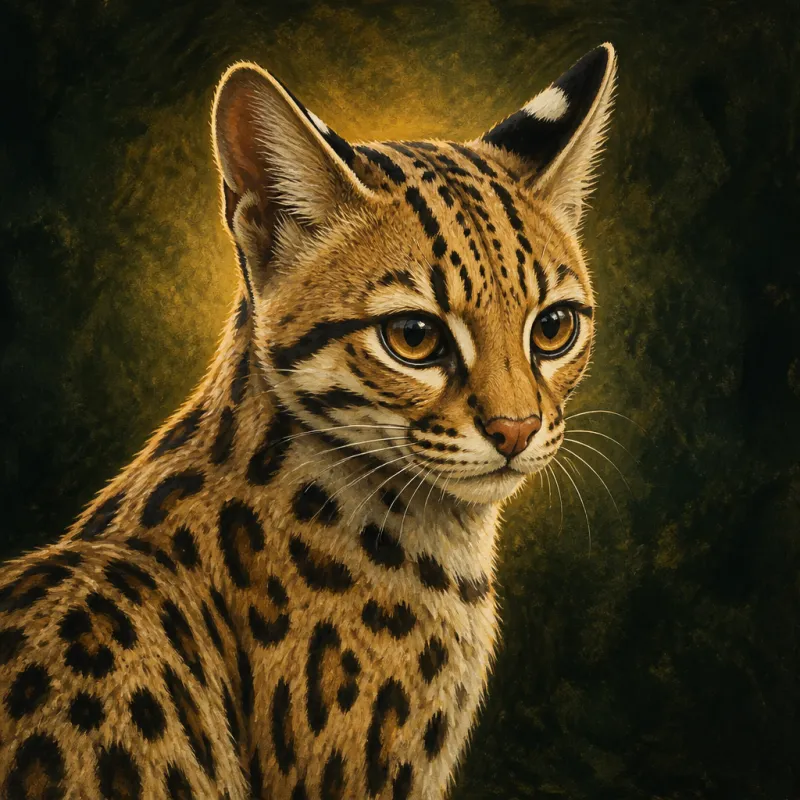
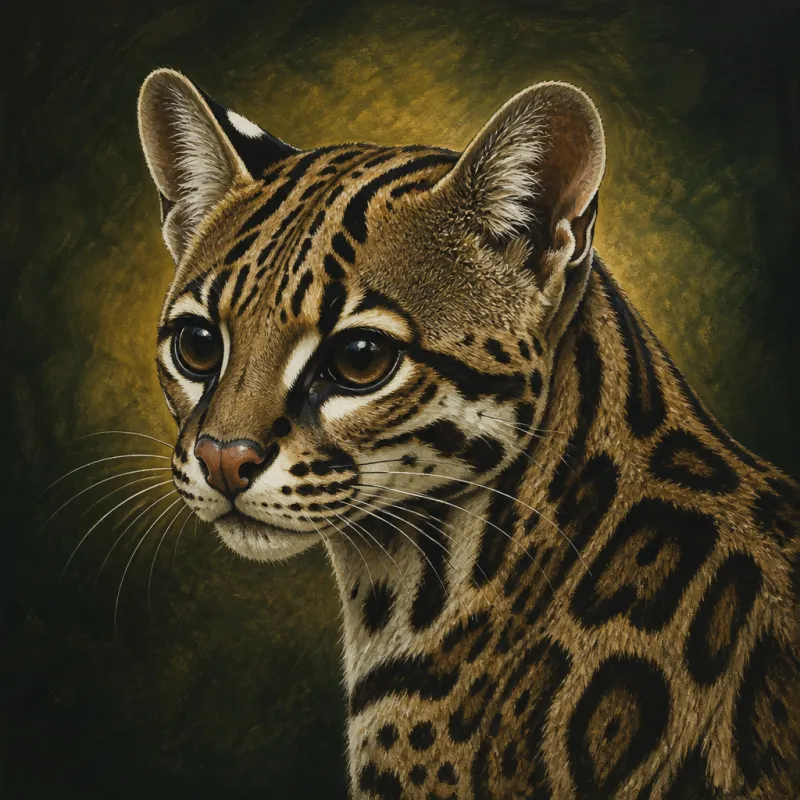
At a glance
- The margay averages about 1.4 times the body mass of the southern tiger cat.
- Both species use tropical rainforest and montane forest.
- Their ranges both include South America.
- Red List categories differ: Southern Tiger Cat is listed as Vulnerable, Margay as Near Threatened.
Identification
How each species is named and classified.
Southern Tiger Cat
Leopardus guttulus
Margay
Leopardus wiedii
Southern Tiger Cat
Leopardus
Margay
Leopardus
Southern Tiger Cat
Ocelot lineage
Margay
Ocelot lineage
Southern Tiger Cat
Small cats
Margay
Small cats
Southern Tiger Cat
Southern oncilla, Gato-do-mato-pequeno
Margay
Tree ocelot, Gato maracajá
Body and movement
Published field measurements for adults. Ranges cover both sexes unless noted.
Southern Tiger Cat
16 in – 24 in (40–60 cm)
Margay
19 in – 2 ft 7 in (48–79 cm) Longer
Southern Tiger Cat
8 in – 17 in (20–42 cm)
Margay
13 in – 20 in (33–51 cm) Longer
Southern Tiger Cat
9 in – 12 in (23–30 cm)
Margay
12 in – 15 in (30–38 cm) Taller
Southern Tiger Cat
4–7.7 lb (1.8–3.5 kg)
Slightly heavier on average than the northern species.
Margay
5.7–10.8 lb (2.6–4.9 kg) Heavier
Sexes are similar in size, unusual among cats.
Southern Tiger Cat
Not reliably measured
Not measured in the field.
Margay
Not reliably measured
Not measured; the margay is an agility specialist rather than a runner.
Life span
Typical adult longevity. Figures for managed care come from zoo and sanctuary records.
Southern Tiger Cat
10–13 years Longer
Margay
10–12 years
Southern Tiger Cat
14–17 years
Margay
18–20 years Longer
Habitat and range
Where each species lives and the conditions it tolerates.
Southern Tiger Cat
tropical rainforest, montane forest, dry forest, agricultural mosaic
Atlantic Forest and adjacent araucaria woodland, including secondary forest and shade plantations that retain canopy cover.
Margay
tropical rainforest, montane forest, cloud forest
Almost exclusively continuous forest with a closed canopy, from lowland rainforest to cloud forest above 9,000 feet. The species tolerates disturbance poorly.
Southern Tiger Cat
South America
Southern and south-eastern Brazil, eastern Paraguay and the Misiones region of north-eastern Argentina.
Margay
North America, South America
From northern Mexico through Central America and Amazonia to northern Argentina and southern Brazil.
Diet and behaviour
Feeding ecology, social organisation and hunting technique.
Southern Tiger Cat
small mammals, birds, reptiles, insects
Small rodents and marsupials, birds, lizards and insects.
Margay
small mammals, birds, reptiles, insects
Tree-dwelling rodents, opossums, squirrels, birds, lizards and large invertebrates, taken mostly above ground.
Southern Tiger Cat
Solitary
Detected at low densities in most surveys; individuals appear to avoid areas with high ocelot activity.
Margay
Solitary
Rarely observed; ranges are large relative to body size, and litters almost always consist of a single kitten.
Southern Tiger Cat
Nocturnal and crepuscular
Predominantly night active, with activity shifting where larger cats are present.
Margay
Nocturnal
Strongly night active, spending daylight hours resting in tree hollows and on branches.
Southern Tiger Cat
Ground stalk in forest understorey
Takes small prey on the forest floor and in low vegetation, hunting mostly by short stalks.
Margay
Arboreal pursuit and ambush
Hunts within the canopy, chasing rodents and birds along branches; field researchers in Brazil have documented a margay imitating the calls of pied tamarins, apparently to draw them closer.
Southern Tiger Cat
Strong
Climbs readily but forages mainly at ground level.
Margay
Exceptional More developed
The benchmark climbing cat of the Americas: it descends head first, hangs by one hind foot and moves confidently through fine branches.
Southern Tiger Cat
Very limited
No notable association with water.
Margay
Limited More developed
Rarely recorded in water.
Conservation
Red List category, population direction and the pressures documented for each species.
Southern Tiger Cat
VU — Vulnerable
Assessed 2016
Margay
NT — Near Threatened
Assessed 2015
Southern Tiger Cat
Decreasing
Margay
Decreasing
Southern Tiger Cat
Atlantic Forest clearance, Fragmentation into small isolated patches, Road mortality, Domestic dog attacks, Disease from domestic cats
Assessed as Vulnerable. Loss and fragmentation of the Atlantic Forest, combined with dog attacks and road mortality in the surrounding farmland, drive the decline.
Margay
Deforestation, Forest fragmentation, Road mortality, Illegal pet trade, Very low reproductive output
Dependence on unbroken forest makes the margay especially sensitive to clearance and fragmentation, and its low reproductive rate slows any recovery.
Notable traits
Details that do not fit neatly into a measurement table.
Southern Tiger Cat
- It was described as separate from the northern tiger cat only in 2013, on genetic grounds.
- The two tiger cat species show no evidence of current interbreeding where their ranges approach one another.
- Its stronghold biome has lost the great majority of its original forest cover.
Margay
- Litters of a single kitten are the norm, one of the lowest reproductive rates among cats.
- The ankle rotation that allows head-first descent is shared with only a handful of felids worldwide.
- Its eyes are proportionally larger than an ocelot's, an adaptation to hunting in dark canopy.
Sources used for this comparison
- IUCN Red List of Threatened Species Global assessment categories, population trends and documented threats.
- IUCN SSC Cat Specialist Group Species accounts, distribution notes and Cat News reporting for every wild felid.
- Small Wild Cat Conservation Foundation Dedicated research and field reporting on the lesser-known felids.
- Wildlife Conservation Society Field programmes, camera-trap surveys and population monitoring.
- Animal Diversity Web, University of Michigan Museum of Zoology Reviewed species accounts with morphometric ranges and reproductive data.