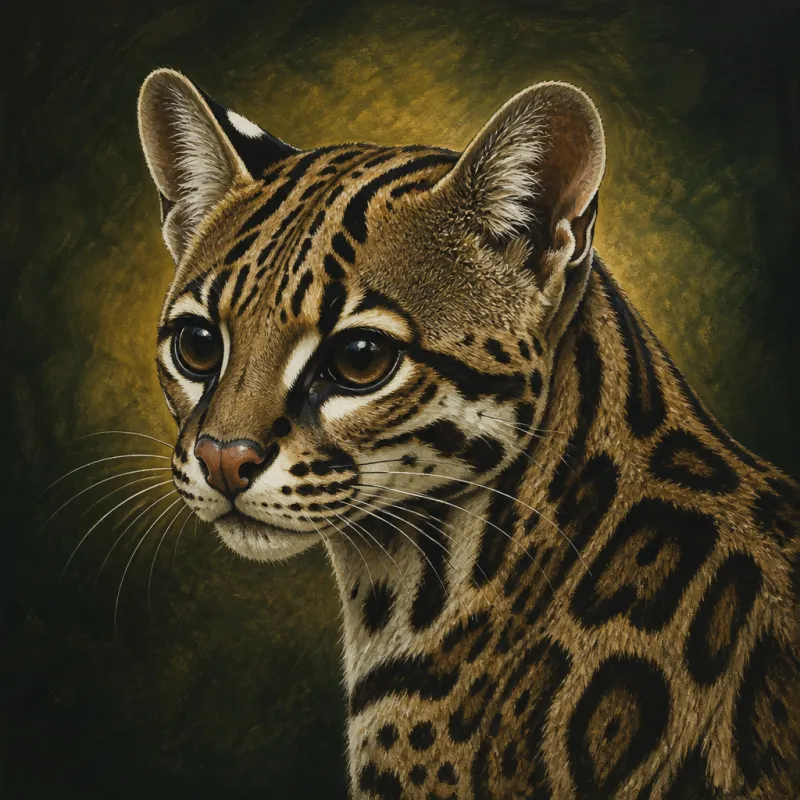
A margay looks like a small, long-tailed ocelot, but the differences are functional. Larger eyes, a proportionally longer tail and unusually flexible ankle joints all serve life in the canopy.
Those ankles rotate close to 180 degrees, letting the cat descend trunks head first, run along the undersides of branches and catch itself when a foothold gives way.
Size and measurements
| Head-body length | 19 in – 2 ft 7 in (48–79 cm) |
|---|---|
| Tail length | 13 in – 20 in (33–51 cm) |
| Shoulder height | 12 in – 15 in (30–38 cm) |
| Body weight | 5.7–10.8 lb (2.6–4.9 kg) — Sexes are similar in size, unusual among cats. |
| Top recorded speed | Not reliably measured — Not measured; the margay is an agility specialist rather than a runner. |
| Lifespan in the wild | 10–12 years |
| Lifespan under human care | 18–20 years |
Habitat and range
Almost exclusively continuous forest with a closed canopy, from lowland rainforest to cloud forest above 9,000 feet. The species tolerates disturbance poorly.
From northern Mexico through Central America and Amazonia to northern Argentina and southern Brazil.
Diet and hunting
Tree-dwelling rodents, opossums, squirrels, birds, lizards and large invertebrates, taken mostly above ground.
Hunting strategy — Arboreal pursuit and ambush. Hunts within the canopy, chasing rodents and birds along branches; field researchers in Brazil have documented a margay imitating the calls of pied tamarins, apparently to draw them closer.
Behaviour and activity
Solitary. Rarely observed; ranges are large relative to body size, and litters almost always consist of a single kitten.
Nocturnal. Strongly night active, spending daylight hours resting in tree hollows and on branches.
Climbing and swimming
Climbing — Exceptional. The benchmark climbing cat of the Americas: it descends head first, hangs by one hind foot and moves confidently through fine branches.
Swimming — Limited. Rarely recorded in water.
Conservation status
The Margay is currently listed as Near Threatened on the IUCN Red List, with a population trend recorded as decreasing in the assessment published in 2015.
Dependence on unbroken forest makes the margay especially sensitive to clearance and fragmentation, and its low reproductive rate slows any recovery.
Documented threats
- Deforestation
- Forest fragmentation
- Road mortality
- Illegal pet trade
- Very low reproductive output
Look up the current Red List assessment for Leopardus wiedii
Notable traits
- Litters of a single kitten are the norm, one of the lowest reproductive rates among cats.
- The ankle rotation that allows head-first descent is shared with only a handful of felids worldwide.
- Its eyes are proportionally larger than an ocelot's, an adaptation to hunting in dark canopy.
Sources for this profile
- IUCN Red List of Threatened Species Global assessment categories, population trends and documented threats.
- IUCN SSC Cat Specialist Group Species accounts, distribution notes and Cat News reporting for every wild felid.
- Small Wild Cat Conservation Foundation Dedicated research and field reporting on the lesser-known felids.
- Wildlife Conservation Society Field programmes, camera-trap surveys and population monitoring.
- Animal Diversity Web, University of Michigan Museum of Zoology Reviewed species accounts with morphometric ranges and reproductive data.