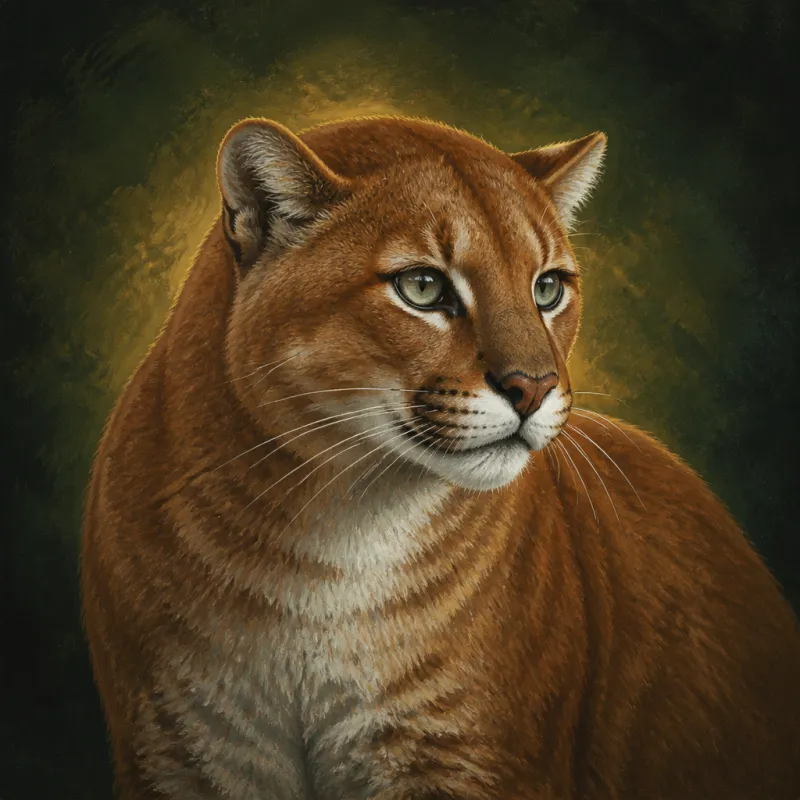
Closely related to the caracal despite living in a completely different environment, the African golden cat is stocky, short-legged and variable in colour, ranging from deep chestnut to slate grey, with spotting that may cover the whole body or almost none of it.
It is one of the least studied cats in the world. The first substantial field footage came from camera-trap projects in Uganda and Gabon, and much of its ecology is still inferred rather than observed.
Size and measurements
| Head-body length | 2 ft – 3 ft 4 in (61–101 cm) |
|---|---|
| Tail length | 6 in – 18 in (16–46 cm) |
| Shoulder height | 15 in – 22 in (38–55 cm) |
| Body weight | 12–35 lb (5.5–16 kg) — Based on a small number of measured specimens. |
| Top recorded speed | Not reliably measured — No field measurement exists. |
| Lifespan in the wild | 10–12 years |
| Lifespan under human care | 12–15 years |
Habitat and range
Moist tropical forest, bamboo zones and montane forest up to about 11,500 feet; the species is strongly associated with dense, undisturbed canopy.
The rainforest belt of West and Central Africa, from Senegal and Guinea east through the Congo Basin to western Kenya and Uganda.
Diet and hunting
Rodents, tree hyrax, duikers, monkeys and forest birds; there are documented cases of golden cats following monkey groups to catch animals disturbed from the canopy.
Hunting strategy — Ground stalk in dense forest. Hunts mainly on the forest floor, ambushing rodents and small ungulates in thick undergrowth.
Behaviour and activity
Solitary. Extremely secretive; density estimates rely almost entirely on camera-trap arrays, and even experienced field teams rarely see the animal directly.
Cathemeral. Camera-trap records show activity spread across day and night, with local variation that may reflect prey and disturbance.
Climbing and swimming
Climbing — Strong. Capable in trees and recorded hunting hyrax in the canopy, though most hunting is terrestrial.
Swimming — Limited. No substantial record of swimming behaviour.
Conservation status
The African Golden Cat is currently listed as Vulnerable on the IUCN Red List, with a population trend recorded as decreasing in the assessment published in 2015.
Rainforest loss and the commercial bushmeat trade are the main pressures. The cat is caught in snares set for other animals and is also taken deliberately in some regions.
Documented threats
- Deforestation and logging
- Bushmeat snaring
- Prey depletion
- Mining expansion
- Very limited baseline data
Look up the current Red List assessment for Caracal aurata
Notable traits
- Colour morphs vary so widely that early naturalists described several separate species.
- It is the only forest-dwelling member of the caracal lineage.
- Much of what is known about its diet comes from analysis of scats collected on forest trails.
Sources for this profile
- IUCN Red List of Threatened Species Global assessment categories, population trends and documented threats.
- IUCN SSC Cat Specialist Group Species accounts, distribution notes and Cat News reporting for every wild felid.
- Panthera Field research programmes and species profiles for big and small wild cats.
- Small Wild Cat Conservation Foundation Dedicated research and field reporting on the lesser-known felids.
- Wildlife Conservation Society Field programmes, camera-trap surveys and population monitoring.