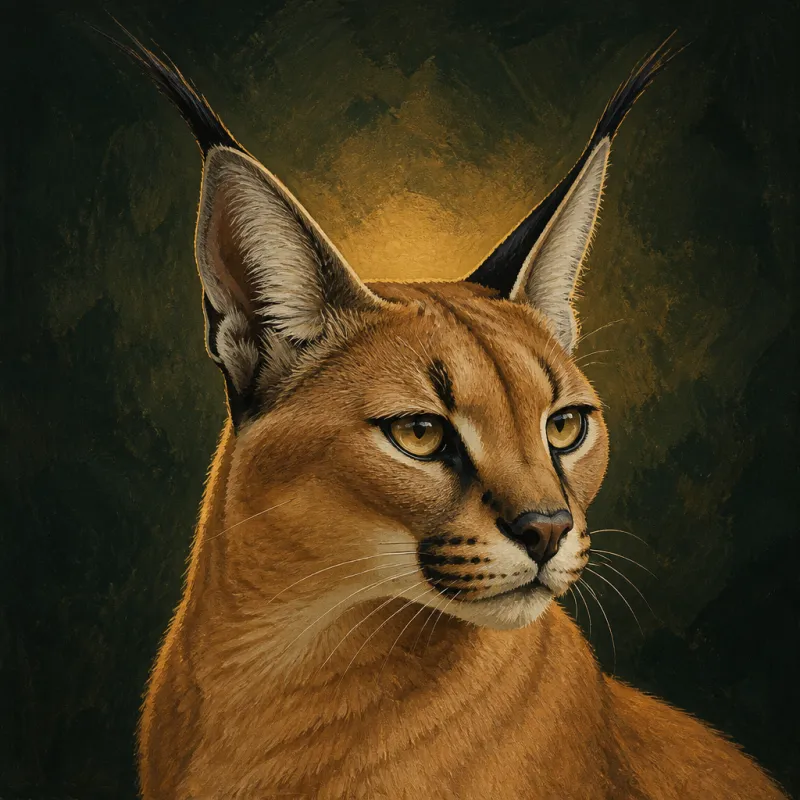
The caracal is compact and powerfully built behind, with hind legs longer than the front and a short, unmarked tawny coat that disappears against dry grass and sand.
Its most striking feature is the ear: long black tufts sit above ears controlled by around twenty muscles, giving fine directional hearing that supports hunting in the dark.
Size and measurements
| Head-body length | 2 ft – 3 ft (62–91 cm) |
|---|---|
| Tail length | 7 in – 13 in (18–34 cm) |
| Shoulder height | 16 in – 20 in (40–50 cm) |
| Body weight | 15–42 lb (7–19 kg) — Males average noticeably heavier than females across the range. |
| Top recorded speed | 50 mph (80 km/h) — Short sprints over open ground; the species is better known for vertical leaping than for sustained speed. |
| Lifespan in the wild | 10–12 years |
| Lifespan under human care | 16–19 years |
Habitat and range
Dry woodland, scrub, semi-desert and rocky hills; caracals avoid true desert interiors and dense equatorial rainforest but do well on farmland margins.
Widespread across Africa outside the Sahara core and Congo rainforest, and through the Arabian Peninsula, the Middle East, Central Asia and into north-western India.
Diet and hunting
Hyrax, hares, rodents and gamebirds form the bulk of the diet, with small antelope taken by larger individuals.
Hunting strategy — Stalk and vertical leap. The caracal creeps close, then launches; birds flushing from cover are struck in mid-air, sometimes several feet above the ground.
Behaviour and activity
Solitary and territorial. Adults hold large ranges and are rarely seen; they are among the most successful cats at persisting in farmed landscapes, which brings them into conflict with sheep farmers.
Nocturnal. Almost entirely night active where persecuted; more crepuscular activity is recorded inside protected areas.
Climbing and swimming
Climbing — Strong. Climbs well and will cache food in trees, though it hunts on the ground.
Swimming — Limited. Occupies dry country and rarely encounters, or enters, deep water.
Conservation status
The Caracal is currently listed as Least Concern on the IUCN Red List, with a population trend recorded as stable in the assessment published in 2016.
Widespread and reasonably secure in Africa; populations in Central Asia and North Africa are much smaller and are considered at risk locally.
Documented threats
- Killing in response to livestock losses
- Habitat conversion in Asia
- Road mortality near cities
- Trade as exotic pets
- Depletion of small-mammal prey
Look up the current Red List assessment for Caracal caracal
Notable traits
- The name derives from a Turkish word meaning "black ear".
- Caracals were historically trained in Persia and India to hunt birds, a practice recorded for centuries.
- Urban caracals on the Cape Peninsula in South Africa are the subject of a long-running research programme.
Sources for this profile
- IUCN Red List of Threatened Species Global assessment categories, population trends and documented threats.
- IUCN SSC Cat Specialist Group Species accounts, distribution notes and Cat News reporting for every wild felid.
- Panthera Field research programmes and species profiles for big and small wild cats.
- Small Wild Cat Conservation Foundation Dedicated research and field reporting on the lesser-known felids.
- Animal Diversity Web, University of Michigan Museum of Zoology Reviewed species accounts with morphometric ranges and reproductive data.