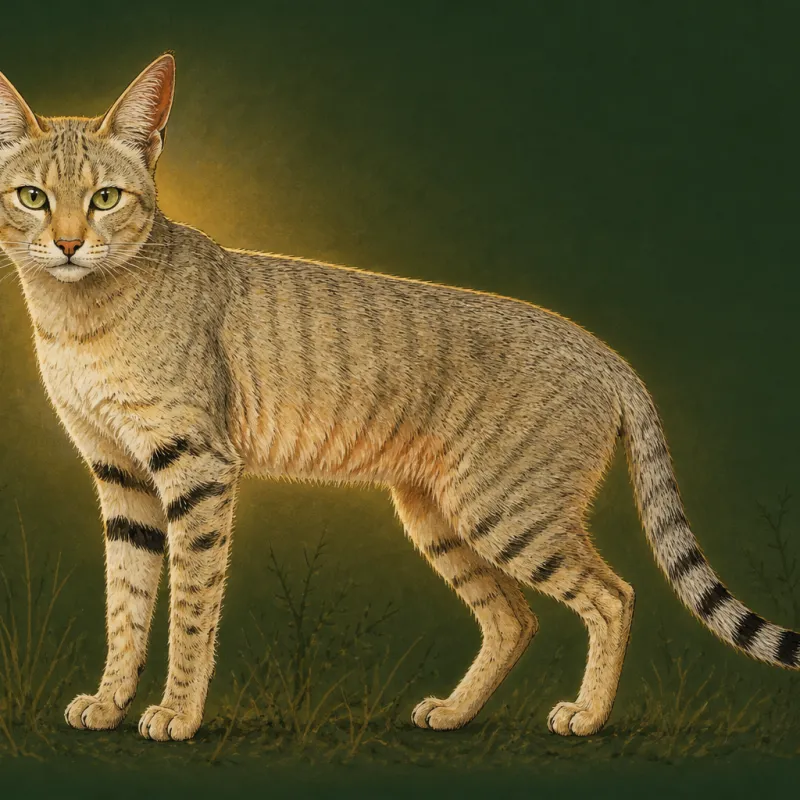
African wildcats look deceptively familiar: a sandy-grey tabby with faint stripes, rusty-tinged ears and noticeably long legs. The upright sitting posture, with the tail wrapped forward, is the same silhouette that appears in ancient Egyptian art.
Genetic studies place the origin of domestic cats in this species, beginning with animals drawn to rodent-rich grain stores in the Near East some ten thousand years ago.
Size and measurements
| Head-body length | 18 in – 2 ft 6 in (45–75 cm) |
|---|---|
| Tail length | 10 in – 15 in (25–38 cm) |
| Shoulder height | 13 in – 15 in (32–38 cm) |
| Body weight | 6.6–14 lb (3–6.5 kg) — Males average about a kilogram heavier than females. |
| Top recorded speed | Not reliably measured — Not measured in the field. |
| Lifespan in the wild | 8–12 years |
| Lifespan under human care | 15–17 years |
Habitat and range
Almost every habitat in Africa except rainforest interior and the driest sand seas, plus scrub and steppe across the Middle East and Central Asia.
Across Africa outside the Congo rainforest, and through the Arabian Peninsula, the Middle East, Central Asia and into western India and China.
Diet and hunting
Rodents form the great majority of the diet, with birds, lizards and insects making up the remainder.
Hunting strategy — Stalk and pounce on rodents. Hunts by walking slowly through cover, freezing at sounds and finishing with a short rush.
Behaviour and activity
Solitary. Solitary and territorial, though tolerant of human settlement — the same trait that started the domestication process.
Nocturnal and crepuscular. Mostly active from dusk to dawn, resting by day in burrows, thickets and rock crevices.
Climbing and swimming
Climbing — Strong. Climbs well and uses trees for escape and rest.
Swimming — Very limited. Avoids water, in common with most arid-country cats.
Conservation status
The African Wildcat is currently listed as Least Concern on the IUCN Red List, with a population trend recorded as decreasing in the assessment published in 2022.
The species remains widespread, but genetic mixing with free-ranging domestic cats is eroding wild populations, particularly near settlements. Pure wild-type populations are increasingly restricted to remote areas.
Documented threats
- Hybridisation with domestic cats
- Disease transmitted by domestic cats
- Habitat conversion
- Persecution near poultry
- Road mortality
Look up the current Red List assessment for Felis lybica
Notable traits
- All domestic cats descend from this species, not from the European wildcat.
- Wild individuals sit with a distinctly upright posture that helps separate them from feral tabbies.
- Genetic screening is now a standard part of conservation work, since appearance alone cannot confirm a pure wild animal.
Sources for this profile
- IUCN Red List of Threatened Species Global assessment categories, population trends and documented threats.
- IUCN SSC Cat Specialist Group Species accounts, distribution notes and Cat News reporting for every wild felid.
- Small Wild Cat Conservation Foundation Dedicated research and field reporting on the lesser-known felids.
- Animal Diversity Web, University of Michigan Museum of Zoology Reviewed species accounts with morphometric ranges and reproductive data.
- National Geographic — Animals General natural-history reference for behaviour, range and ecology.