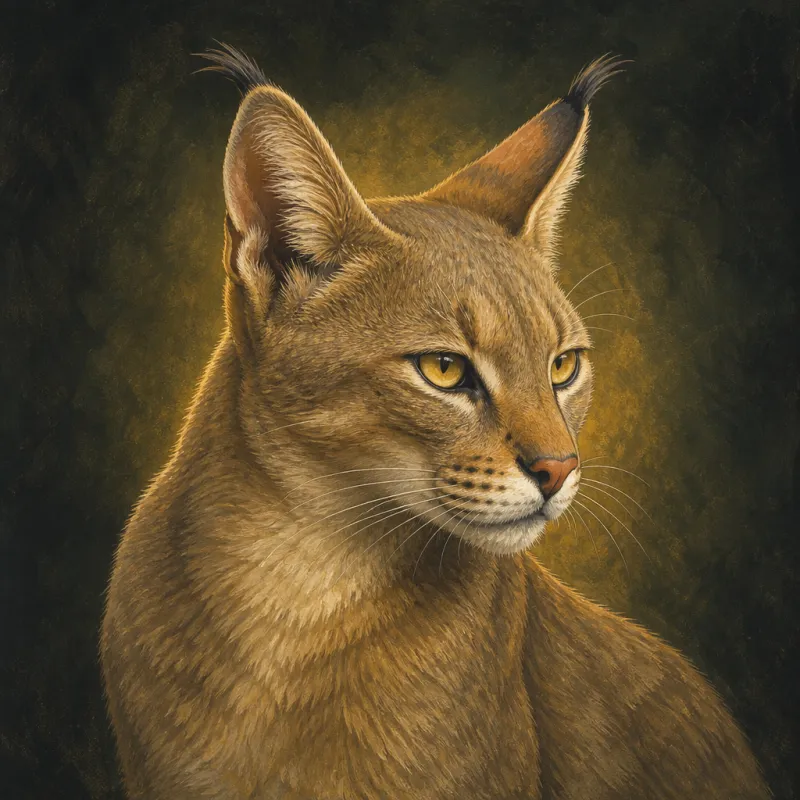
Jungle cats are tall and lean, with unmarked sandy-grey fur, small ear tufts and a short, ringed tail. The name is misleading: the species is most at home in wetland vegetation, tall grass and irrigated cropland.
It adapts well to farmland, particularly rice paddy and sugarcane, where rodents are abundant — which also brings it into frequent contact and conflict with people.
Size and measurements
| Head-body length | 20 in – 3 ft 1 in (50–94 cm) |
|---|---|
| Tail length | 8 in – 14 in (20–36 cm) |
| Shoulder height | 14 in – 15 in (35–38 cm) |
| Body weight | 6.6–35 lb (3–16 kg) — Most adults fall between 4 and 8 kg; the largest records come from the north of the range. |
| Top recorded speed | Not reliably measured — Not measured in the field. |
| Lifespan in the wild | 10–12 years |
| Lifespan under human care | 15–20 years |
Habitat and range
Reedbeds, marsh margins, tall grassland, riverine thickets and irrigated farmland; it avoids both rainforest and true desert.
From Egypt and the Middle East through the Caucasus, Central Asia, India and Sri Lanka to southern China and mainland South East Asia.
Diet and hunting
Rodents dominate, supplemented by waterbirds, fish, frogs, snakes and hares.
Hunting strategy — Active search in dense vegetation. Moves steadily through reeds and crops, flushing rodents and birds, and will wade into shallow water after fish and frogs.
Behaviour and activity
Solitary. Solitary and territorial, though it is more visible than most small cats because it hunts in open cropland.
Crepuscular and partly diurnal. Active around dawn and dusk with substantial daytime hunting, particularly in winter and in undisturbed areas.
Climbing and swimming
Climbing — Capable. Climbs when needed but hunts almost entirely on the ground.
Swimming — Strong. Comfortable in water, swimming across channels and hunting in shallow marsh.
Conservation status
The Jungle Cat is currently listed as Least Concern on the IUCN Red List, with a population trend recorded as decreasing in the assessment published in 2016.
Still widespread, but wetland drainage, intensified agriculture and killing near poultry have caused declines in the western part of the range, especially in Egypt and the Middle East.
Documented threats
- Wetland drainage
- Agricultural intensification
- Killing near poultry
- Road mortality
- Poisoning of rodent prey
Look up the current Red List assessment for Felis chaus
Notable traits
- Mummified jungle cats have been recovered from ancient Egyptian tombs.
- It is the largest species in the genus that also contains the domestic cat.
- Kittens show faint stripes that fade almost completely in adults.
Sources for this profile
- IUCN Red List of Threatened Species Global assessment categories, population trends and documented threats.
- IUCN SSC Cat Specialist Group Species accounts, distribution notes and Cat News reporting for every wild felid.
- Small Wild Cat Conservation Foundation Dedicated research and field reporting on the lesser-known felids.
- Animal Diversity Web, University of Michigan Museum of Zoology Reviewed species accounts with morphometric ranges and reproductive data.
- National Geographic — Animals General natural-history reference for behaviour, range and ecology.