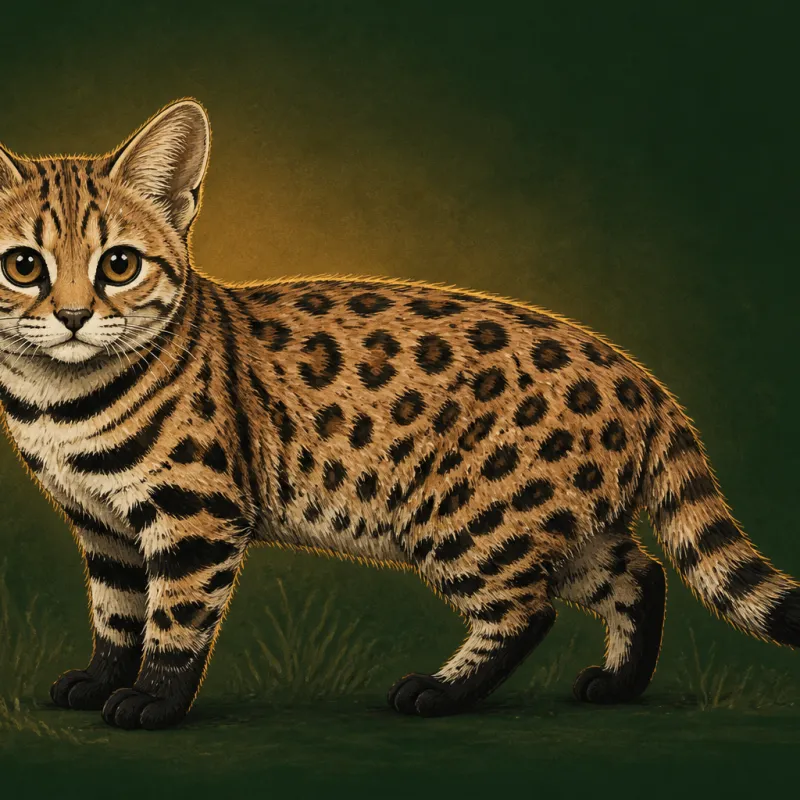
A black-footed cat weighs about as much as a bag of flour, yet it hunts almost continuously through the night, covering several miles and attempting a strike every half hour or so.
Only the undersides of the feet are black; the coat itself is tawny with bold dark spots and bars. The species is restricted to the dry grassland and scrub of southern Africa.
Size and measurements
| Head-body length | 14 in – 20 in (36–52 cm) |
|---|---|
| Tail length | 5 in – 8 in (12–20 cm) |
| Shoulder height | 7 in – 10 in (17–25 cm) |
| Body weight | 2.2–5.5 lb (1–2.5 kg) — Females often weigh little more than a kilogram. |
| Top recorded speed | Not reliably measured — Not measured in the field. |
| Lifespan in the wild | 6–8 years |
| Lifespan under human care | 10–14 years |
Habitat and range
Open, dry short-grass plains and Karoo scrub with termite mounds and rodent burrows for shelter; it avoids both rocky mountain terrain and dense woodland.
Restricted to South Africa, Botswana and Namibia, with marginal records from southern Zimbabwe and Angola.
Diet and hunting
Gerbils, mice, shrews, larks and other ground birds, plus large insects; prey is small, and a great many items are needed each night.
Hunting strategy — Continuous fast-paced hunting. Uses three modes: a fast hunt through grass, a slow stalking search, and patient waiting at rodent burrow entrances.
Behaviour and activity
Solitary. Shelters by day in hollow termite mounds and abandoned burrows — the origin of its local nickname — and hunts alone through the night.
Nocturnal. Emerges after dark and remains active for most of the night, returning to shelter before dawn.
Climbing and swimming
Climbing — Limited. A ground specialist that seldom climbs; its habitat is largely treeless.
Swimming — Very limited. Occupies arid habitat with almost no standing water.
Conservation status
The Black-footed Cat is currently listed as Vulnerable on the IUCN Red List, with a population trend recorded as decreasing in the assessment published in 2016.
A small range, low population density and heavy exposure to poisoning and predator-control measures aimed at other species keep this cat under pressure.
Documented threats
- Poisoning aimed at jackals and other carnivores
- Overgrazing and loss of prey
- Road mortality
- Predation by domestic dogs
- Disease in small populations
Look up the current Red List assessment for Felis nigripes
Notable traits
- Field studies record hunting success on roughly six of every ten attempts, the highest documented rate for any cat.
- It uses hollow termite mounds as dens, which is why farmers call it the anthill tiger.
- Despite its tiny size it is famously intolerant of handling and does not tame.
Sources for this profile
- IUCN Red List of Threatened Species Global assessment categories, population trends and documented threats.
- IUCN SSC Cat Specialist Group Species accounts, distribution notes and Cat News reporting for every wild felid.
- Small Wild Cat Conservation Foundation Dedicated research and field reporting on the lesser-known felids.
- Smithsonian's National Zoo and Conservation Biology Institute Body measurements, longevity records and life-history notes.
- Animal Diversity Web, University of Michigan Museum of Zoology Reviewed species accounts with morphometric ranges and reproductive data.