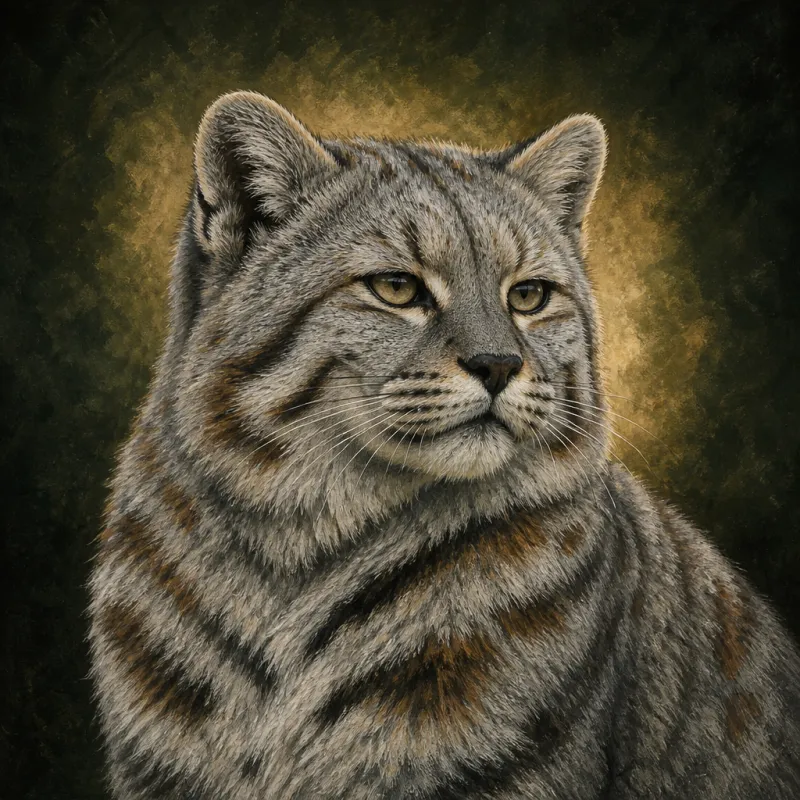
Adapted to thin air and freezing nights above 13,000 feet, the Andean mountain cat has thick ash-grey fur, dark flank blotches and a heavy, ringed tail used for balance on boulder fields.
It is scarce everywhere it occurs. The first photographs of a wild individual were taken only in the 1990s, and much of what is known comes from a handful of camera-trap and scat-genetics studies.
Size and measurements
| Head-body length | 22 in – 2 ft 9 in (57–85 cm) |
|---|---|
| Tail length | 16 in – 19 in (41–48 cm) |
| Shoulder height | 13 in – 15 in (33–38 cm) |
| Body weight | 8.8–12 lb (4–5.5 kg) — Very few animals have ever been weighed. |
| Top recorded speed | Not reliably measured — No field measurement exists. |
| Lifespan in the wild | 10–12 years |
| Lifespan under human care | 12–15 years |
Habitat and range
Arid, rocky terrain above the treeline in the high Andes, and rocky steppe in northern Patagonia, generally between 10,000 and 16,000 feet.
Southern Peru, western Bolivia, northern Chile and north-western Argentina, with a disjunct population in the Patagonian steppe.
Diet and hunting
Mountain viscachas dominate the diet, supplemented by chinchillas, tuco-tucos, birds and lizards.
Hunting strategy — Ambush around rock colonies. Hunts by waiting near viscacha colonies and rushing over broken rock.
Behaviour and activity
Solitary. Densities are extremely low, and individuals appear to range widely across rocky outcrops that hold viscacha colonies.
Crepuscular and nocturnal. Most records fall around twilight, with some daytime activity in cold, clear weather.
Climbing and swimming
Climbing — Strong. Highly capable on rock and scree; trees are absent from most of its range.
Swimming — Very limited. No meaningful records; the habitat offers little standing water.
Conservation status
The Andean Mountain Cat is currently listed as Endangered on the IUCN Red List, with a population trend recorded as decreasing in the assessment published in 2016.
Assessed as Endangered with a small and declining population. Its dependence on a single main prey species, itself hunted by people, makes the situation fragile.
Documented threats
- Decline of mountain viscacha populations
- Killing for traditional and ceremonial use
- Mining expansion in high-altitude basins
- Habitat fragmentation
- Dogs accompanying herders
Look up the current Red List assessment for Leopardus jacobita
Notable traits
- Fewer than 1,500 mature individuals are estimated to survive.
- Dried specimens appear in some Andean ceremonial traditions, which is a documented source of mortality.
- The tail can approach three-quarters of head-body length and is unusually thick and heavily ringed.
Sources for this profile
- IUCN Red List of Threatened Species Global assessment categories, population trends and documented threats.
- IUCN SSC Cat Specialist Group Species accounts, distribution notes and Cat News reporting for every wild felid.
- Small Wild Cat Conservation Foundation Dedicated research and field reporting on the lesser-known felids.
- Wildlife Conservation Society Field programmes, camera-trap surveys and population monitoring.
- National Geographic — Animals General natural-history reference for behaviour, range and ecology.