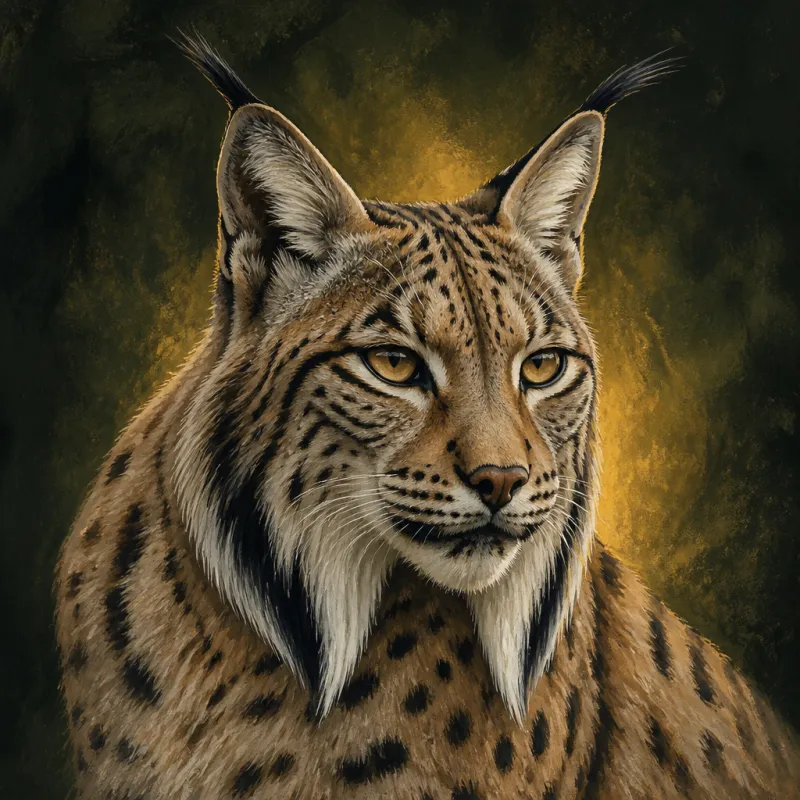
Smaller and more heavily spotted than the Eurasian lynx, the Iberian lynx has a pronounced cheek ruff, long black ear tufts and a build suited to hunting in dense Mediterranean scrub.
It is one of the most specialised felids alive: European rabbits typically supply the large majority of its food, so rabbit disease outbreaks translate directly into lynx declines.
Size and measurements
| Head-body length | 2 ft 3 in – 2 ft 8 in (68–82 cm) |
|---|---|
| Tail length | 5 in – 12 in (12–30 cm) |
| Shoulder height | 18 in – 20 in (45–50 cm) |
| Body weight | 18–33 lb (8–15 kg) — Males average about 12.8 kg, females about 9.3 kg. |
| Top recorded speed | Not reliably measured — Not systematically measured in the field. |
| Lifespan in the wild | 9–13 years |
| Lifespan under human care | 15–20 years |
Habitat and range
Mediterranean scrub mosaics of dense cover for shelter and open pasture for rabbits, typically in cork oak and holm oak landscapes.
Southern and central Spain and eastern Portugal. Reintroduction programmes have re-established populations well beyond the two relict nuclei of Doñana and the Sierra Morena.
Diet and hunting
European rabbit is the staple; red-legged partridge, rodents and young ungulates are taken when rabbits are scarce.
Hunting strategy — Stalk and short rush in scrub. The lynx works rabbit warrens and scrub edges, closing quietly before a brief sprint.
Behaviour and activity
Solitary and territorial. Territories are held for years and passed between generations; young disperse only when a vacancy opens, which makes habitat connectivity critical.
Crepuscular and nocturnal. Most movement occurs at twilight, shifting towards daylight in cold winter weather.
Climbing and swimming
Climbing — Capable. Climbs trees when pressed but hunts almost entirely on the ground.
Swimming — Limited. Avoids water; there are few records of deliberate swimming.
Conservation status
The Iberian Lynx is currently listed as Vulnerable on the IUCN Red List, with a population trend recorded as increasing in the assessment published in 2024.
Moved from Endangered to Vulnerable in 2024 after two decades of captive breeding, reintroduction, rabbit habitat management and road mitigation raised the population from fewer than one hundred animals to several thousand.
Documented threats
- Rabbit population crashes from viral disease
- Road mortality
- Habitat fragmentation
- Illegal killing and snaring
- Genetic bottlenecks in small nuclei
Look up the current Red List assessment for Lynx pardinus
Notable traits
- The species was reduced to roughly one hundred individuals in two isolated populations in the early 2000s.
- Its recovery is one of the largest proportional improvements ever recorded for a wild cat.
- Underpasses and fencing along Spanish highways were built specifically to cut lynx road deaths.
Sources for this profile
- IUCN Red List of Threatened Species Global assessment categories, population trends and documented threats.
- IUCN SSC Cat Specialist Group Species accounts, distribution notes and Cat News reporting for every wild felid.
- Iberian Lynx Ex-situ Conservation Programme Annual census figures and reintroduction reporting for the Iberian lynx.
- LIFE Lynx-Connect (European Commission LIFE programme) Population recovery monitoring across Spain and Portugal.
- World Wildlife Fund Range descriptions, threat summaries and conservation programme reporting.