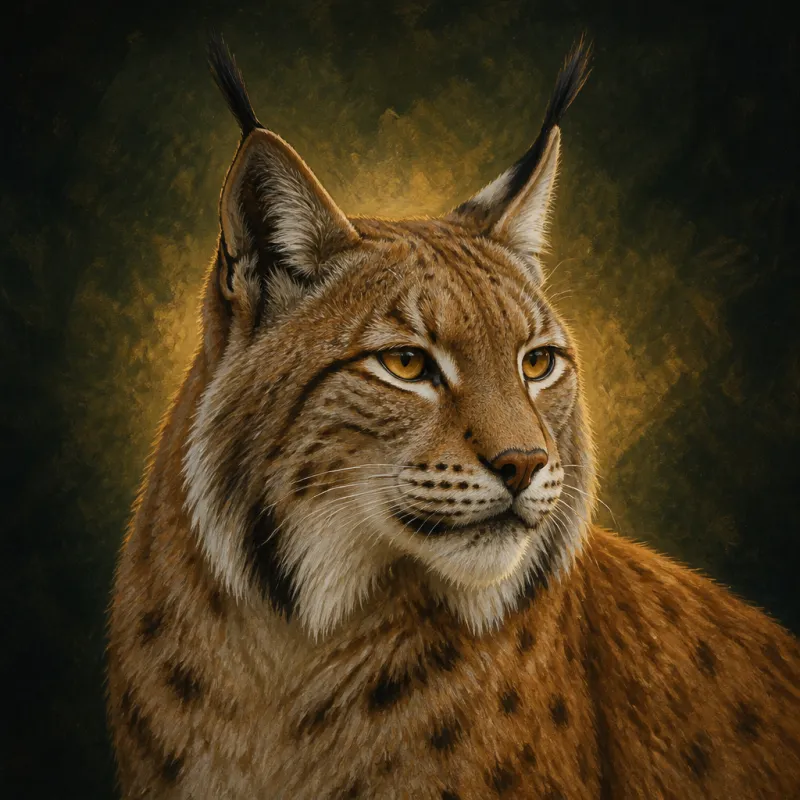
At up to twice the mass of a Canada lynx, this species hunts prey far larger than itself. Roe deer, chamois and musk deer are regular kills, which sets it apart from the hare-dependent lynxes.
It is also the most widely distributed lynx, occupying forests from Western Europe across Siberia to the Russian Far East, with populations in the Caucasus, Central Asia and the Himalaya.
Size and measurements
| Head-body length | 2 ft 6 in – 4 ft 3 in (76–130 cm) |
|---|---|
| Tail length | 4 in – 10 in (11–25 cm) |
| Shoulder height | 24 in – 2 ft 6 in (60–75 cm) |
| Body weight | 29–66 lb (13–30 kg) — Siberian animals are the largest; a few males exceed 30 kg. |
| Top recorded speed | Not reliably measured — Not reliably measured; the species hunts by stalking, not pursuit. |
| Lifespan in the wild | 10–17 years |
| Lifespan under human care | 20–24 years |
Habitat and range
Forested landscapes with dense understorey and low human disturbance, from lowland woodland to alpine forest edge above 12,000 feet in Central Asia.
Scandinavia, the Baltic states, the Carpathians, the Balkans, the Alps, and across Russia, the Caucasus, Central Asia, Mongolia, China and the Himalaya.
Diet and hunting
Roe deer and chamois dominate in Europe; hares, marmots, musk deer and gamebirds are more important in Asia.
Hunting strategy — Patient stalk followed by a short charge. The lynx tracks or waits near deer trails and closes to within a few bounds before attacking the throat; large kills are cached and revisited.
Behaviour and activity
Solitary and territorial. Home ranges are very large, and males overlap several females. Adults are exceptionally difficult to observe even where they are common.
Nocturnal and crepuscular. Chiefly active from dusk to dawn, resting by day in rock crevices, root plates or dense thickets.
Climbing and swimming
Climbing — Strong. A confident climber that uses trees for resting and for escape from wolves.
Swimming — Capable. Crosses rivers when necessary but shows no preference for water.
Conservation status
The Eurasian Lynx is currently listed as Least Concern on the IUCN Red List, with a population trend recorded as stable in the assessment published in 2015.
Widespread and recovering in parts of Europe thanks to reintroduction and legal protection, but the Balkan lynx survives as a tiny isolated population and remains critically threatened.
Documented threats
- Illegal killing
- Habitat fragmentation by infrastructure
- Prey depletion in parts of Asia
- Conflict with livestock and game interests
- Isolation of reintroduced nuclei
Look up the current Red List assessment for Lynx lynx
Notable traits
- Reintroduction projects re-established the species in Switzerland, Slovenia, Austria and France after regional extinction.
- It is the only lynx for which deer form the main prey base across much of the range.
- Winter tracking in snow remains one of the standard monitoring methods across northern Europe.
Sources for this profile
- IUCN Red List of Threatened Species Global assessment categories, population trends and documented threats.
- IUCN SSC Cat Specialist Group Species accounts, distribution notes and Cat News reporting for every wild felid.
- World Wildlife Fund Range descriptions, threat summaries and conservation programme reporting.
- National Geographic — Animals General natural-history reference for behaviour, range and ecology.
- Animal Diversity Web, University of Michigan Museum of Zoology Reviewed species accounts with morphometric ranges and reproductive data.