European carnivores
Eurasian Lynx vs Iberian Lynx
Europe holds two lynx species. One nearly disappeared and is now a conservation success story; the other is the largest lynx in the world and hunts deer.
At a glance
- The eurasian lynx averages about 1.9 times the body mass of the iberian lynx.
- The two species occupy different habitat types with no overlap in our classification.
- Their ranges both include Europe.
- Red List categories differ: Eurasian Lynx is listed as Least Concern, Iberian Lynx as Vulnerable.
A large difference in size and diet
The Eurasian lynx is roughly twice the weight of its Iberian relative and routinely kills roe deer and chamois. The Iberian lynx is a rabbit specialist: European rabbits typically make up the large majority of its diet, and rabbit disease outbreaks translate almost immediately into lynx declines.
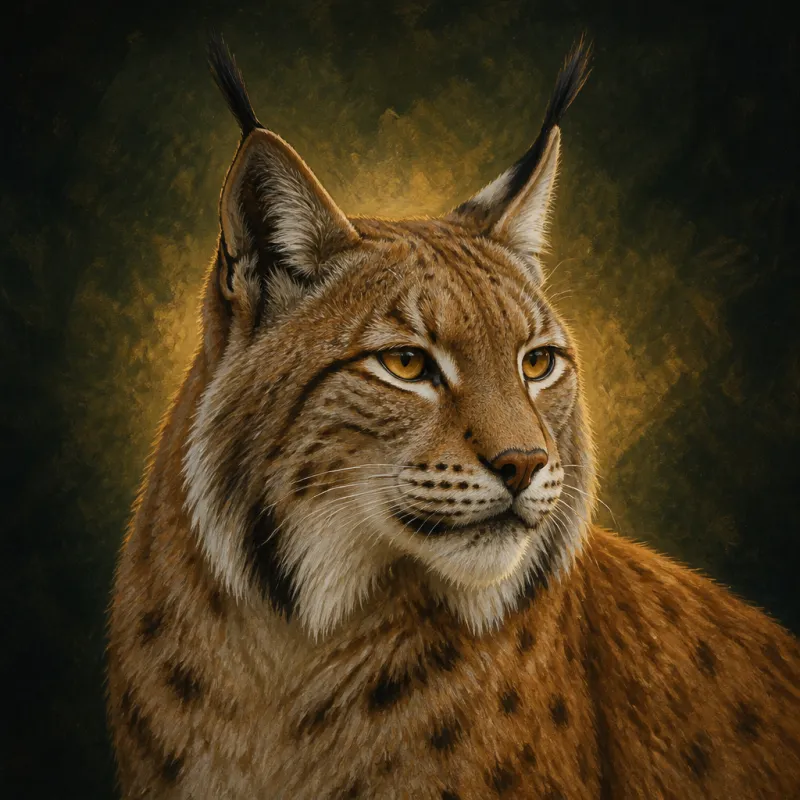
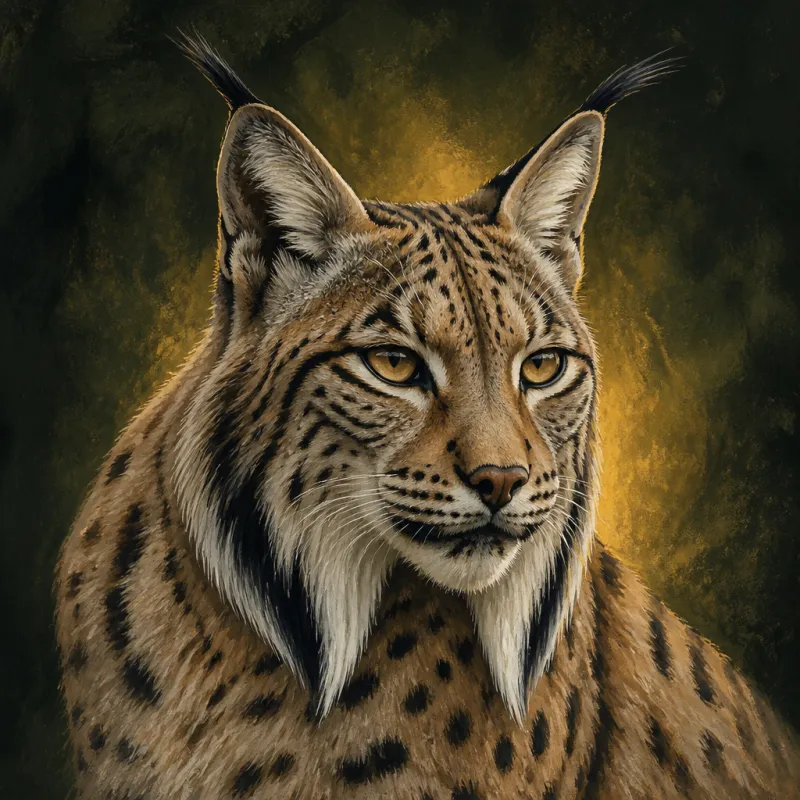
Appearance follows that difference. The Iberian lynx is more heavily spotted, with a pronounced cheek ruff and long ear tufts; the Eurasian lynx has a plainer coat that varies from faintly spotted to almost uniform.
Two conservation trajectories
The Iberian lynx fell to roughly a hundred animals in two isolated populations in the early 2000s. Captive breeding, reintroduction, rabbit habitat management and road mitigation raised that figure into the thousands, and the species was moved from Endangered to Vulnerable in 2024.
The Eurasian lynx followed a different path. Extirpated across much of western Europe by the twentieth century, it has been reintroduced in Switzerland, Slovenia, Austria and France and is now listed as Least Concern globally, although the Balkan population remains critically small.
What their ranges look like today
The Iberian lynx is confined to Spain and Portugal, and its habitat is Mediterranean scrub mosaic. The Eurasian lynx ranges from Scandinavia across Russia to the Himalaya, in forest and mountain terrain. Their ranges do not meet.
What to take away
- The Eurasian lynx hunts deer; the Iberian lynx depends on rabbits.
- The Iberian lynx recovered from about a hundred animals and was downlisted in 2024.
- The two species occupy entirely separate parts of Europe.
Identification
How each species is named and classified.
Eurasian Lynx
Lynx lynx
Iberian Lynx
Lynx pardinus
Eurasian Lynx
Lynx
Iberian Lynx
Lynx
Eurasian Lynx
Lynx lineage
Iberian Lynx
Lynx lineage
Eurasian Lynx
Medium-sized cats
Iberian Lynx
Medium-sized cats
Eurasian Lynx
Northern lynx, Siberian lynx
Iberian Lynx
Spanish lynx, Pardel lynx
Body and movement
Published field measurements for adults. Ranges cover both sexes unless noted.
Eurasian Lynx
2 ft 6 in – 4 ft 3 in (76–130 cm) Longer
Iberian Lynx
2 ft 3 in – 2 ft 8 in (68–82 cm)
Eurasian Lynx
4 in – 10 in (11–25 cm)
Iberian Lynx
5 in – 12 in (12–30 cm) Longer
Eurasian Lynx
24 in – 2 ft 6 in (60–75 cm) Taller
Iberian Lynx
18 in – 20 in (45–50 cm)
Eurasian Lynx
29–66 lb (13–30 kg) Heavier
Siberian animals are the largest; a few males exceed 30 kg.
Iberian Lynx
18–33 lb (8–15 kg)
Males average about 12.8 kg, females about 9.3 kg.
Eurasian Lynx
Not reliably measured
Not reliably measured; the species hunts by stalking, not pursuit.
Iberian Lynx
Not reliably measured
Not systematically measured in the field.
Life span
Typical adult longevity. Figures for managed care come from zoo and sanctuary records.
Eurasian Lynx
10–17 years Longer
Iberian Lynx
9–13 years
Eurasian Lynx
20–24 years Longer
Iberian Lynx
15–20 years
Habitat and range
Where each species lives and the conditions it tolerates.
Eurasian Lynx
temperate forest, boreal forest, montane forest, rocky alpine
Forested landscapes with dense understorey and low human disturbance, from lowland woodland to alpine forest edge above 12,000 feet in Central Asia.
Iberian Lynx
semi-arid scrub, dry forest, agricultural mosaic
Mediterranean scrub mosaics of dense cover for shelter and open pasture for rabbits, typically in cork oak and holm oak landscapes.
Eurasian Lynx
Europe, Asia
Scandinavia, the Baltic states, the Carpathians, the Balkans, the Alps, and across Russia, the Caucasus, Central Asia, Mongolia, China and the Himalaya.
Iberian Lynx
Europe
Southern and central Spain and eastern Portugal. Reintroduction programmes have re-established populations well beyond the two relict nuclei of Doñana and the Sierra Morena.
Diet and behaviour
Feeding ecology, social organisation and hunting technique.
Eurasian Lynx
medium ungulates, hares, small mammals, birds
Roe deer and chamois dominate in Europe; hares, marmots, musk deer and gamebirds are more important in Asia.
Iberian Lynx
hares, small mammals, birds
European rabbit is the staple; red-legged partridge, rodents and young ungulates are taken when rabbits are scarce.
Eurasian Lynx
Solitary and territorial
Home ranges are very large, and males overlap several females. Adults are exceptionally difficult to observe even where they are common.
Iberian Lynx
Solitary and territorial
Territories are held for years and passed between generations; young disperse only when a vacancy opens, which makes habitat connectivity critical.
Eurasian Lynx
Nocturnal and crepuscular
Chiefly active from dusk to dawn, resting by day in rock crevices, root plates or dense thickets.
Iberian Lynx
Crepuscular and nocturnal
Most movement occurs at twilight, shifting towards daylight in cold winter weather.
Eurasian Lynx
Patient stalk followed by a short charge
The lynx tracks or waits near deer trails and closes to within a few bounds before attacking the throat; large kills are cached and revisited.
Iberian Lynx
Stalk and short rush in scrub
The lynx works rabbit warrens and scrub edges, closing quietly before a brief sprint.
Eurasian Lynx
Strong More developed
A confident climber that uses trees for resting and for escape from wolves.
Iberian Lynx
Capable
Climbs trees when pressed but hunts almost entirely on the ground.
Eurasian Lynx
Capable More developed
Crosses rivers when necessary but shows no preference for water.
Iberian Lynx
Limited
Avoids water; there are few records of deliberate swimming.
Conservation
Red List category, population direction and the pressures documented for each species.
Eurasian Lynx
LC — Least Concern
Assessed 2015
Iberian Lynx
VU — Vulnerable
Assessed 2024
Eurasian Lynx
Stable
Iberian Lynx
Increasing
Eurasian Lynx
Illegal killing, Habitat fragmentation by infrastructure, Prey depletion in parts of Asia, Conflict with livestock and game interests, Isolation of reintroduced nuclei
Widespread and recovering in parts of Europe thanks to reintroduction and legal protection, but the Balkan lynx survives as a tiny isolated population and remains critically threatened.
Iberian Lynx
Rabbit population crashes from viral disease, Road mortality, Habitat fragmentation, Illegal killing and snaring, Genetic bottlenecks in small nuclei
Moved from Endangered to Vulnerable in 2024 after two decades of captive breeding, reintroduction, rabbit habitat management and road mitigation raised the population from fewer than one hundred animals to several thousand.
Notable traits
Details that do not fit neatly into a measurement table.
Eurasian Lynx
- Reintroduction projects re-established the species in Switzerland, Slovenia, Austria and France after regional extinction.
- It is the only lynx for which deer form the main prey base across much of the range.
- Winter tracking in snow remains one of the standard monitoring methods across northern Europe.
Iberian Lynx
- The species was reduced to roughly one hundred individuals in two isolated populations in the early 2000s.
- Its recovery is one of the largest proportional improvements ever recorded for a wild cat.
- Underpasses and fencing along Spanish highways were built specifically to cut lynx road deaths.
Sources used for this comparison
- IUCN Red List of Threatened Species Global assessment categories, population trends and documented threats.
- IUCN SSC Cat Specialist Group Species accounts, distribution notes and Cat News reporting for every wild felid.
- World Wildlife Fund Range descriptions, threat summaries and conservation programme reporting.
- National Geographic — Animals General natural-history reference for behaviour, range and ecology.
- Animal Diversity Web, University of Michigan Museum of Zoology Reviewed species accounts with morphometric ranges and reproductive data.
- Iberian Lynx Ex-situ Conservation Programme Annual census figures and reintroduction reporting for the Iberian lynx.
- LIFE Lynx-Connect (European Commission LIFE programme) Population recovery monitoring across Spain and Portugal.