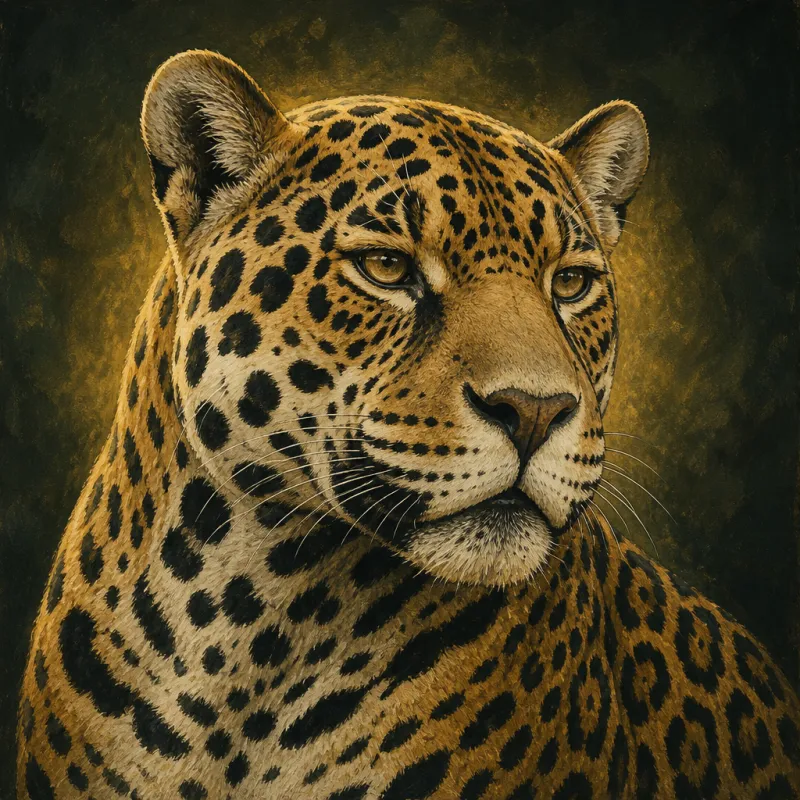
Jaguars are compact and heavily muscled, with a broad head and short limbs compared with leopards of similar mass. Their rosettes usually enclose one or more small spots, which is the simplest way to separate them from leopards in photographs.
Bite force relative to body size is among the highest of any cat, and jaguars frequently kill by piercing the skull or cervical vertebrae rather than by suffocation. That technique lets them exploit prey with heavy natural armour.
Size and measurements
| Head-body length | 3 ft 7 in – 6 ft 1 in (110–185 cm) |
|---|---|
| Tail length | 18 in – 2 ft 6 in (45–75 cm) |
| Shoulder height | 2 ft 1 in – 2 ft 6 in (63–76 cm) |
| Body weight | 99–265 lb (45–120 kg) — Pantanal males are the heaviest; Central American animals are markedly smaller. |
| Top recorded speed | 50 mph (80 km/h) — Brief sprints only; jaguars are ambush hunters in dense cover. |
| Lifespan in the wild | 12–15 years |
| Lifespan under human care | 20–23 years |
Habitat and range
Strongly associated with water: floodplains, riverine forest, seasonally flooded grassland and swamp forest support the highest densities recorded for the species.
From northern Mexico — with occasional records in Arizona and New Mexico — through Central America to northern Argentina. The Amazon basin and the Pantanal hold the largest remaining populations.
Diet and hunting
Capybara, peccary, caiman, giant anteater, armadillo, turtles and fish. More than eighty prey species have been recorded across the range.
Hunting strategy — Ambush with a skull-piercing bite. Jaguars stalk close, often from water or dense vegetation, and frequently attack from above or behind. Caiman and turtles are killed with a direct bite through bone or shell.
Behaviour and activity
Solitary. Adults hold overlapping home ranges and communicate through scrapes, scent marking and a sawing call. Extended male associations have been documented in the Pantanal, which is unusual for the species.
Cathemeral, peaking at dawn and dusk. Activity shifts with prey and disturbance; jaguars in undisturbed wetlands often hunt in daylight, while those near settlements become largely nocturnal.
Climbing and swimming
Climbing — Strong. Confident climbers that rest and ambush from branches, though they cache prey on the ground far more often than leopards do.
Swimming — Exceptional. Jaguars swim across major rivers, hunt in shallow water and have been filmed diving after caiman.
Conservation status
The Jaguar is currently listed as Near Threatened on the IUCN Red List, with a population trend recorded as decreasing in the assessment published in 2017.
Still widespread in Amazonia, but the species has been lost from roughly half its historical range, with severe fragmentation in Mexico, Central America, the Atlantic Forest and the Argentine Chaco.
Documented threats
- Deforestation for pasture and soy
- Retaliatory killing by ranchers
- Trade in teeth and other parts
- Prey depletion
- Road and dam construction
Look up the current Red List assessment for Panthera onca
Notable traits
- Melanistic jaguars — the so-called black panthers of the Americas — still carry rosettes, visible in raking light.
- The Pantanal supports some of the highest jaguar densities recorded anywhere, and its animals are the heaviest on average.
- Jaguars are one of the few cats known to prey routinely on large reptiles, including adult caiman.
Sources for this profile
- IUCN Red List of Threatened Species Global assessment categories, population trends and documented threats.
- IUCN SSC Cat Specialist Group Species accounts, distribution notes and Cat News reporting for every wild felid.
- Panthera Field research programmes and species profiles for big and small wild cats.
- Wildlife Conservation Society Field programmes, camera-trap surveys and population monitoring.
- U.S. Fish and Wildlife Service Federal listing status and recovery planning for cats occurring in the United States.