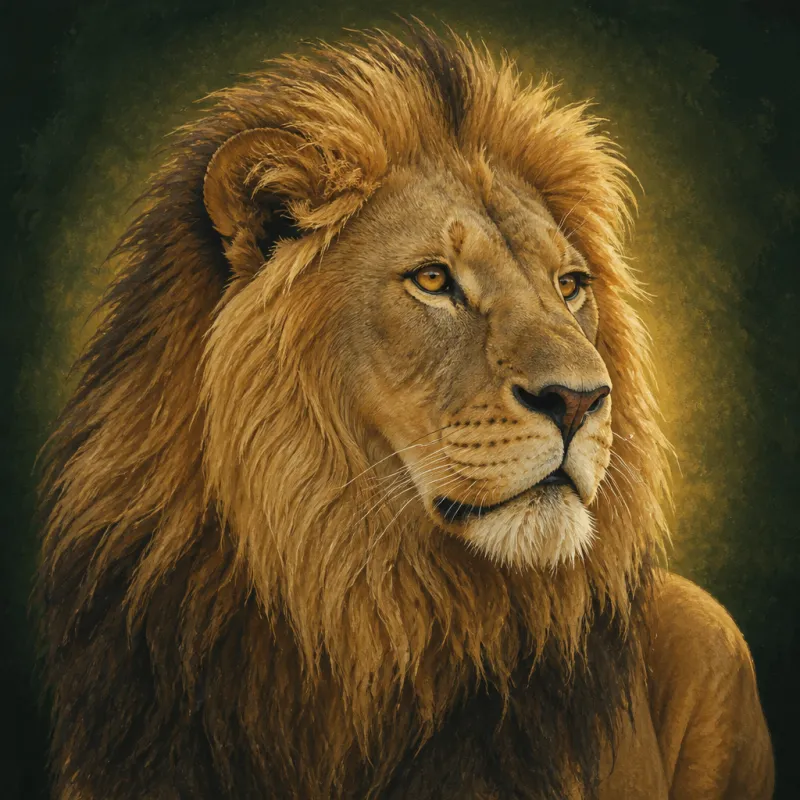
Lions are built for open country. Long limbs, a deep chest and a comparatively short spine suit short, powerful charges across grassland rather than the climbing and stalking work that shapes forest cats. Males carry a mane whose colour and extent vary with age, temperature and testosterone, and which functions as a signal of condition rather than as armour.
Group living sets the species apart from every other felid. A pride is built around related females and their offspring, with a coalition of one to several males holding tenure for a period that rarely exceeds a few years. Hunting, cub rearing and territorial defence are all shaped by that social structure.
Size and measurements
| Head-body length | 5 ft 3 in – 8 ft 2 in (160–250 cm) |
|---|---|
| Tail length | 2 ft 4 in – 3 ft 5 in (70–105 cm) |
| Shoulder height | 3 ft 3 in – 4 ft 1 in (100–125 cm) |
| Body weight | 243–496 lb (110–225 kg) — Males typically 150–225 kg, females 110–152 kg. |
| Top recorded speed | 50 mph (80 km/h) — Sustained only for short charges of a few hundred feet. |
| Lifespan in the wild | 12–16 years |
| Lifespan under human care | 20–25 years |
Habitat and range
Open and lightly wooded landscapes with water and abundant grazing herds. Lions avoid closed rainforest and true desert interiors, but persist in arid systems such as the Kalahari where prey concentrates seasonally.
Fragmented populations across sub-Saharan Africa, with strongholds in southern and eastern Africa. A single Asiatic population survives in and around the Gir landscape of Gujarat, India.
Diet and hunting
Zebra, wildebeest, buffalo, gemsbok and warthog dominate the diet where available. Lions readily appropriate kills made by hyaenas, cheetahs and wild dogs.
Hunting strategy — Cooperative stalk and ambush. Females often hunt together, with individuals taking consistent flanking or centre positions. Cooperation raises success rates against large prey such as buffalo, which single lions rarely tackle.
Behaviour and activity
Social — lives in prides. Prides usually hold three to twelve related adult females plus dependent young; males live in coalitions and defend access to one or more prides. Roaring maintains spacing between groups and can carry several miles at night.
Nocturnal and crepuscular. Most hunting happens between dusk and dawn, with peaks in dark, moonless conditions. Daylight hours are spent resting, often for twenty hours in hot weather.
Climbing and swimming
Climbing — Limited. Adults climb heavily and infrequently, although the tree-resting lions of Lake Manyara and Queen Elizabeth National Park show the behaviour is learned locally.
Swimming — Limited. Lions swim when they must cross channels, as in the Okavango Delta, but avoid deep water where possible.
Conservation status
The Lion is currently listed as Vulnerable on the IUCN Red List, with a population trend recorded as decreasing in the assessment published in 2023.
The species has disappeared from the large majority of its historical range and now survives mostly inside or beside protected areas. West African populations are of particular concern, and the Asiatic population depends on a single landscape.
Documented threats
- Habitat conversion
- Prey depletion
- Retaliatory killing after livestock loss
- Poorly regulated hunting
- Trade in bones and body parts
Look up the current Red List assessment for Panthera leo
Notable traits
- A lion roar is produced by an unusually elastic, square-shaped vocal fold that allows loud calls at low effort.
- Prides fission and fuse: members frequently split into smaller subgroups for days at a time rather than travelling as one unit.
- Asiatic lions are on average smaller than southern African lions and typically show a longitudinal fold of skin along the belly.
Sources for this profile
- IUCN Red List of Threatened Species Global assessment categories, population trends and documented threats.
- IUCN SSC Cat Specialist Group Species accounts, distribution notes and Cat News reporting for every wild felid.
- Panthera Field research programmes and species profiles for big and small wild cats.
- Smithsonian's National Zoo and Conservation Biology Institute Body measurements, longevity records and life-history notes.
- World Wildlife Fund Range descriptions, threat summaries and conservation programme reporting.