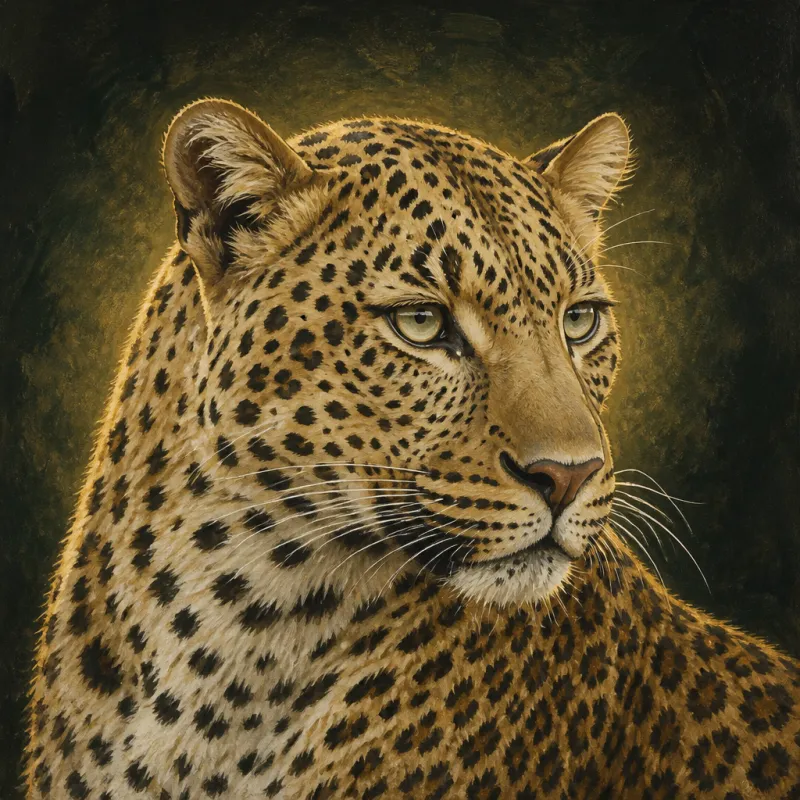
Leopards have the widest habitat tolerance of any big cat and the broadest recorded prey list. Their build is a compromise: long body, relatively short legs, and disproportionately powerful shoulders and neck that allow them to carry prey heavier than themselves up vertical trunks.
That strength solves a competition problem. Where lions, tigers, hyaenas or dholes are present, a leopard that caches a carcass in a tree keeps a meal it would otherwise lose.
Size and measurements
| Head-body length | 2 ft 11 in – 6 ft 3 in (90–190 cm) |
|---|---|
| Tail length | 23 in – 3 ft 7 in (58–110 cm) |
| Shoulder height | 18 in – 2 ft 7 in (45–78 cm) |
| Body weight | 37–198 lb (17–90 kg) — Arabian leopards from about 17 kg; large African and Persian males approach 90 kg. |
| Top recorded speed | 36 mph (58 km/h) — Measured over short distances; leopards depend on stalking to within a few strides. |
| Lifespan in the wild | 12–15 years |
| Lifespan under human care | 20–23 years |
Habitat and range
From equatorial rainforest to the fringes of the Arabian and Kalahari deserts, and from sea level to above 15,000 feet in the Himalaya. Leopards persist in farmland and near cities where cover and small prey remain.
Widespread but fragmented across sub-Saharan Africa, with relict populations in North Africa, Arabia, the Caucasus, Central and South Asia, South East Asia, China and the Russian Far East.
Diet and hunting
Extremely catholic: impala, bushbuck, duiker, hyrax, hares, monkeys, birds, rodents and, in some landscapes, domestic dogs and goats.
Hunting strategy — Close stalk and pounce. Leopards use cover to approach within a few strides, then attack with a rush and a throat bite. Prey is often dragged to cover or hoisted into a tree.
Behaviour and activity
Solitary and territorial. Adults maintain scent-marked ranges, with males overlapping several females. Leopards are notably tolerant of human presence when not persecuted, and often move unseen through settled country.
Nocturnal and crepuscular. Predominantly night active, especially near people, though forest populations with low disturbance also hunt in daylight.
Climbing and swimming
Climbing — Exceptional. Among the strongest climbers of all large cats; leopards regularly lift carcasses of their own body mass into the canopy.
Swimming — Capable. Competent in water and willing to cross rivers, but far less aquatic than tigers or jaguars.
Conservation status
The Leopard is currently listed as Vulnerable on the IUCN Red List, with a population trend recorded as decreasing in the assessment published in 2023.
Widespread persistence disguises steep regional losses. Several subspecies — notably the Amur, Arabian, Javan and Sri Lankan leopards — survive as very small, isolated populations.
Documented threats
- Habitat fragmentation
- Prey depletion
- Retaliatory and preventative killing
- Illegal skin and bone trade
- Poorly regulated hunting
Look up the current Red List assessment for Panthera pardus
Notable traits
- Leopard rosettes lack the interior spots typical of jaguars, the most reliable field distinction between the two.
- The Amur leopard, restricted to the Russian-Chinese border forests, is among the rarest big cats on Earth.
- Melanism occurs most often in humid forest populations of South and South East Asia.
Sources for this profile
- IUCN Red List of Threatened Species Global assessment categories, population trends and documented threats.
- IUCN SSC Cat Specialist Group Species accounts, distribution notes and Cat News reporting for every wild felid.
- Panthera Field research programmes and species profiles for big and small wild cats.
- World Wildlife Fund Range descriptions, threat summaries and conservation programme reporting.
- Smithsonian's National Zoo and Conservation Biology Institute Body measurements, longevity records and life-history notes.