Neotropical small cats
Margay vs Ocelot
Two spotted cats of the same American forests, so alike in pattern that they are regularly confused, and so different in behaviour that they rarely compete.
At a glance
- The ocelot averages about 3.3 times the body mass of the margay.
- Both species use tropical rainforest.
- Their ranges both include North America and South America.
- Red List categories differ: Margay is listed as Near Threatened, Ocelot as Least Concern.
Size and proportion
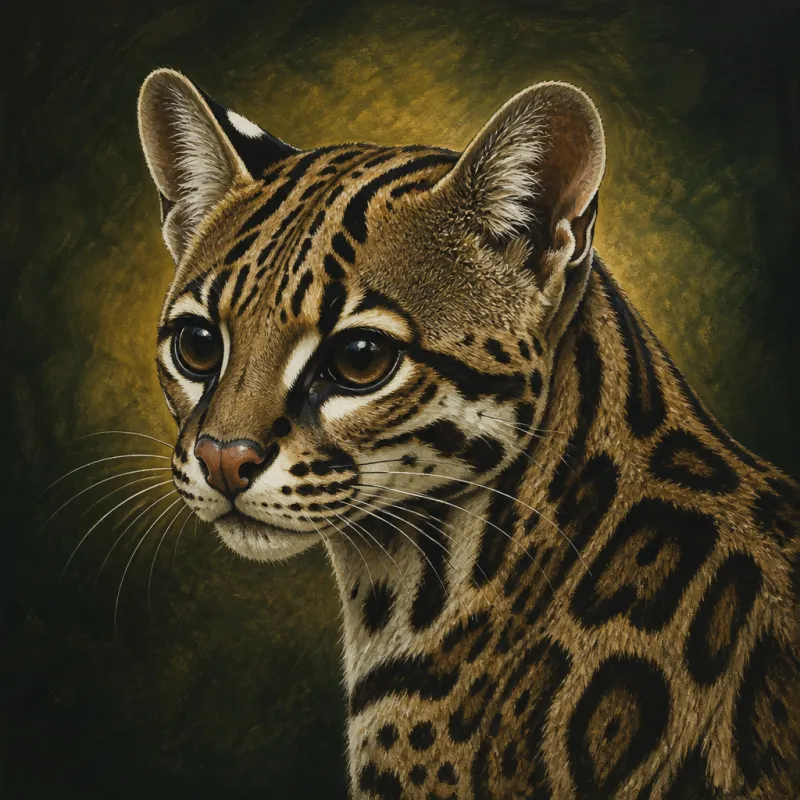
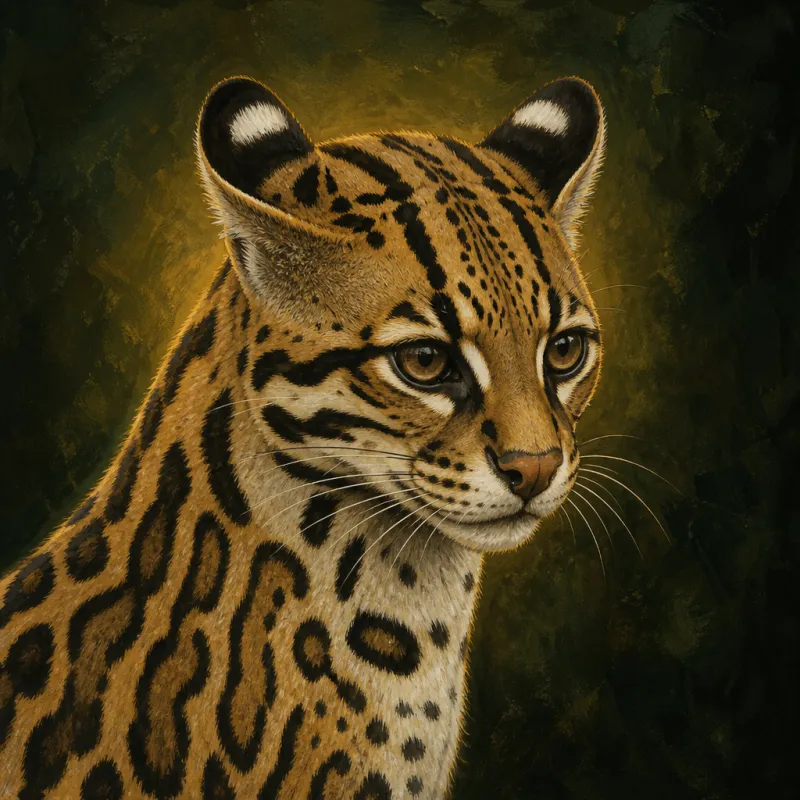
The ocelot is roughly twice to three times the weight of a margay. In photographs, where scale is lost, the margay gives itself away by proportion: larger eyes, a rounder head and a distinctly longer tail relative to body length.
Those proportions are functional. Big eyes gather light in dark canopy, and the long tail balances an animal that spends most of its life above the ground.
Two levels of the same forest
Ocelots hunt on the forest floor, walking slowly along established routes and taking rodents, reptiles and ground birds. Margays hunt in the canopy, chasing squirrels and birds through branches, and they possess ankle joints that rotate close to a half-turn, allowing head-first descent and one-footed hanging.
The vertical split reduces direct competition, but it does not remove the ocelot's influence: where ocelots are abundant, margays occur at lower densities and shift their activity, a well-documented pattern known as the ocelot effect.
Different conservation outlooks
The ocelot remains widespread and is listed as Least Concern globally, although its United States population in southern Texas is tiny and federally endangered. The margay is Near Threatened, held back by its dependence on continuous canopy and by litters that almost always contain a single kitten.
What to take away
- Margays are far smaller, with proportionally larger eyes and longer tails.
- Ocelots hunt on the ground; margays hunt in the canopy and can descend head first.
- Margays reproduce very slowly, which limits recovery after forest loss.
Identification
How each species is named and classified.
Margay
Leopardus wiedii
Ocelot
Leopardus pardalis
Margay
Leopardus
Ocelot
Leopardus
Margay
Ocelot lineage
Ocelot
Ocelot lineage
Margay
Small cats
Ocelot
Medium-sized cats
Margay
Tree ocelot, Gato maracajá
Ocelot
Painted leopard, Dwarf leopard
Body and movement
Published field measurements for adults. Ranges cover both sexes unless noted.
Margay
19 in – 2 ft 7 in (48–79 cm)
Ocelot
22 in – 3 ft 3 in (55–100 cm) Longer
Margay
13 in – 20 in (33–51 cm) Longer
Ocelot
10 in – 18 in (26–45 cm)
Margay
12 in – 15 in (30–38 cm)
Ocelot
16 in – 20 in (40–50 cm) Taller
Margay
5.7–10.8 lb (2.6–4.9 kg)
Sexes are similar in size, unusual among cats.
Ocelot
15–40 lb (7–18 kg) Heavier
Males average roughly a third heavier than females.
Margay
Not reliably measured
Not measured; the margay is an agility specialist rather than a runner.
Ocelot
Not reliably measured
Not measured in the field; ocelots hunt by slow searching, not pursuit.
Life span
Typical adult longevity. Figures for managed care come from zoo and sanctuary records.
Margay
10–12 years Longer
Ocelot
7–10 years
Margay
18–20 years
Ocelot
20–23 years Longer
Habitat and range
Where each species lives and the conditions it tolerates.
Margay
tropical rainforest, montane forest, cloud forest
Almost exclusively continuous forest with a closed canopy, from lowland rainforest to cloud forest above 9,000 feet. The species tolerates disturbance poorly.
Ocelot
tropical rainforest, dry forest, mangrove, semi-arid scrub, savanna, wetland
Dense cover is the constant requirement, from Amazon rainforest and flooded várzea to Texan thornscrub and coastal mangrove.
Margay
North America, South America
From northern Mexico through Central America and Amazonia to northern Argentina and southern Brazil.
Ocelot
North America, South America
From south Texas and northern Mexico through Central America to northern Argentina. The United States population is confined to a few small areas of southern Texas.
Diet and behaviour
Feeding ecology, social organisation and hunting technique.
Margay
small mammals, birds, reptiles, insects
Tree-dwelling rodents, opossums, squirrels, birds, lizards and large invertebrates, taken mostly above ground.
Ocelot
small mammals, reptiles, birds, fish
Rodents, opossums, armadillos, iguanas, snakes, birds and fish; most prey items weigh under two pounds.
Margay
Solitary
Rarely observed; ranges are large relative to body size, and litters almost always consist of a single kitten.
Ocelot
Solitary and territorial
Adults hold defended ranges and travel long distances along established routes each night, often several miles.
Margay
Nocturnal
Strongly night active, spending daylight hours resting in tree hollows and on branches.
Ocelot
Nocturnal and crepuscular
Predominantly night active, with some daytime movement during cool or wet weather.
Margay
Arboreal pursuit and ambush
Hunts within the canopy, chasing rodents and birds along branches; field researchers in Brazil have documented a margay imitating the calls of pied tamarins, apparently to draw them closer.
Ocelot
Slow ground search with short pounce
Ocelots walk slowly through cover, pausing frequently, and rely on hearing and smell as much as sight.
Margay
Exceptional More developed
The benchmark climbing cat of the Americas: it descends head first, hangs by one hind foot and moves confidently through fine branches.
Ocelot
Strong
Climbs and rests in trees but takes most prey on the forest floor.
Margay
Limited
Rarely recorded in water.
Ocelot
Strong More developed
Comfortable in water, crossing rivers and hunting along flooded forest edges.
Conservation
Red List category, population direction and the pressures documented for each species.
Margay
NT — Near Threatened
Assessed 2015
Ocelot
LC — Least Concern
Assessed 2015
Margay
Decreasing
Ocelot
Decreasing
Margay
Deforestation, Forest fragmentation, Road mortality, Illegal pet trade, Very low reproductive output
Dependence on unbroken forest makes the margay especially sensitive to clearance and fragmentation, and its low reproductive rate slows any recovery.
Ocelot
Deforestation and fragmentation, Road mortality, Retaliatory killing near poultry, Historical fur trade legacy, Isolation of border populations
Secure at the species level across Amazonia, but the northern edge of the range is in serious trouble: the Texas population numbers only a few dozen animals and is federally listed as endangered in the United States.
Notable traits
Details that do not fit neatly into a measurement table.
Margay
- Litters of a single kitten are the norm, one of the lowest reproductive rates among cats.
- The ankle rotation that allows head-first descent is shared with only a handful of felids worldwide.
- Its eyes are proportionally larger than an ocelot's, an adaptation to hunting in dark canopy.
Ocelot
- Hundreds of thousands of ocelot skins entered the international fur trade in the 1960s and 1970s before trade controls took effect.
- Highway underpasses in Texas were built specifically to reduce ocelot road deaths.
- Each animal's rosette pattern is unique, which underpins camera-trap population estimates.
Sources used for this comparison
- IUCN Red List of Threatened Species Global assessment categories, population trends and documented threats.
- IUCN SSC Cat Specialist Group Species accounts, distribution notes and Cat News reporting for every wild felid.
- Small Wild Cat Conservation Foundation Dedicated research and field reporting on the lesser-known felids.
- Wildlife Conservation Society Field programmes, camera-trap surveys and population monitoring.
- Animal Diversity Web, University of Michigan Museum of Zoology Reviewed species accounts with morphometric ranges and reproductive data.
- U.S. Fish and Wildlife Service Federal listing status and recovery planning for cats occurring in the United States.
- Panthera Field research programmes and species profiles for big and small wild cats.