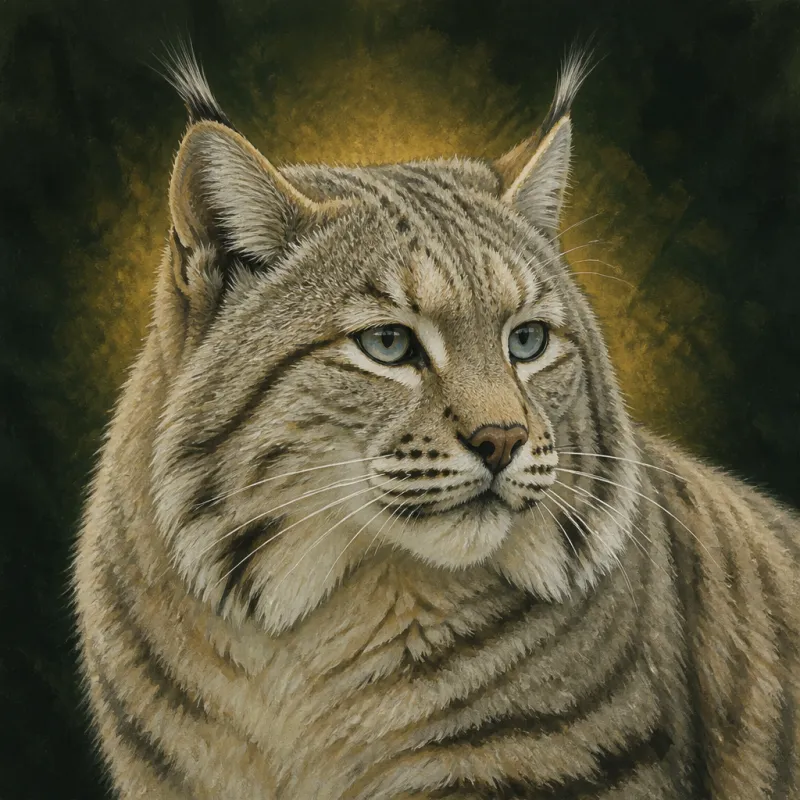
Thick-furred, with dense pale sand-coloured hair, faint flank stripes and distinct ear tufts, the Chinese mountain cat is built for cold, open high-altitude grassland between roughly 8,000 and 16,000 feet.
It remained one of the least documented cats in the world until camera traps and field surveys in Sichuan and Qinghai finally produced images of wild animals and basic ecological information.
Size and measurements
| Head-body length | 24 in – 2 ft 9 in (60–85 cm) |
|---|---|
| Tail length | 11 in – 16 in (29–41 cm) |
| Shoulder height | 11 in – 13 in (28–34 cm) |
| Body weight | 14–20 lb (6.5–9 kg) — Based on a small number of measured animals. |
| Top recorded speed | Not reliably measured — Not measured in the field. |
| Lifespan in the wild | 8–10 years |
| Lifespan under human care | 10–14 years |
Habitat and range
Alpine meadow, steppe and shrubland on the eastern Tibetan Plateau, generally in open country with rodent colonies rather than in true desert.
Endemic to China, with confirmed records from Qinghai, Sichuan and Gansu provinces.
Diet and hunting
Plateau pikas and zokors form the core of the diet, along with voles and ground birds.
Hunting strategy — Listening and digging at burrows. Hunts by locating rodents acoustically in open grassland and digging them out.
Behaviour and activity
Solitary. Dens in burrows on grassland slopes; observations remain few, and much of the species' behaviour is still undocumented.
Nocturnal and crepuscular. Most records come from dusk and night hours, matching pika and rodent activity.
Climbing and swimming
Climbing — Limited. A ground-dwelling cat in a largely treeless landscape.
Swimming — Very limited. No notable association with water.
Conservation status
The Chinese Mountain Cat is currently listed as Vulnerable on the IUCN Red List, with a population trend recorded as decreasing in the assessment published in 2015.
A small range and dependence on plateau pikas make this cat vulnerable to large-scale rodent poisoning programmes. Interbreeding with free-ranging domestic cats has also been documented.
Documented threats
- Poisoning campaigns against plateau pikas
- Hybridisation with domestic cats
- Grassland degradation
- Killing by herding dogs
- Very small known range
Look up the current Red List assessment for Felis bieti
Notable traits
- The first photographs of a wild individual were obtained only in 2007.
- Genetic work has confirmed hybridisation with village cats on the plateau.
- Its dense coat and heavily furred ears are adaptations to sustained sub-freezing temperatures.
Sources for this profile
- IUCN Red List of Threatened Species Global assessment categories, population trends and documented threats.
- IUCN SSC Cat Specialist Group Species accounts, distribution notes and Cat News reporting for every wild felid.
- Small Wild Cat Conservation Foundation Dedicated research and field reporting on the lesser-known felids.
- Wildlife Conservation Society Field programmes, camera-trap surveys and population monitoring.
- Animal Diversity Web, University of Michigan Museum of Zoology Reviewed species accounts with morphometric ranges and reproductive data.