Species comparison
Clouded Leopard vs Tiger
A side-by-side look at Neofelis nebulosa and Panthera tigris across body measurements, habitat, diet, behaviour and conservation status.
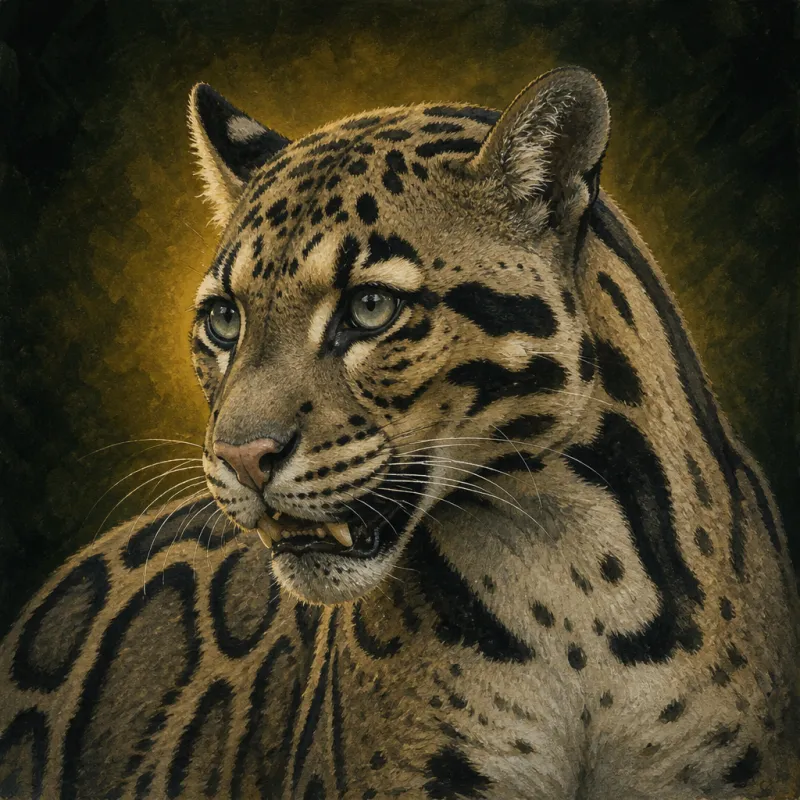
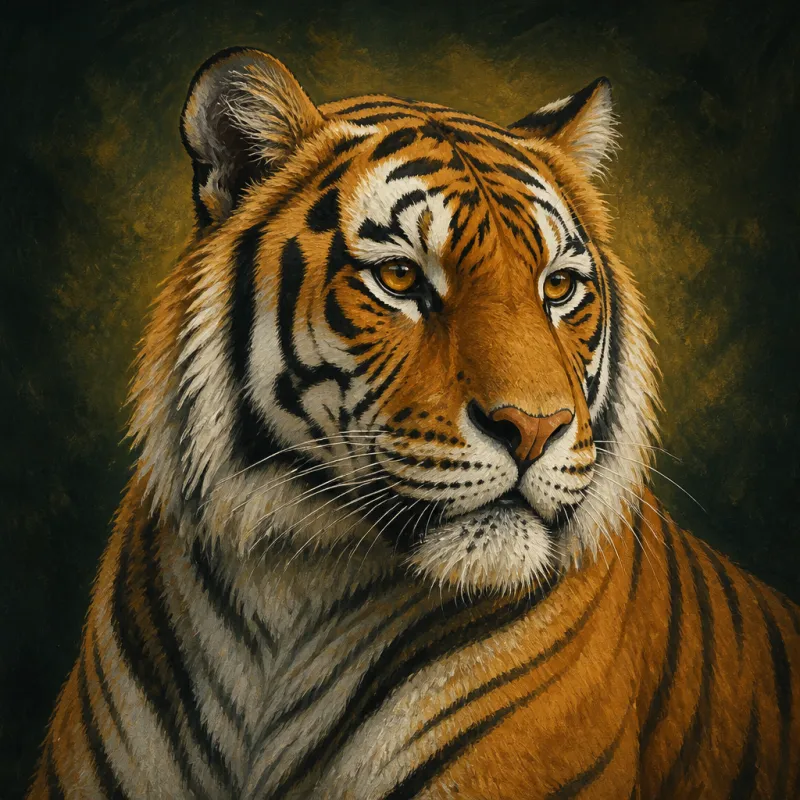
At a glance
- The tiger averages about 9.3 times the body mass of the clouded leopard.
- Both species use tropical rainforest and montane forest.
- Their ranges both include Asia.
- Red List categories differ: Clouded Leopard is listed as Vulnerable, Tiger as Endangered.
Identification
How each species is named and classified.
Clouded Leopard
Neofelis nebulosa
Tiger
Panthera tigris
Clouded Leopard
Neofelis
Tiger
Panthera
Clouded Leopard
Panthera lineage
Tiger
Panthera lineage
Clouded Leopard
Medium-sized cats
Tiger
Big cats
Clouded Leopard
Mainland clouded leopard
Tiger
Bengal tiger, Amur tiger, Siberian tiger
Body and movement
Published field measurements for adults. Ranges cover both sexes unless noted.
Clouded Leopard
2 ft 3 in – 3 ft 7 in (68–108 cm)
Tiger
4 ft 7 in – 9 ft 2 in (140–280 cm) Longer
Clouded Leopard
2 ft – 3 ft (61–91 cm)
Tiger
24 in – 3 ft 7 in (60–110 cm) Longer
Clouded Leopard
20 in – 22 in (50–55 cm)
Tiger
2 ft 7 in – 3 ft 7 in (80–110 cm) Taller
Clouded Leopard
24–55 lb (11–25 kg)
Males are noticeably heavier than females.
Tiger
165–573 lb (75–260 kg) Heavier
Sumatran females from about 75 kg; large males from mainland Asia exceed 200 kg.
Clouded Leopard
Not reliably measured
No reliable field measurement exists for this species.
Tiger
40 mph (65 km/h)
Short bursts over open ground; tigers rely on cover rather than pursuit.
Life span
Typical adult longevity. Figures for managed care come from zoo and sanctuary records.
Clouded Leopard
10–12 years
Tiger
10–15 years Longer
Clouded Leopard
13–17 years
Tiger
16–22 years Longer
Habitat and range
Where each species lives and the conditions it tolerates.
Clouded Leopard
tropical rainforest, montane forest, dry forest
Primarily closed-canopy evergreen forest, but also recorded in secondary growth, mangrove, dry woodland and, in the Himalaya, forest above 8,000 feet.
Tiger
tropical rainforest, mangrove, temperate forest, grassland, montane forest
Any landscape offering dense cover, water and sufficient large prey, from the Sundarbans mangroves to Russian pine and oak forest where winter temperatures fall far below freezing.
Clouded Leopard
Asia
Mainland South East Asia and the eastern Himalaya: Nepal, north-east India, Bhutan, Myanmar, Thailand, Laos, Cambodia, Vietnam, Malaysia and southern China.
Tiger
Asia
Scattered populations in India, Nepal, Bhutan, Bangladesh, Myanmar, Thailand, Malaysia, Indonesia (Sumatra), Russia and China. The species now occupies a small fraction of its historical Asian range.
Diet and behaviour
Feeding ecology, social organisation and hunting technique.
Clouded Leopard
primates, small mammals, birds, medium ungulates
Gibbons, macaques, slow lorises, porcupines, squirrels, pheasants, small deer and pigs, taken both in trees and on the ground.
Tiger
large ungulates, medium ungulates, small mammals
Sambar, chital, wild boar, gaur calves and, in the Russian Far East, red deer and roe deer. Tigers can consume very large meals and then cache and revisit a carcass for several days.
Clouded Leopard
Solitary
Secretive and rarely observed directly; most ecological knowledge comes from camera trapping and a small number of radio-collared animals.
Tiger
Solitary and territorial
Adults hold exclusive ranges against the same sex, marked with scrapes, scent and scratch trees. A male's territory typically overlaps those of several females.
Clouded Leopard
Nocturnal and crepuscular
Camera-trap records cluster at night and around dusk, with daytime resting in trees.
Tiger
Nocturnal and crepuscular
Chiefly active at night and around dawn and dusk, though tigers in undisturbed forest and cold climates also move by day.
Clouded Leopard
Arboreal and ground ambush
Prey is approached quietly and killed with a bite to the nape or skull, aided by unusually long canines.
Tiger
Solitary stalk and short rush
Tigers approach to within a few dozen feet under cover, then attack in a single explosive rush, using body mass to unbalance prey before a throat or nape bite. Most attempts fail.
Clouded Leopard
Exceptional More developed
One of the most arboreal cats: it can hang from branches by its hind feet and climb down trunks head first.
Tiger
Limited
Cubs climb readily; heavy adults rarely do so except under duress, such as when escaping flood water or elephants.
Clouded Leopard
Capable
Recorded crossing rivers, though the species is not associated with wetlands.
Tiger
Exceptional More developed
Tigers swim across wide rivers and tidal creeks, cool off in pools during hot weather, and in the Sundarbans routinely move between islands.
Conservation
Red List category, population direction and the pressures documented for each species.
Clouded Leopard
VU — Vulnerable
Assessed 2016
Tiger
EN — Endangered
Assessed 2022
Clouded Leopard
Decreasing
Tiger
Increasing
Clouded Leopard
Deforestation, Indiscriminate snaring, Trade in skins, teeth and bones, Prey depletion, Habitat fragmentation
Forest loss across South East Asia is the dominant pressure, compounded by intensive snaring that removes both the cat and its prey.
Tiger
Poaching for skins and body parts, Prey depletion by snaring, Habitat loss and fragmentation, Human-tiger conflict, Infrastructure development
The most recent global assessment raised the estimated population, partly through recovery in India, Nepal and Bhutan and partly through better survey coverage. Gains are uneven: several South East Asian populations have collapsed within a generation.
Notable traits
Details that do not fit neatly into a measurement table.
Clouded Leopard
- Relative to skull length, its canines are the longest of any living cat, a proportion often compared with extinct sabre-toothed forms.
- Rotating hind ankles allow head-first descent, a trait shared with very few other cats.
- The tail can be as long as the head and body, acting as a balance beam in the canopy.
Tiger
- Stripe patterns are individually unique and are also present on the skin, not only on the fur.
- Tiger hearing is tuned to low frequencies, and chuffing — a soft, breathy greeting — is used at close range between familiar animals.
- A single adult may need the equivalent of a large deer every week, which is why prey density, not forest area alone, sets local carrying capacity.
Sources used for this comparison
- IUCN Red List of Threatened Species Global assessment categories, population trends and documented threats.
- IUCN SSC Cat Specialist Group Species accounts, distribution notes and Cat News reporting for every wild felid.
- Smithsonian's National Zoo and Conservation Biology Institute Body measurements, longevity records and life-history notes.
- Wildlife Conservation Society Field programmes, camera-trap surveys and population monitoring.
- National Geographic — Animals General natural-history reference for behaviour, range and ecology.
- Panthera Field research programmes and species profiles for big and small wild cats.
- World Wildlife Fund Range descriptions, threat summaries and conservation programme reporting.