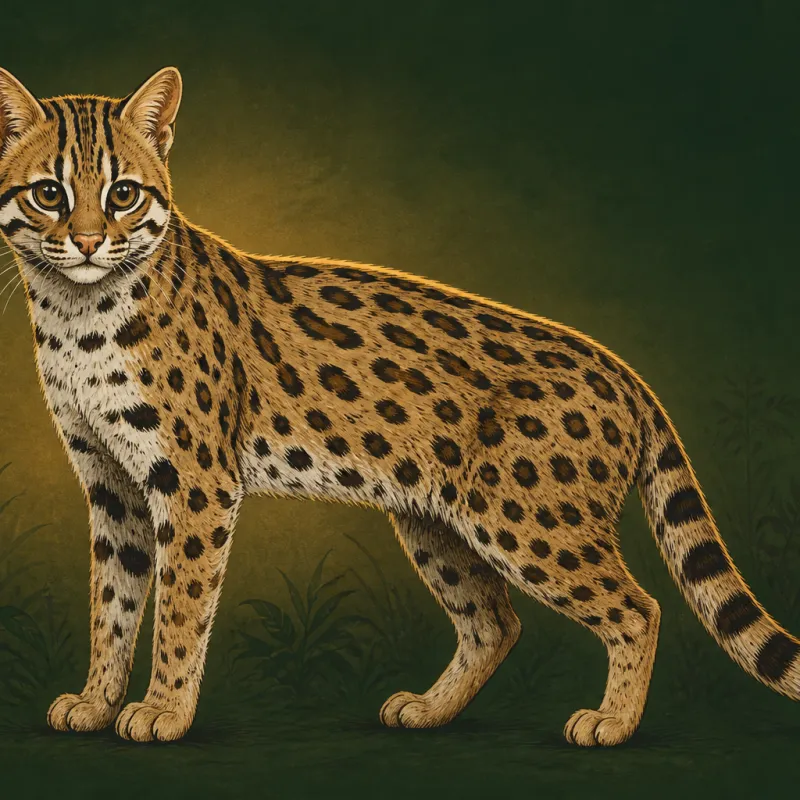
Leopard cats vary enormously across their range: animals from the Russian Far East are roughly twice the weight of those from tropical Asia, with much longer, paler fur.
Archaeological remains from Neolithic China show leopard cats living in farming villages some 5,000 years ago, an early commensal relationship that did not lead to domestication but that shows how readily the species uses human landscapes.
Size and measurements
| Head-body length | 15 in – 2 ft 2 in (38–66 cm) |
|---|---|
| Tail length | 7 in – 12 in (17–31 cm) |
| Shoulder height | 8 in – 11 in (20–28 cm) |
| Body weight | 2.6–15 lb (1.2–7 kg) — Tropical animals often weigh under 3 kg; northern animals reach 6–7 kg. |
| Top recorded speed | Not reliably measured — Not measured in the field. |
| Lifespan in the wild | 8–12 years |
| Lifespan under human care | 13–17 years |
Habitat and range
Nearly any wooded or shrubby habitat below about 10,000 feet, including secondary forest, plantation edges and farmland with cover.
From the Russian Far East, Korea and eastern China through the Himalaya and South Asia to mainland South East Asia.
Diet and hunting
Rodents make up the bulk of the diet, with birds, lizards, frogs, fish and large insects taken opportunistically.
Hunting strategy — Active search on the ground. Covers ground steadily through cover, pouncing on rodents and flushing birds; it also fishes in shallow streams.
Behaviour and activity
Solitary. Adaptable and comparatively common; individuals hold modest home ranges and tolerate a good deal of human activity.
Nocturnal and crepuscular. Chiefly night active, with more daytime movement in undisturbed forest and in cold northern winters.
Climbing and swimming
Climbing — Strong. A confident climber that dens in tree hollows.
Swimming — Strong. Swims well and has colonised numerous offshore islands.
Conservation status
The Leopard Cat is currently listed as Least Concern on the IUCN Red List, with a population trend recorded as stable in the assessment published in 2015.
The most secure of the Asian small cats, though hunting for skins, road mortality and intensive plantation agriculture reduce numbers locally.
Documented threats
- Hunting for fur and meat
- Road mortality
- Intensification of plantation agriculture
- Persecution near poultry
- Hybridisation pressure from domestic cats
Look up the current Red List assessment for Prionailurus bengalensis
Notable traits
- Remains from Neolithic Chinese villages show leopard cats hunting rodents around early grain stores.
- Northern and tropical populations differ so much in size and coat that they were long treated as many subspecies.
- It is one of the few small Asian cats that regularly hunts fish in shallow water.
Sources for this profile
- IUCN Red List of Threatened Species Global assessment categories, population trends and documented threats.
- IUCN SSC Cat Specialist Group Species accounts, distribution notes and Cat News reporting for every wild felid.
- Small Wild Cat Conservation Foundation Dedicated research and field reporting on the lesser-known felids.
- Animal Diversity Web, University of Michigan Museum of Zoology Reviewed species accounts with morphometric ranges and reproductive data.
- National Geographic — Animals General natural-history reference for behaviour, range and ecology.