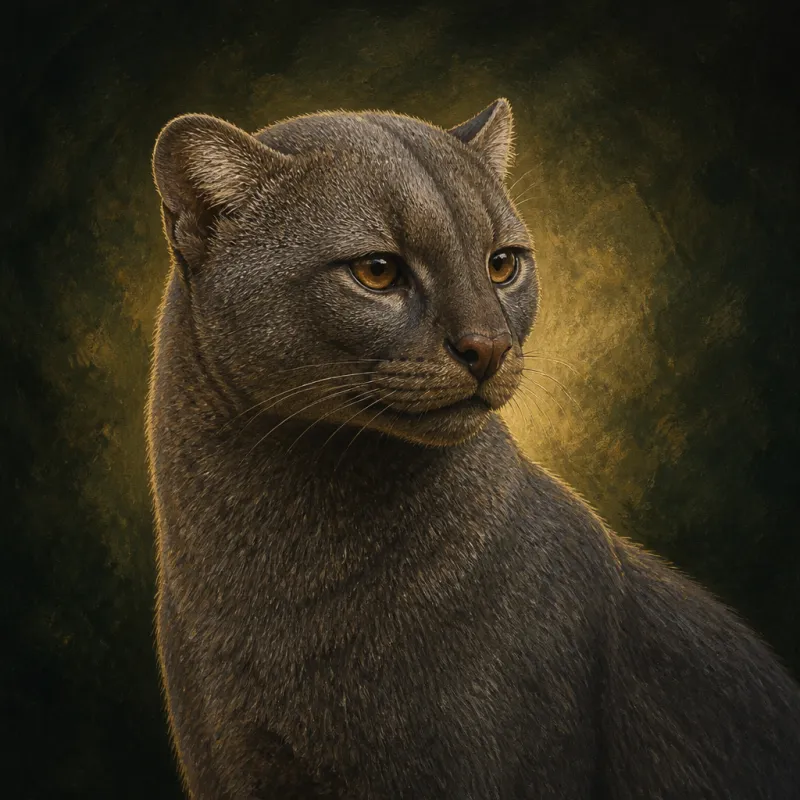
The jaguarundi looks unlike any other American cat: short legs, an elongated body, a small flattened head and a long tail give it an otter- or mustelid-like outline that has confused observers for centuries.
Its closest living relative is the puma, and both descend from a lineage that reached the Americas from Eurasia. Coat colour comes in a dark grey-black form and a reddish form, and both can occur in the same litter.
Size and measurements
| Head-body length | 21 in – 2 ft 6 in (53–77 cm) |
|---|---|
| Tail length | 12 in – 24 in (31–60 cm) |
| Shoulder height | 10 in – 14 in (25–35 cm) |
| Body weight | 7.7–20 lb (3.5–9 kg) — Males average slightly larger than females. |
| Top recorded speed | Not reliably measured — No reliable measurement published. |
| Lifespan in the wild | 8–10 years |
| Lifespan under human care | 10–15 years |
Habitat and range
Prefers dense low cover — thorn scrub, secondary growth, forest edge and riverside thickets — more often than closed primary rainforest.
From northern Mexico through Central America to northern Argentina. Historical records exist for southern Texas, where the species is federally listed but has not been confirmed in decades.
Diet and hunting
Rodents, ground birds, lizards, frogs, large invertebrates and occasional fruit; most prey weighs under a pound.
Hunting strategy — Active ground search. Rather than sitting in ambush, jaguarundis quarter dense cover on foot, flushing and pouncing on small prey; they will also climb after birds.
Behaviour and activity
Solitary. Usually seen alone, occasionally in pairs. It is more terrestrial than most Neotropical cats and moves through thick cover with a distinctly low, gliding gait.
Diurnal. One of the few strongly day-active cats, with peaks in the morning and mid-afternoon. This may reduce competition with the largely nocturnal ocelot.
Climbing and swimming
Climbing — Capable. Climbs well but hunts mainly on the ground, unlike the closely sympatric margay.
Swimming — Capable. Enters water readily and has been observed swimming across small rivers.
Conservation status
The Jaguarundi is currently listed as Least Concern on the IUCN Red List, with a population trend recorded as decreasing in the assessment published in 2015.
Still widespread, but the northern edge of the range has contracted sharply and populations in Mexico and Central America are considered at risk.
Documented threats
- Loss of dense low cover
- Conversion of scrub to farmland
- Road mortality
- Persecution near poultry
- Fragmentation of riparian corridors
Look up the current Red List assessment for Herpailurus yagouaroundi
Notable traits
- Grey and reddish colour morphs were once described as two separate species.
- It produces an unusually varied vocal repertoire, including chirps, whistles and a bird-like call.
- Its build reflects a diet of small ground prey, not the arboreal hunting typical of similarly sized Neotropical cats.
Sources for this profile
- IUCN Red List of Threatened Species Global assessment categories, population trends and documented threats.
- IUCN SSC Cat Specialist Group Species accounts, distribution notes and Cat News reporting for every wild felid.
- U.S. Fish and Wildlife Service Federal listing status and recovery planning for cats occurring in the United States.
- Small Wild Cat Conservation Foundation Dedicated research and field reporting on the lesser-known felids.
- Animal Diversity Web, University of Michigan Museum of Zoology Reviewed species accounts with morphometric ranges and reproductive data.