Species comparison
Asian Golden Cat vs Sunda Clouded Leopard
A side-by-side look at Catopuma temminckii and Neofelis diardi across body measurements, habitat, diet, behaviour and conservation status.
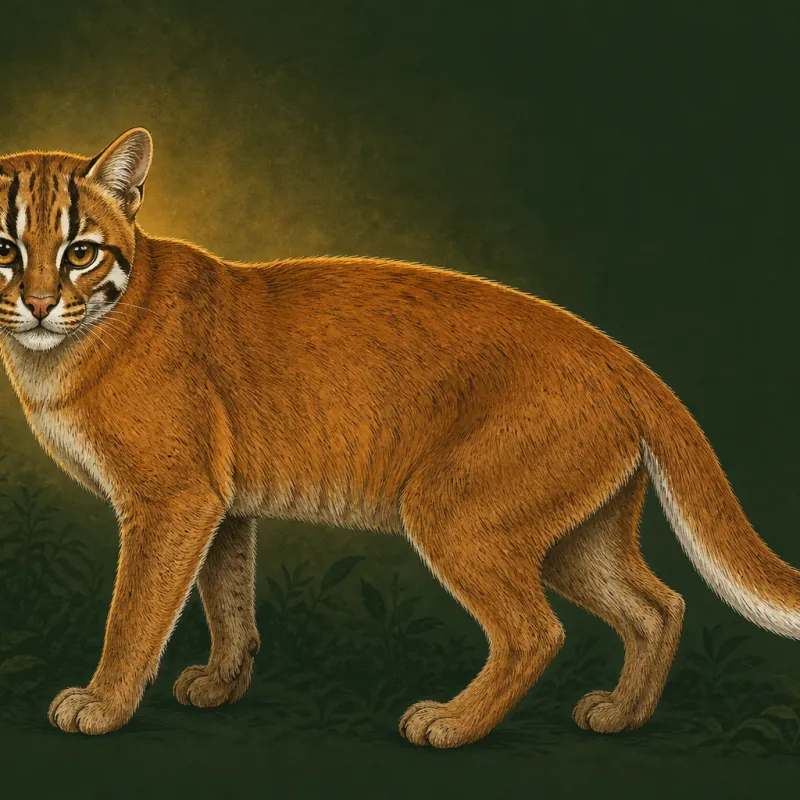
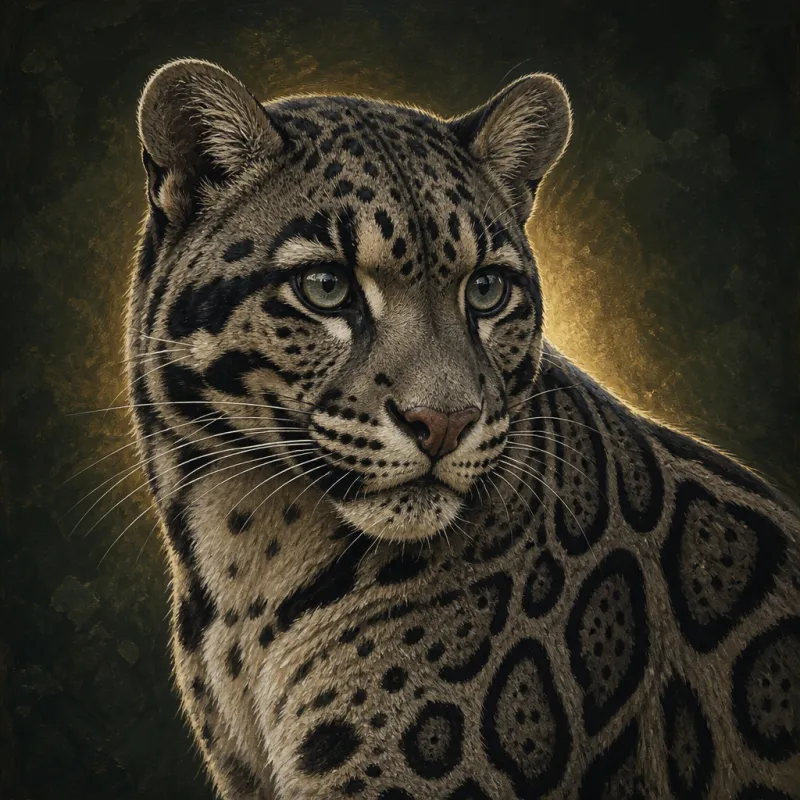
At a glance
- The sunda clouded leopard averages about 1.5 times the body mass of the asian golden cat.
- Both species use tropical rainforest and montane forest.
- Their ranges both include Asia.
- Red List categories differ: Asian Golden Cat is listed as Near Threatened, Sunda Clouded Leopard as Vulnerable.
Identification
How each species is named and classified.
Asian Golden Cat
Catopuma temminckii
Sunda Clouded Leopard
Neofelis diardi
Asian Golden Cat
Catopuma
Sunda Clouded Leopard
Neofelis
Asian Golden Cat
Bay cat lineage
Sunda Clouded Leopard
Panthera lineage
Asian Golden Cat
Medium-sized cats
Sunda Clouded Leopard
Medium-sized cats
Asian Golden Cat
Temminck's cat, Fire cat
Sunda Clouded Leopard
Bornean clouded leopard, Sundaland clouded leopard
Body and movement
Published field measurements for adults. Ranges cover both sexes unless noted.
Asian Golden Cat
2 ft 2 in – 3 ft 5 in (66–105 cm)
Sunda Clouded Leopard
2 ft 4 in – 3 ft 5 in (70–105 cm) Longer
Asian Golden Cat
16 in – 22 in (40–57 cm)
Sunda Clouded Leopard
24 in – 2 ft 9 in (60–85 cm) Longer
Asian Golden Cat
18 in – 22 in (45–56 cm)
Sunda Clouded Leopard
20 in – 22 in (50–55 cm) Taller
Asian Golden Cat
20–35 lb (9–16 kg)
Males average heavier than females.
Sunda Clouded Leopard
26–57 lb (12–26 kg) Heavier
Limited sample sizes; most figures come from a small number of captured animals.
Asian Golden Cat
Not reliably measured
Not measured in the field.
Sunda Clouded Leopard
Not reliably measured
Not measured in the field.
Life span
Typical adult longevity. Figures for managed care come from zoo and sanctuary records.
Asian Golden Cat
10–12 years
Sunda Clouded Leopard
10–12 years
Asian Golden Cat
17–20 years Longer
Sunda Clouded Leopard
13–17 years
Habitat and range
Where each species lives and the conditions it tolerates.
Asian Golden Cat
tropical rainforest, montane forest, dry forest
Evergreen and mixed forest from lowland to about 12,000 feet in the Himalaya, including bamboo, secondary growth and drier deciduous woodland.
Sunda Clouded Leopard
tropical rainforest, montane forest
Lowland and hill dipterocarp forest, peat swamp forest and montane forest; the species also uses selectively logged forest, though at lower densities than in primary habitat.
Asian Golden Cat
Asia
From Nepal and north-east India through Bhutan, Myanmar, southern China, Thailand, Laos, Cambodia and Vietnam to peninsular Malaysia and Sumatra.
Sunda Clouded Leopard
Asia
Endemic to Borneo and Sumatra, with separate subspecies recognised on each island.
Diet and behaviour
Feeding ecology, social organisation and hunting technique.
Asian Golden Cat
small mammals, birds, medium ungulates, reptiles
Rodents, hares, birds and reptiles, plus muntjac and young ungulates; the species is strong enough to take prey considerably larger than itself.
Sunda Clouded Leopard
small mammals, primates, birds, medium ungulates
Bearded pig, mouse deer, macaques, proboscis monkeys, porcupines, civets and birds.
Asian Golden Cat
Solitary
Mostly terrestrial and territorial. Field observations remain sparse despite the cat's relatively large size.
Sunda Clouded Leopard
Solitary
Individuals maintain large home ranges relative to body size; detections are strongly associated with continuous forest cover.
Asian Golden Cat
Crepuscular and partly diurnal
Camera-trap studies show more daytime activity than early accounts suggested, with peaks around dawn and dusk.
Sunda Clouded Leopard
Nocturnal and crepuscular
Camera-trap data show a strong night-time peak, with some crepuscular movement.
Asian Golden Cat
Ground stalking in forest
Hunts on the forest floor, using cover for a close approach before a short rush.
Sunda Clouded Leopard
Stalking ambush in forest
Hunts both from branches and along the ground, taking prey up to the size of a young bearded pig.
Asian Golden Cat
Strong
Climbs well and will follow prey into trees, though it hunts mainly on the ground.
Sunda Clouded Leopard
Exceptional More developed
Highly arboreal, with the same rotating ankle anatomy as the mainland species.
Asian Golden Cat
Limited
No strong association with water.
Sunda Clouded Leopard
Capable More developed
Recorded crossing rivers within its forest range.
Conservation
Red List category, population direction and the pressures documented for each species.
Asian Golden Cat
NT — Near Threatened
Assessed 2015
Sunda Clouded Leopard
VU — Vulnerable
Assessed 2015
Asian Golden Cat
Decreasing
Sunda Clouded Leopard
Decreasing
Asian Golden Cat
Deforestation, Indiscriminate snaring, Trade in skins and bones, Prey depletion, Retaliatory killing near livestock
Assessed as Near Threatened. Deforestation across South East Asia and pervasive snaring for the wild-meat and skin trade are the main pressures.
Sunda Clouded Leopard
Conversion of forest to plantation, Logging, Fragmentation of lowland forest, Snaring, Trade in skins
Conversion of lowland forest to oil-palm plantation has removed a large share of the best habitat on both islands, leaving increasingly isolated forest blocks.
Notable traits
Details that do not fit neatly into a measurement table.
Asian Golden Cat
- At least six coat morphs have been recorded, an unusual level of variation for a wild cat.
- Local names in several range countries translate as "fire cat" or "rock cat".
- A spotted morph photographed in China initially confused researchers, who suspected a new species.
Sunda Clouded Leopard
- It was described as a distinct species only in 2006, after genetic comparison with mainland clouded leopards.
- Its cloud markings are smaller, darker-edged and more densely spotted than those of the mainland species.
- On Borneo it occupies the ecological role that tigers and leopards fill elsewhere in Asia.
Sources used for this comparison
- IUCN Red List of Threatened Species Global assessment categories, population trends and documented threats.
- IUCN SSC Cat Specialist Group Species accounts, distribution notes and Cat News reporting for every wild felid.
- Small Wild Cat Conservation Foundation Dedicated research and field reporting on the lesser-known felids.
- Wildlife Conservation Society Field programmes, camera-trap surveys and population monitoring.
- Animal Diversity Web, University of Michigan Museum of Zoology Reviewed species accounts with morphometric ranges and reproductive data.
- World Wildlife Fund Range descriptions, threat summaries and conservation programme reporting.