Wetland specialists
Flat-headed Cat vs Fishing Cat
Most cats avoid water. These two Asian species built their entire biology around it, and both are now limited by how quickly wetlands are disappearing.
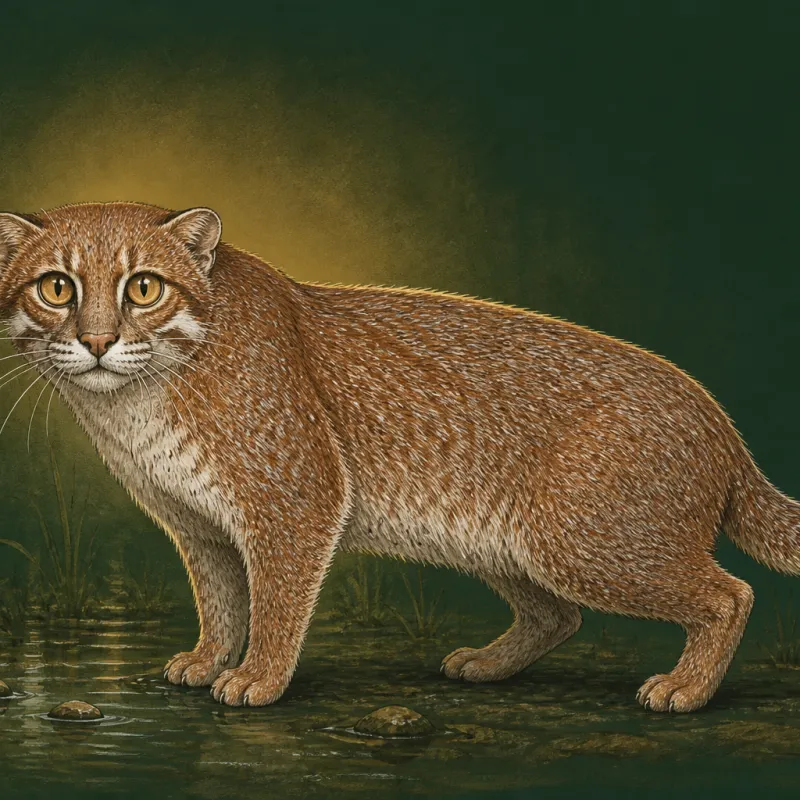
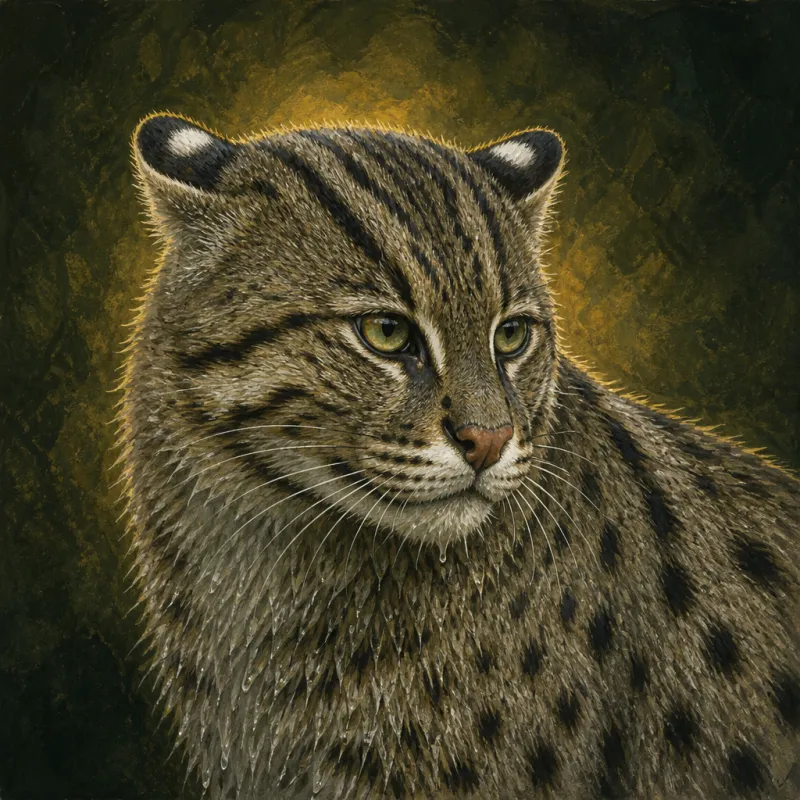
At a glance
- The fishing cat averages about 5.3 times the body mass of the flat-headed cat.
- Both species use wetland and tropical rainforest.
- Their ranges both include Asia.
- Red List categories differ: Flat-headed Cat is listed as Endangered, Fishing Cat as Vulnerable.
Adaptations for a wet life
Both species have partially webbed forefeet and dense double-layered coats that keep the skin dry. Beyond that they diverge. The fishing cat is powerfully built and dives after fish; the flat-headed cat is a fraction of its size and wades in shallows, seizing prey with its forepaws.
The flat-headed cat carries the more extreme adaptations: a long narrow jaw, backward-angled premolars for gripping slippery prey, forward-set eyes for close-range binocular vision, and claws that never fully retract.
Scale of the difference
A male fishing cat can weigh several times as much as a flat-headed cat, which puts them in different prey classes. Fishing cats take large fish, rodents, waterbirds and snakes; flat-headed cats concentrate on small fish, frogs and crustaceans.
A shared threat
Both depend on lowland freshwater habitat in the fastest-changing part of Asia. Drainage, aquaculture, plantation conversion and pollution have removed a large share of it. The flat-headed cat is assessed as Endangered and the fishing cat as Vulnerable, and for both species conservation is essentially a question of whether wetlands survive.
What to take away
- Both have partly webbed feet and water-shedding coats, but at very different body sizes.
- The flat-headed cat is the more extreme specialist, down to its tooth shape and eye position.
- Wetland loss is the single dominant threat to both species.
Identification
How each species is named and classified.
Flat-headed Cat
Prionailurus planiceps
Fishing Cat
Prionailurus viverrinus
Flat-headed Cat
Prionailurus
Fishing Cat
Prionailurus
Flat-headed Cat
Leopard cat lineage
Fishing Cat
Leopard cat lineage
Flat-headed Cat
Small cats
Fishing Cat
Medium-sized cats
Flat-headed Cat
Kucing hutan
Fishing Cat
Mach-bagral
Body and movement
Published field measurements for adults. Ranges cover both sexes unless noted.
Flat-headed Cat
16 in – 20 in (41–50 cm)
Fishing Cat
22 in – 2 ft 10 in (57–86 cm) Longer
Flat-headed Cat
5 in – 8 in (13–20 cm)
Fishing Cat
8 in – 12 in (20–30 cm) Longer
Flat-headed Cat
7 in – 9 in (18–22 cm)
Fishing Cat
15 in – 16 in (38–41 cm) Taller
Flat-headed Cat
3.3–5.5 lb (1.5–2.5 kg)
Known from a small number of measured specimens.
Fishing Cat
11–35 lb (5–16 kg) Heavier
Males 8.5–16 kg, females 5–7 kg; a marked size difference between the sexes.
Flat-headed Cat
Not reliably measured
Not measured in the field.
Fishing Cat
Not reliably measured
Not measured; the species hunts by patience and swimming, not speed.
Life span
Typical adult longevity. Figures for managed care come from zoo and sanctuary records.
Flat-headed Cat
8–10 years
Fishing Cat
10–12 years Longer
Flat-headed Cat
10–14 years
Fishing Cat
12–17 years Longer
Habitat and range
Where each species lives and the conditions it tolerates.
Flat-headed Cat
wetland, tropical rainforest, mangrove
Peat swamp forest, riverine forest and freshwater swamp in lowland areas, almost always within a short distance of water.
Fishing Cat
wetland, mangrove, agricultural mosaic, tropical rainforest
Marshes, reedbeds, oxbow lakes, mangrove creeks, tidal channels and flooded rice paddy — always close to permanent water with fish.
Flat-headed Cat
Asia
Peninsular Malaysia, southern Thailand, Borneo and Sumatra, in an increasingly fragmented set of lowland wetland sites.
Fishing Cat
Asia
Scattered wetland populations in India, Nepal, Bangladesh, Sri Lanka, Myanmar, Thailand, Cambodia and Indonesia (Java), with historical records from several other countries.
Diet and behaviour
Feeding ecology, social organisation and hunting technique.
Flat-headed Cat
fish, amphibians, small mammals, insects
Fish, frogs and crustaceans dominate, with rodents and insects taken as well.
Fishing Cat
fish, small mammals, birds, reptiles
Fish supply the majority of the diet, along with rodents, waterbirds, snakes, frogs and molluscs.
Flat-headed Cat
Solitary
Very rarely observed; almost all modern records come from camera traps set along watercourses.
Fishing Cat
Solitary
Adults hold ranges centred on water bodies. In several countries the species now lives largely inside human-dominated wetland, including aquaculture ponds and paddy landscapes.
Flat-headed Cat
Nocturnal
Night active, with occasional records around dusk.
Fishing Cat
Nocturnal
Strongly night active, resting during the day in dense reed or scrub near water.
Flat-headed Cat
Shallow-water grabbing
Hunts by wading in shallow water and seizing prey with the forepaws, plunging the head beneath the surface.
Fishing Cat
Aquatic ambush and diving
Waits at the water's edge and hooks fish with a forepaw, or swims and dives to take prey below the surface.
Flat-headed Cat
Capable
Climbs adequately but forages almost entirely at water level.
Fishing Cat
Capable
Climbs competently but spends most of its time at ground and water level.
Flat-headed Cat
Exceptional
Highly aquatic, with partially webbed feet and a strong association with permanent water.
Fishing Cat
Exceptional
One of the strongest swimmers among cats; it will swim long distances and dive fully underwater.
Conservation
Red List category, population direction and the pressures documented for each species.
Flat-headed Cat
EN — Endangered
Assessed 2015
Fishing Cat
VU — Vulnerable
Assessed 2016
Flat-headed Cat
Decreasing
Fishing Cat
Decreasing
Flat-headed Cat
Drainage of peat swamp forest, Conversion to oil-palm plantation, Water pollution and fish depletion, Snaring, Extreme habitat fragmentation
Assessed as Endangered, with a very small estimated population. Over two-thirds of the lowland wetland habitat it depends on has been drained, converted or degraded.
Fishing Cat
Wetland drainage and conversion, Aquaculture expansion, Retaliatory killing at fish ponds, Snaring and hunting, Pollution of waterways
Wetland loss is the central problem: drainage, aquaculture conversion, pollution and settlement have removed much of the habitat this species requires, and remaining populations are highly fragmented.
Notable traits
Details that do not fit neatly into a measurement table.
Flat-headed Cat
- Its eyes are set unusually far forward, giving the wide binocular field needed to judge prey underwater.
- The claws retract only partly, leaving them permanently ready for gripping.
- Captive individuals have been recorded washing food in water before eating.
Fishing Cat
- Partial webbing between the toes of the forefeet helps with swimming and with scooping fish.
- The species is the state animal of West Bengal, India.
- Conservation projects increasingly work with fish farmers, since much remaining habitat lies on private land.
Sources used for this comparison
- IUCN Red List of Threatened Species Global assessment categories, population trends and documented threats.
- IUCN SSC Cat Specialist Group Species accounts, distribution notes and Cat News reporting for every wild felid.
- Small Wild Cat Conservation Foundation Dedicated research and field reporting on the lesser-known felids.
- World Wildlife Fund Range descriptions, threat summaries and conservation programme reporting.
- Wildlife Conservation Society Field programmes, camera-trap surveys and population monitoring.
- Fishing Cat Conservation Alliance Wetland felid research, distribution records and conservation planning.