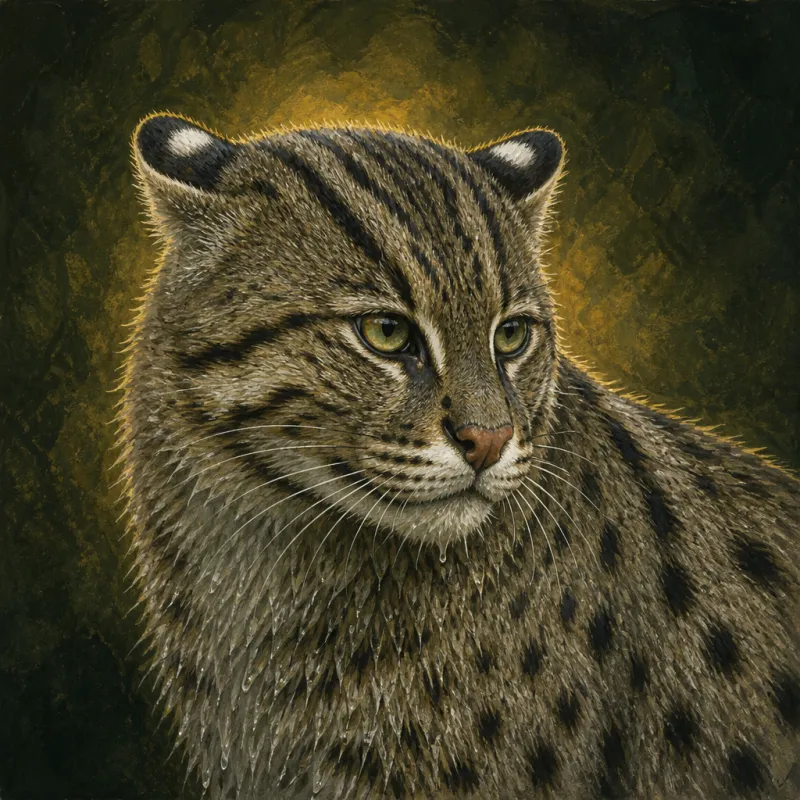
Roughly twice the weight of a domestic cat and far more powerfully built, the fishing cat is adapted for hunting in and beside water. Its forefeet carry partial webbing, and a dense underlayer of fur keeps the skin dry while the guard hairs get soaked.
It hunts by watching from the bank and scooping with a paw, or by entering the water entirely and diving after fish. Some individuals have been observed tapping the surface to imitate insect movement.
Size and measurements
| Head-body length | 22 in – 2 ft 10 in (57–86 cm) |
|---|---|
| Tail length | 8 in – 12 in (20–30 cm) |
| Shoulder height | 15 in – 16 in (38–41 cm) |
| Body weight | 11–35 lb (5–16 kg) — Males 8.5–16 kg, females 5–7 kg; a marked size difference between the sexes. |
| Top recorded speed | Not reliably measured — Not measured; the species hunts by patience and swimming, not speed. |
| Lifespan in the wild | 10–12 years |
| Lifespan under human care | 12–17 years |
Habitat and range
Marshes, reedbeds, oxbow lakes, mangrove creeks, tidal channels and flooded rice paddy — always close to permanent water with fish.
Scattered wetland populations in India, Nepal, Bangladesh, Sri Lanka, Myanmar, Thailand, Cambodia and Indonesia (Java), with historical records from several other countries.
Diet and hunting
Fish supply the majority of the diet, along with rodents, waterbirds, snakes, frogs and molluscs.
Hunting strategy — Aquatic ambush and diving. Waits at the water's edge and hooks fish with a forepaw, or swims and dives to take prey below the surface.
Behaviour and activity
Solitary. Adults hold ranges centred on water bodies. In several countries the species now lives largely inside human-dominated wetland, including aquaculture ponds and paddy landscapes.
Nocturnal. Strongly night active, resting during the day in dense reed or scrub near water.
Climbing and swimming
Climbing — Capable. Climbs competently but spends most of its time at ground and water level.
Swimming — Exceptional. One of the strongest swimmers among cats; it will swim long distances and dive fully underwater.
Conservation status
The Fishing Cat is currently listed as Vulnerable on the IUCN Red List, with a population trend recorded as decreasing in the assessment published in 2016.
Wetland loss is the central problem: drainage, aquaculture conversion, pollution and settlement have removed much of the habitat this species requires, and remaining populations are highly fragmented.
Documented threats
- Wetland drainage and conversion
- Aquaculture expansion
- Retaliatory killing at fish ponds
- Snaring and hunting
- Pollution of waterways
Look up the current Red List assessment for Prionailurus viverrinus
Notable traits
- Partial webbing between the toes of the forefeet helps with swimming and with scooping fish.
- The species is the state animal of West Bengal, India.
- Conservation projects increasingly work with fish farmers, since much remaining habitat lies on private land.
Sources for this profile
- IUCN Red List of Threatened Species Global assessment categories, population trends and documented threats.
- IUCN SSC Cat Specialist Group Species accounts, distribution notes and Cat News reporting for every wild felid.
- Fishing Cat Conservation Alliance Wetland felid research, distribution records and conservation planning.
- Small Wild Cat Conservation Foundation Dedicated research and field reporting on the lesser-known felids.
- World Wildlife Fund Range descriptions, threat summaries and conservation programme reporting.