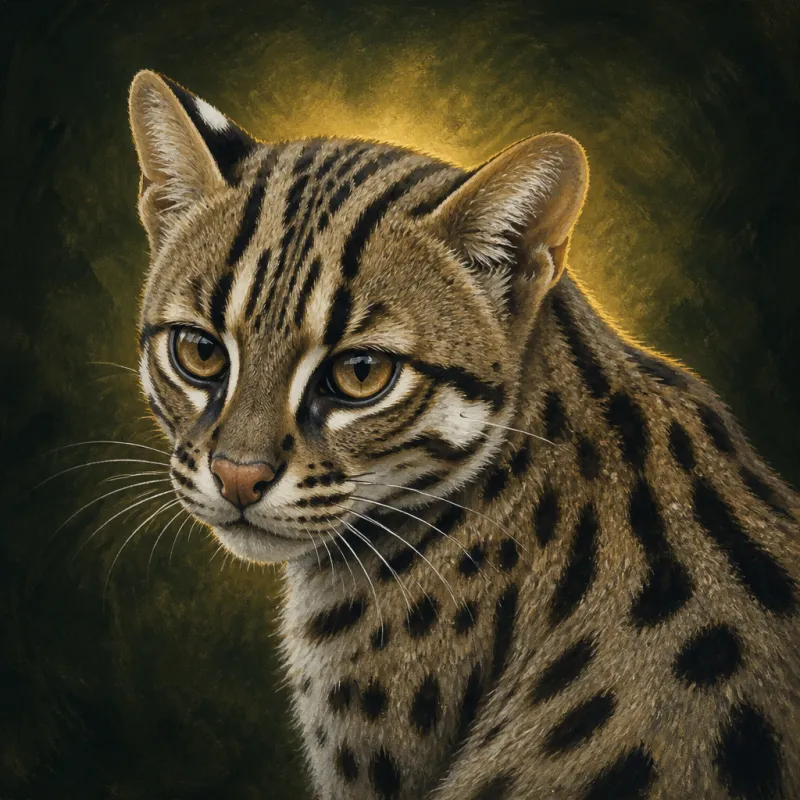
Sunda leopard cats are generally smaller and more heavily marked than their mainland relatives, with shorter, coarser fur suited to a consistently warm, humid climate.
Genetic analysis published in 2017 separated the island populations from Prionailurus bengalensis, dividing what had been treated as a single, exceptionally variable species.
Size and measurements
| Head-body length | 16 in – 24 in (40–60 cm) |
|---|---|
| Tail length | 7 in – 12 in (17–30 cm) |
| Shoulder height | 8 in – 10 in (20–26 cm) |
| Body weight | 3.3–9.9 lb (1.5–4.5 kg) — Consistently lighter than northern mainland leopard cats. |
| Top recorded speed | Not reliably measured — Not measured in the field. |
| Lifespan in the wild | 8–12 years |
| Lifespan under human care | 13–16 years |
Habitat and range
Lowland and hill forest, secondary growth, plantation edges and farmland; the species uses oil-palm landscapes where rodents are abundant and cover remains.
Java, Bali, Borneo, Sumatra, Palawan and other Philippine islands, and smaller islands across the Sunda Shelf.
Diet and hunting
Rats and mice dominate, along with birds, lizards, frogs and invertebrates.
Hunting strategy — Active ground search. Patrols plantation rows, forest edge and stream banks, hunting rodents and ground-nesting birds.
Behaviour and activity
Solitary. Common in many surveys and comparatively tolerant of modified landscapes, provided some cover and rodent prey persist.
Nocturnal. Strongly night active, with camera-trap records clustering well after dark.
Climbing and swimming
Climbing — Strong. Climbs and dens in trees, though most hunting is terrestrial.
Swimming — Strong. Swims capably, which has helped the species reach numerous islands.
Conservation status
The Sunda Leopard Cat is currently listed as Least Concern on the IUCN Red List, with a population trend recorded as decreasing in the assessment published in 2021.
Still widespread and locally common, but hunting for skins, snaring and the conversion of forest to plantation reduce numbers in parts of the range.
Documented threats
- Forest conversion to plantation
- Snaring and hunting for skins
- Rodenticide use in plantations
- Road mortality
- Pet trade
Look up the current Red List assessment for Prionailurus javanensis
Notable traits
- The species was separated from the mainland leopard cat in 2017 on genetic and morphological evidence.
- It is one of the few wild cats that appears to benefit, at least temporarily, from rodent booms in plantation landscapes.
- Island populations vary enough in size and markings that further taxonomic work is likely.
Sources for this profile
- IUCN Red List of Threatened Species Global assessment categories, population trends and documented threats.
- IUCN SSC Cat Specialist Group Species accounts, distribution notes and Cat News reporting for every wild felid.
- Small Wild Cat Conservation Foundation Dedicated research and field reporting on the lesser-known felids.
- World Wildlife Fund Range descriptions, threat summaries and conservation programme reporting.
- Animal Diversity Web, University of Michigan Museum of Zoology Reviewed species accounts with morphometric ranges and reproductive data.