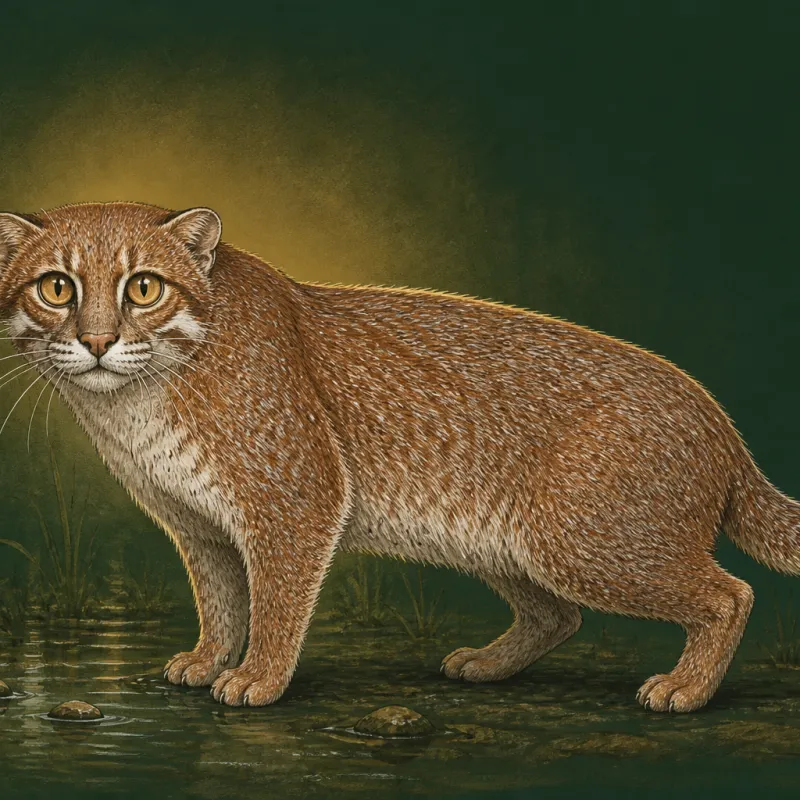
Everything about this cat points to a diet of fish and frogs. The jaw is long and narrow, the premolars are sharp and backward-angled, the eyes sit far forward for binocular vision at close range, and the claws remain partly exposed even when retracted.
It is confined to lowland freshwater habitat in one of the most heavily converted regions on the planet, which is why it is considered one of the most threatened small cats in Asia.
Size and measurements
| Head-body length | 16 in – 20 in (41–50 cm) |
|---|---|
| Tail length | 5 in – 8 in (13–20 cm) |
| Shoulder height | 7 in – 9 in (18–22 cm) |
| Body weight | 3.3–5.5 lb (1.5–2.5 kg) — Known from a small number of measured specimens. |
| Top recorded speed | Not reliably measured — Not measured in the field. |
| Lifespan in the wild | 8–10 years |
| Lifespan under human care | 10–14 years |
Habitat and range
Peat swamp forest, riverine forest and freshwater swamp in lowland areas, almost always within a short distance of water.
Peninsular Malaysia, southern Thailand, Borneo and Sumatra, in an increasingly fragmented set of lowland wetland sites.
Diet and hunting
Fish, frogs and crustaceans dominate, with rodents and insects taken as well.
Hunting strategy — Shallow-water grabbing. Hunts by wading in shallow water and seizing prey with the forepaws, plunging the head beneath the surface.
Behaviour and activity
Solitary. Very rarely observed; almost all modern records come from camera traps set along watercourses.
Nocturnal. Night active, with occasional records around dusk.
Climbing and swimming
Climbing — Capable. Climbs adequately but forages almost entirely at water level.
Swimming — Exceptional. Highly aquatic, with partially webbed feet and a strong association with permanent water.
Conservation status
The Flat-headed Cat is currently listed as Endangered on the IUCN Red List, with a population trend recorded as decreasing in the assessment published in 2015.
Assessed as Endangered, with a very small estimated population. Over two-thirds of the lowland wetland habitat it depends on has been drained, converted or degraded.
Documented threats
- Drainage of peat swamp forest
- Conversion to oil-palm plantation
- Water pollution and fish depletion
- Snaring
- Extreme habitat fragmentation
Look up the current Red List assessment for Prionailurus planiceps
Notable traits
- Its eyes are set unusually far forward, giving the wide binocular field needed to judge prey underwater.
- The claws retract only partly, leaving them permanently ready for gripping.
- Captive individuals have been recorded washing food in water before eating.
Sources for this profile
- IUCN Red List of Threatened Species Global assessment categories, population trends and documented threats.
- IUCN SSC Cat Specialist Group Species accounts, distribution notes and Cat News reporting for every wild felid.
- Small Wild Cat Conservation Foundation Dedicated research and field reporting on the lesser-known felids.
- World Wildlife Fund Range descriptions, threat summaries and conservation programme reporting.
- Wildlife Conservation Society Field programmes, camera-trap surveys and population monitoring.