Species comparison
Leopard vs Sunda Clouded Leopard
A side-by-side look at Panthera pardus and Neofelis diardi across body measurements, habitat, diet, behaviour and conservation status.
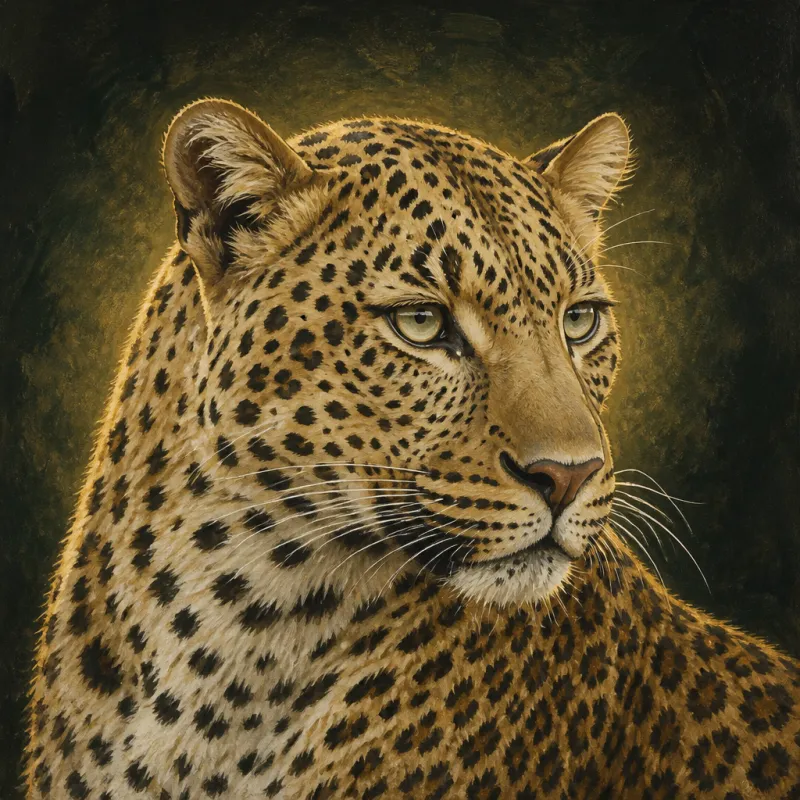
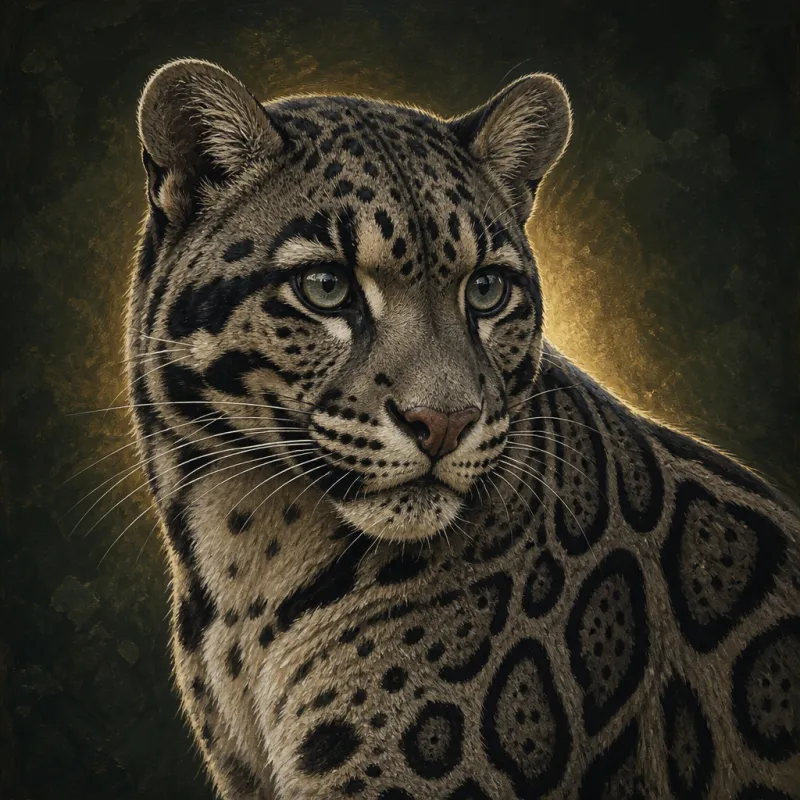
At a glance
- The leopard averages about 2.8 times the body mass of the sunda clouded leopard.
- Both species use tropical rainforest and montane forest.
- Their ranges both include Asia.
- Both are currently listed as Vulnerable on the Red List.
Identification
How each species is named and classified.
Leopard
Panthera pardus
Sunda Clouded Leopard
Neofelis diardi
Leopard
Panthera
Sunda Clouded Leopard
Neofelis
Leopard
Panthera lineage
Sunda Clouded Leopard
Panthera lineage
Leopard
Big cats
Sunda Clouded Leopard
Medium-sized cats
Leopard
African leopard, Amur leopard, Arabian leopard
Sunda Clouded Leopard
Bornean clouded leopard, Sundaland clouded leopard
Body and movement
Published field measurements for adults. Ranges cover both sexes unless noted.
Leopard
2 ft 11 in – 6 ft 3 in (90–190 cm) Longer
Sunda Clouded Leopard
2 ft 4 in – 3 ft 5 in (70–105 cm)
Leopard
23 in – 3 ft 7 in (58–110 cm) Longer
Sunda Clouded Leopard
24 in – 2 ft 9 in (60–85 cm)
Leopard
18 in – 2 ft 7 in (45–78 cm) Taller
Sunda Clouded Leopard
20 in – 22 in (50–55 cm)
Leopard
37–198 lb (17–90 kg) Heavier
Arabian leopards from about 17 kg; large African and Persian males approach 90 kg.
Sunda Clouded Leopard
26–57 lb (12–26 kg)
Limited sample sizes; most figures come from a small number of captured animals.
Leopard
36 mph (58 km/h)
Measured over short distances; leopards depend on stalking to within a few strides.
Sunda Clouded Leopard
Not reliably measured
Not measured in the field.
Life span
Typical adult longevity. Figures for managed care come from zoo and sanctuary records.
Leopard
12–15 years Longer
Sunda Clouded Leopard
10–12 years
Leopard
20–23 years Longer
Sunda Clouded Leopard
13–17 years
Habitat and range
Where each species lives and the conditions it tolerates.
Leopard
tropical rainforest, savanna, montane forest, semi-arid scrub, temperate forest, agricultural mosaic
From equatorial rainforest to the fringes of the Arabian and Kalahari deserts, and from sea level to above 15,000 feet in the Himalaya. Leopards persist in farmland and near cities where cover and small prey remain.
Sunda Clouded Leopard
tropical rainforest, montane forest
Lowland and hill dipterocarp forest, peat swamp forest and montane forest; the species also uses selectively logged forest, though at lower densities than in primary habitat.
Leopard
Africa, Asia
Widespread but fragmented across sub-Saharan Africa, with relict populations in North Africa, Arabia, the Caucasus, Central and South Asia, South East Asia, China and the Russian Far East.
Sunda Clouded Leopard
Asia
Endemic to Borneo and Sumatra, with separate subspecies recognised on each island.
Diet and behaviour
Feeding ecology, social organisation and hunting technique.
Leopard
medium ungulates, small mammals, primates, birds, reptiles
Extremely catholic: impala, bushbuck, duiker, hyrax, hares, monkeys, birds, rodents and, in some landscapes, domestic dogs and goats.
Sunda Clouded Leopard
small mammals, primates, birds, medium ungulates
Bearded pig, mouse deer, macaques, proboscis monkeys, porcupines, civets and birds.
Leopard
Solitary and territorial
Adults maintain scent-marked ranges, with males overlapping several females. Leopards are notably tolerant of human presence when not persecuted, and often move unseen through settled country.
Sunda Clouded Leopard
Solitary
Individuals maintain large home ranges relative to body size; detections are strongly associated with continuous forest cover.
Leopard
Nocturnal and crepuscular
Predominantly night active, especially near people, though forest populations with low disturbance also hunt in daylight.
Sunda Clouded Leopard
Nocturnal and crepuscular
Camera-trap data show a strong night-time peak, with some crepuscular movement.
Leopard
Close stalk and pounce
Leopards use cover to approach within a few strides, then attack with a rush and a throat bite. Prey is often dragged to cover or hoisted into a tree.
Sunda Clouded Leopard
Stalking ambush in forest
Hunts both from branches and along the ground, taking prey up to the size of a young bearded pig.
Leopard
Exceptional
Among the strongest climbers of all large cats; leopards regularly lift carcasses of their own body mass into the canopy.
Sunda Clouded Leopard
Exceptional
Highly arboreal, with the same rotating ankle anatomy as the mainland species.
Leopard
Capable
Competent in water and willing to cross rivers, but far less aquatic than tigers or jaguars.
Sunda Clouded Leopard
Capable
Recorded crossing rivers within its forest range.
Conservation
Red List category, population direction and the pressures documented for each species.
Leopard
VU — Vulnerable
Assessed 2023
Sunda Clouded Leopard
VU — Vulnerable
Assessed 2015
Leopard
Decreasing
Sunda Clouded Leopard
Decreasing
Leopard
Habitat fragmentation, Prey depletion, Retaliatory and preventative killing, Illegal skin and bone trade, Poorly regulated hunting
Widespread persistence disguises steep regional losses. Several subspecies — notably the Amur, Arabian, Javan and Sri Lankan leopards — survive as very small, isolated populations.
Sunda Clouded Leopard
Conversion of forest to plantation, Logging, Fragmentation of lowland forest, Snaring, Trade in skins
Conversion of lowland forest to oil-palm plantation has removed a large share of the best habitat on both islands, leaving increasingly isolated forest blocks.
Notable traits
Details that do not fit neatly into a measurement table.
Leopard
- Leopard rosettes lack the interior spots typical of jaguars, the most reliable field distinction between the two.
- The Amur leopard, restricted to the Russian-Chinese border forests, is among the rarest big cats on Earth.
- Melanism occurs most often in humid forest populations of South and South East Asia.
Sunda Clouded Leopard
- It was described as a distinct species only in 2006, after genetic comparison with mainland clouded leopards.
- Its cloud markings are smaller, darker-edged and more densely spotted than those of the mainland species.
- On Borneo it occupies the ecological role that tigers and leopards fill elsewhere in Asia.
Sources used for this comparison
- IUCN Red List of Threatened Species Global assessment categories, population trends and documented threats.
- IUCN SSC Cat Specialist Group Species accounts, distribution notes and Cat News reporting for every wild felid.
- Panthera Field research programmes and species profiles for big and small wild cats.
- World Wildlife Fund Range descriptions, threat summaries and conservation programme reporting.
- Smithsonian's National Zoo and Conservation Biology Institute Body measurements, longevity records and life-history notes.
- Wildlife Conservation Society Field programmes, camera-trap surveys and population monitoring.
- Small Wild Cat Conservation Foundation Dedicated research and field reporting on the lesser-known felids.