Species comparison
Sand Cat vs Jungle Cat
A side-by-side look at Felis margarita and Felis chaus across body measurements, habitat, diet, behaviour and conservation status.
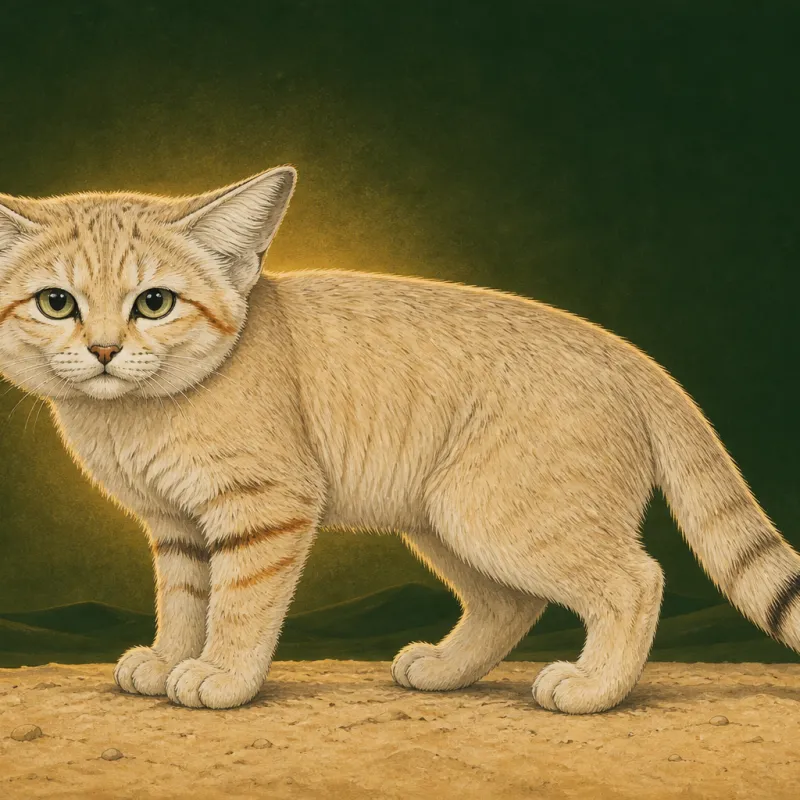
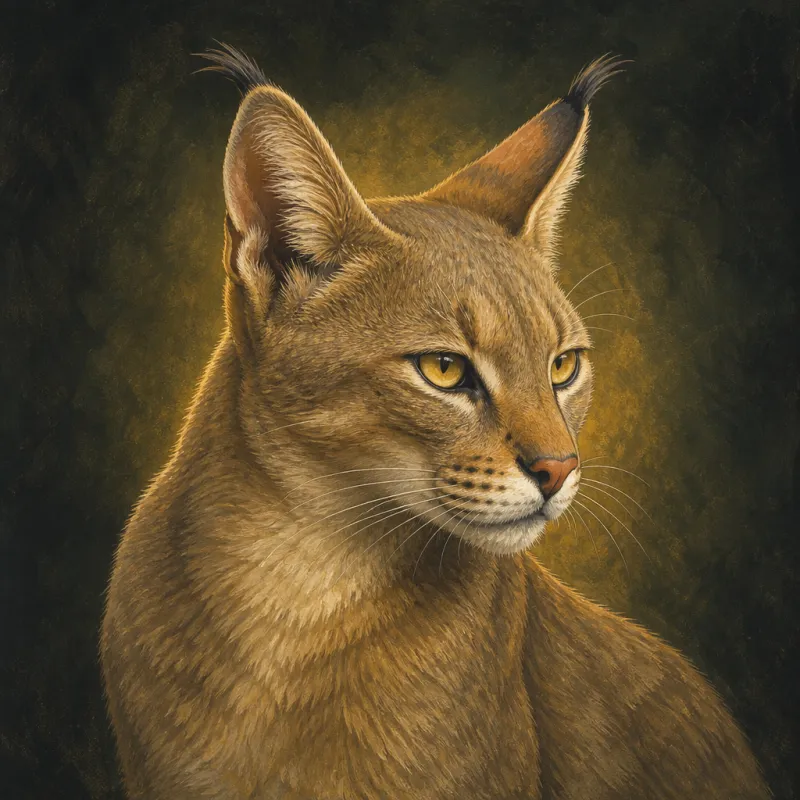
At a glance
- The jungle cat averages about 4 times the body mass of the sand cat.
- The two species occupy different habitat types with no overlap in our classification.
- Their ranges both include Africa and Asia.
- Both are currently listed as Least Concern on the Red List.
Identification
How each species is named and classified.
Sand Cat
Felis margarita
Jungle Cat
Felis chaus
Sand Cat
Felis
Jungle Cat
Felis
Sand Cat
Domestic cat lineage
Jungle Cat
Domestic cat lineage
Sand Cat
Small cats
Jungle Cat
Small cats
Sand Cat
Sand dune cat
Jungle Cat
Reed cat, Swamp cat
Body and movement
Published field measurements for adults. Ranges cover both sexes unless noted.
Sand Cat
15 in – 22 in (39–57 cm)
Jungle Cat
20 in – 3 ft 1 in (50–94 cm) Longer
Sand Cat
9 in – 14 in (23–35 cm) Longer
Jungle Cat
8 in – 14 in (20–36 cm)
Sand Cat
9 in – 12 in (24–30 cm)
Jungle Cat
14 in – 15 in (35–38 cm) Taller
Sand Cat
3–7.5 lb (1.35–3.4 kg)
One of the lightest cats of the Old World.
Jungle Cat
6.6–35 lb (3–16 kg) Heavier
Most adults fall between 4 and 8 kg; the largest records come from the north of the range.
Sand Cat
Not reliably measured
Not measured in the field.
Jungle Cat
Not reliably measured
Not measured in the field.
Life span
Typical adult longevity. Figures for managed care come from zoo and sanctuary records.
Sand Cat
8–10 years
Jungle Cat
10–12 years Longer
Sand Cat
12–14 years
Jungle Cat
15–20 years Longer
Habitat and range
Where each species lives and the conditions it tolerates.
Sand Cat
desert, semi-arid scrub
Sandy and stony desert with sparse vegetation, including dune fields, gravel plains and desert scrub where summer surface temperatures are extreme.
Jungle Cat
wetland, agricultural mosaic, grassland, dry forest
Reedbeds, marsh margins, tall grassland, riverine thickets and irrigated farmland; it avoids both rainforest and true desert.
Sand Cat
Africa, Asia
The Sahara from Morocco to Egypt, the Arabian Peninsula, and parts of Iran, Turkmenistan, Uzbekistan, Kazakhstan and Pakistan.
Jungle Cat
Asia, Africa
From Egypt and the Middle East through the Caucasus, Central Asia, India and Sri Lanka to southern China and mainland South East Asia.
Diet and behaviour
Feeding ecology, social organisation and hunting technique.
Sand Cat
small mammals, reptiles, birds, insects
Gerbils and jerboas dominate; the cat also takes lizards, snakes, birds and large insects, and gets most of its water from its food.
Jungle Cat
small mammals, birds, fish, reptiles
Rodents dominate, supplemented by waterbirds, fish, frogs, snakes and hares.
Sand Cat
Solitary
Shelters in burrows during the day, either dug itself or taken over from rodents and foxes, and can range widely over a single night.
Jungle Cat
Solitary
Solitary and territorial, though it is more visible than most small cats because it hunts in open cropland.
Sand Cat
Nocturnal
Almost entirely night active, avoiding daytime surface temperatures that would be lethal.
Jungle Cat
Crepuscular and partly diurnal
Active around dawn and dusk with substantial daytime hunting, particularly in winter and in undisturbed areas.
Sand Cat
Listening and digging
Locates prey by sound, often beneath the surface, then digs rapidly to reach burrowing rodents.
Jungle Cat
Active search in dense vegetation
Moves steadily through reeds and crops, flushing rodents and birds, and will wade into shallow water after fish and frogs.
Sand Cat
Limited
Its habitat contains few trees; the species is built for digging rather than climbing.
Jungle Cat
Capable More developed
Climbs when needed but hunts almost entirely on the ground.
Sand Cat
Very limited
Effectively never encounters standing water.
Jungle Cat
Strong More developed
Comfortable in water, swimming across channels and hunting in shallow marsh.
Conservation
Red List category, population direction and the pressures documented for each species.
Sand Cat
LC — Least Concern
Assessed 2016
Jungle Cat
LC — Least Concern
Assessed 2016
Sand Cat
Stable
Jungle Cat
Decreasing
Sand Cat
Degradation of desert vegetation by grazing, Off-road vehicle disturbance, Trapping for the pet trade, Killing by herding dogs, Very limited monitoring data
Assessed as Least Concern, though population data are sparse across an enormous and difficult range. Off-road vehicle traffic and trapping are known local pressures.
Jungle Cat
Wetland drainage, Agricultural intensification, Killing near poultry, Road mortality, Poisoning of rodent prey
Still widespread, but wetland drainage, intensified agriculture and killing near poultry have caused declines in the western part of the range, especially in Egypt and the Middle East.
Notable traits
Details that do not fit neatly into a measurement table.
Sand Cat
- It can survive for long periods without drinking, taking the water it needs from prey.
- Fur-covered footpads leave tracks that are almost impossible to read in soft sand.
- Field surveys often rely on night driving, because the species is otherwise practically invisible.
Jungle Cat
- Mummified jungle cats have been recovered from ancient Egyptian tombs.
- It is the largest species in the genus that also contains the domestic cat.
- Kittens show faint stripes that fade almost completely in adults.
Sources used for this comparison
- IUCN Red List of Threatened Species Global assessment categories, population trends and documented threats.
- IUCN SSC Cat Specialist Group Species accounts, distribution notes and Cat News reporting for every wild felid.
- Small Wild Cat Conservation Foundation Dedicated research and field reporting on the lesser-known felids.
- Animal Diversity Web, University of Michigan Museum of Zoology Reviewed species accounts with morphometric ranges and reproductive data.
- National Geographic — Animals General natural-history reference for behaviour, range and ecology.