High-altitude Asian cats
Pallas's Cat vs Chinese Mountain Cat
Both live at high altitude in central Asia, both depend on pikas, and both are threatened by the same rodent control programmes.
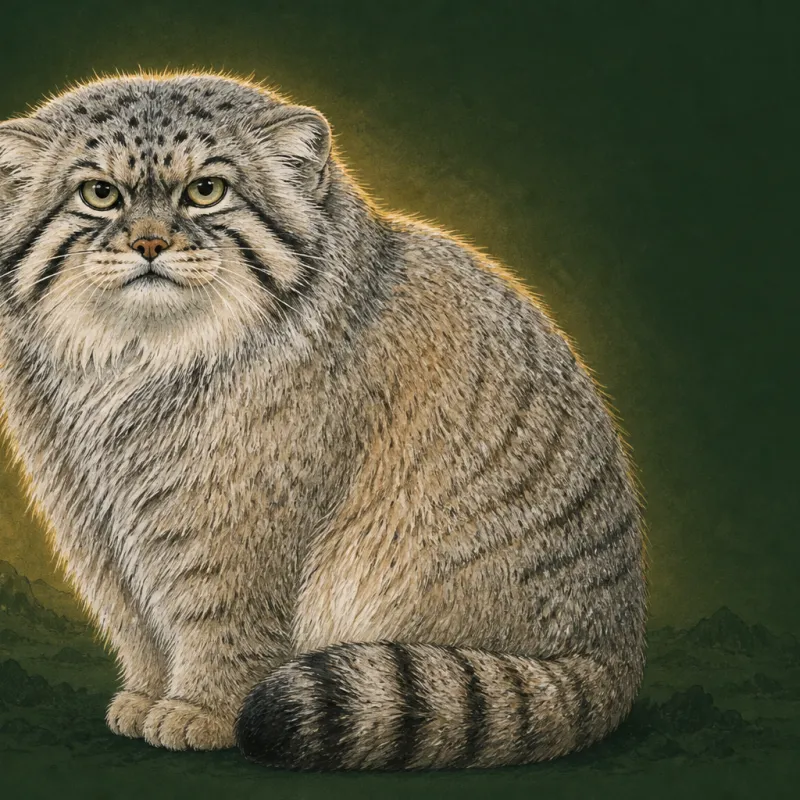
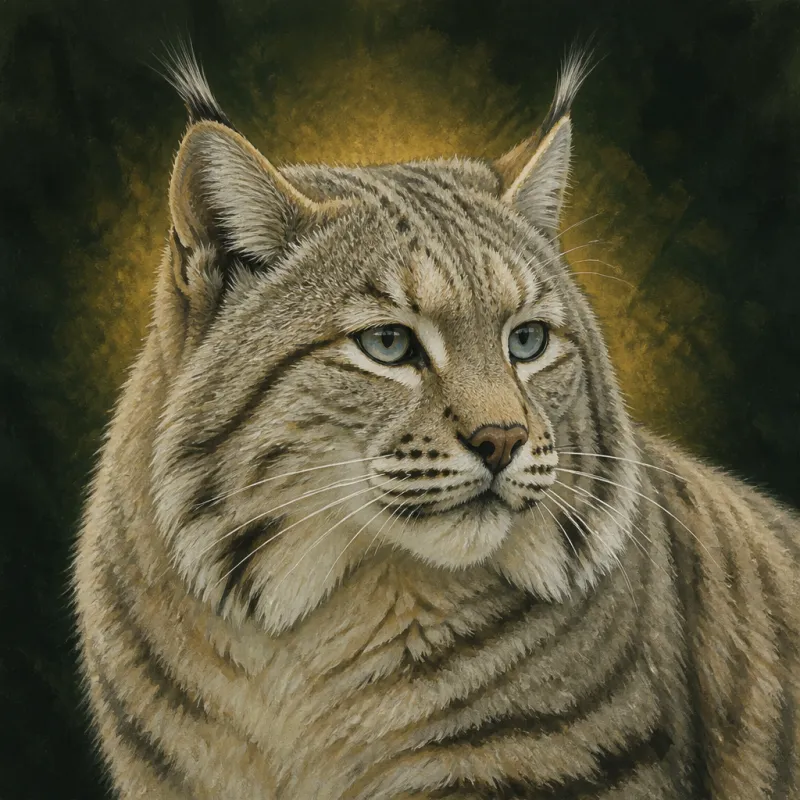
At a glance
- The chinese mountain cat averages about 2.2 times the body mass of the pallas's cat.
- Both species use steppe and rocky alpine.
- Their ranges both include Asia.
- Red List categories differ: Pallas's Cat is listed as Least Concern, Chinese Mountain Cat as Vulnerable.
Similar niche, different build
The Pallas's cat is short-legged and stocky, with the densest coat of any felid relative to its size and ears set low on a flattened skull, letting it peer over rock without exposing itself. The Chinese mountain cat is longer-bodied and taller, with a plainer sandy coat and prominent ear tufts.
Both animals look considerably heavier than they are, an illusion created by very thick winter fur.
A shared dependence on pikas
Plateau pikas and other small burrowing mammals form the core of both diets, and both cats use rodent burrows and rock crevices for shelter. That dependence makes large-scale poisoning campaigns aimed at pikas a direct threat, removing food and denning sites at the same time.
The Pallas's cat has by far the larger range, extending from Iran and the Caucasus across Central Asia to Mongolia, China and southern Russia. The Chinese mountain cat is endemic to a small part of the eastern Tibetan Plateau.
How little is known
Neither species is well studied. The first photographs of a wild Chinese mountain cat date from 2007, and range-wide status work on the manul only became coordinated in the last decade. Hybridisation with village cats has been confirmed for the Chinese mountain cat.
What to take away
- The Pallas's cat is stockier and far more widely distributed.
- Both depend on pikas for food and on burrows for shelter.
- Rodent poisoning programmes are the clearest shared threat.
Identification
How each species is named and classified.
Pallas's Cat
Otocolobus manul
Chinese Mountain Cat
Felis bieti
Pallas's Cat
Otocolobus
Chinese Mountain Cat
Felis
Pallas's Cat
Leopard cat lineage
Chinese Mountain Cat
Domestic cat lineage
Pallas's Cat
Small cats
Chinese Mountain Cat
Small cats
Pallas's Cat
Manul, Steppe cat
Chinese Mountain Cat
Chinese desert cat, Chinese steppe cat
Body and movement
Published field measurements for adults. Ranges cover both sexes unless noted.
Pallas's Cat
18 in – 2 ft 2 in (46–65 cm)
Chinese Mountain Cat
24 in – 2 ft 9 in (60–85 cm) Longer
Pallas's Cat
8 in – 12 in (21–31 cm)
Chinese Mountain Cat
11 in – 16 in (29–41 cm) Longer
Pallas's Cat
11 in – 13 in (28–32 cm)
Chinese Mountain Cat
11 in – 13 in (28–34 cm) Taller
Pallas's Cat
5.5–9.9 lb (2.5–4.5 kg)
The heavy coat makes the animal look considerably larger than it is.
Chinese Mountain Cat
14–20 lb (6.5–9 kg) Heavier
Based on a small number of measured animals.
Pallas's Cat
Not reliably measured
Not measured; the species relies on concealment rather than escape speed.
Chinese Mountain Cat
Not reliably measured
Not measured in the field.
Life span
Typical adult longevity. Figures for managed care come from zoo and sanctuary records.
Pallas's Cat
8–11 years Longer
Chinese Mountain Cat
8–10 years
Pallas's Cat
11–14 years Longer
Chinese Mountain Cat
10–14 years
Habitat and range
Where each species lives and the conditions it tolerates.
Pallas's Cat
steppe, rocky alpine, semi-arid scrub, desert
Cold, dry grassland, rocky outcrops and mountain steppe up to about 17,000 feet, where winter temperatures fall far below freezing and snow cover stays shallow.
Chinese Mountain Cat
steppe, rocky alpine, grassland
Alpine meadow, steppe and shrubland on the eastern Tibetan Plateau, generally in open country with rodent colonies rather than in true desert.
Pallas's Cat
Asia
Mongolia, China, Russia, Kazakhstan, Kyrgyzstan, Tajikistan, Afghanistan, Pakistan, Iran, and parts of the Caucasus and northern India.
Chinese Mountain Cat
Asia
Endemic to China, with confirmed records from Qinghai, Sichuan and Gansu provinces.
Diet and behaviour
Feeding ecology, social organisation and hunting technique.
Pallas's Cat
small mammals, birds, insects
Pikas and voles form the core of the diet; ground birds, marmots and insects are taken opportunistically.
Chinese Mountain Cat
small mammals, birds
Plateau pikas and zokors form the core of the diet, along with voles and ground birds.
Pallas's Cat
Solitary
Shelters in rock crevices and abandoned marmot burrows, and depends on those refuges both for cover and for raising kittens.
Chinese Mountain Cat
Solitary
Dens in burrows on grassland slopes; observations remain few, and much of the species' behaviour is still undocumented.
Pallas's Cat
Crepuscular and cathemeral
Most active around dawn and dusk, but activity shifts through the day in cold weather and near pika colonies.
Chinese Mountain Cat
Nocturnal and crepuscular
Most records come from dusk and night hours, matching pika and rodent activity.
Pallas's Cat
Stalk and ambush at burrow entrances
The cat waits beside pika holes or creeps along rock lines, using cover rather than speed to close the distance.
Chinese Mountain Cat
Listening and digging at burrows
Hunts by locating rodents acoustically in open grassland and digging them out.
Pallas's Cat
Limited
Heavy-bodied and short-legged; it scrambles over rock but is not an agile climber.
Chinese Mountain Cat
Limited
A ground-dwelling cat in a largely treeless landscape.
Pallas's Cat
Very limited
Occupies dry, cold habitats and avoids water.
Chinese Mountain Cat
Very limited
No notable association with water.
Conservation
Red List category, population direction and the pressures documented for each species.
Pallas's Cat
LC — Least Concern
Assessed 2020
Chinese Mountain Cat
VU — Vulnerable
Assessed 2015
Pallas's Cat
Decreasing
Chinese Mountain Cat
Decreasing
Pallas's Cat
Rodent poisoning campaigns, Loss of marmot burrows used as dens, Killing by herding dogs, Trapping and incidental snaring, Overgrazing of steppe habitat
A wide range keeps the global category low, but the species is naturally sparse everywhere, and the loss of marmots and pikas to poisoning campaigns removes both prey and shelter.
Chinese Mountain Cat
Poisoning campaigns against plateau pikas, Hybridisation with domestic cats, Grassland degradation, Killing by herding dogs, Very small known range
A small range and dependence on plateau pikas make this cat vulnerable to large-scale rodent poisoning programmes. Interbreeding with free-ranging domestic cats has also been documented.
Notable traits
Details that do not fit neatly into a measurement table.
Pallas's Cat
- It has round pupils rather than the vertical slits typical of small cats.
- Kittens are highly susceptible to toxoplasmosis outside their native range, a long-standing problem in zoos.
- Its coat contains more hairs per square inch than that of any other felid.
Chinese Mountain Cat
- The first photographs of a wild individual were obtained only in 2007.
- Genetic work has confirmed hybridisation with village cats on the plateau.
- Its dense coat and heavily furred ears are adaptations to sustained sub-freezing temperatures.
Sources used for this comparison
- IUCN Red List of Threatened Species Global assessment categories, population trends and documented threats.
- IUCN SSC Cat Specialist Group Species accounts, distribution notes and Cat News reporting for every wild felid.
- PICA — Pallas's Cat International Conservation Alliance Range-wide status review and field ecology of the Pallas's cat.
- Small Wild Cat Conservation Foundation Dedicated research and field reporting on the lesser-known felids.
- Animal Diversity Web, University of Michigan Museum of Zoology Reviewed species accounts with morphometric ranges and reproductive data.
- Wildlife Conservation Society Field programmes, camera-trap surveys and population monitoring.