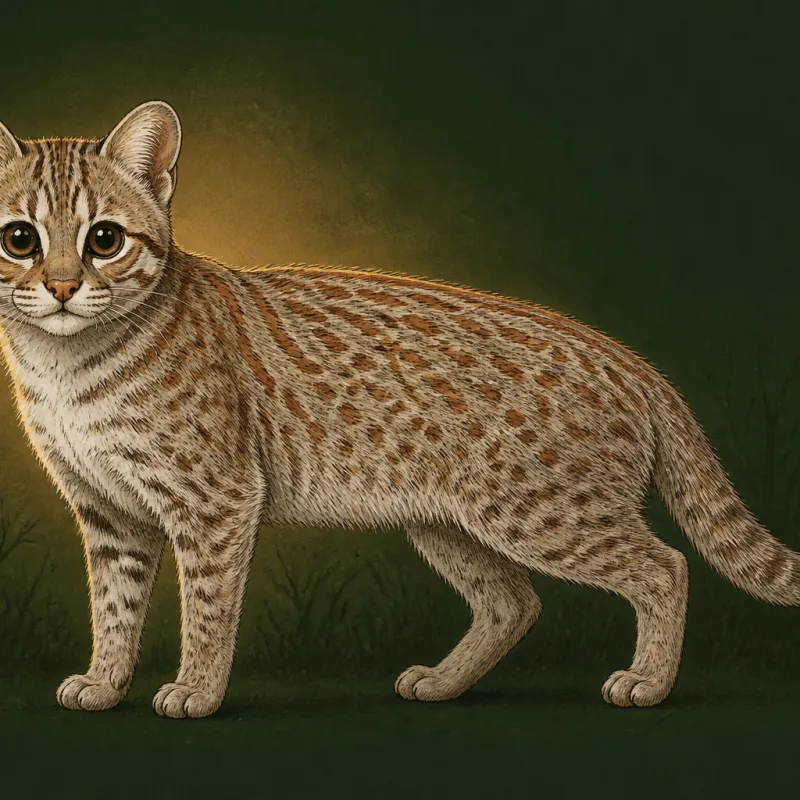
An adult rusty-spotted cat is roughly half the size of a domestic cat, with a short greyish coat marked by rows of rust-coloured blotches along the back and flanks.
Despite its size it is an assured hunter and climber, and it turns up in a wide range of settings — from dry deciduous forest to scrub, bamboo and the edges of villages, where it sometimes shelters in abandoned buildings.
Size and measurements
| Head-body length | 14 in – 19 in (35–48 cm) |
|---|---|
| Tail length | 6 in – 12 in (15–30 cm) |
| Shoulder height | 7 in – 9 in (17–22 cm) |
| Body weight | 2–3.5 lb (0.9–1.6 kg) — Among the lightest of all wild cats. |
| Top recorded speed | Not reliably measured — Not measured in the field. |
| Lifespan in the wild | 8–10 years |
| Lifespan under human care | 12–14 years |
Habitat and range
Deciduous forest, scrub, grassland with rock cover, bamboo and cultivated land; it is not restricted to dense forest as was once believed.
Most of India, plus Sri Lanka and the Nepalese terai, with scattered records extending the known range in recent decades.
Diet and hunting
Rodents and small birds dominate, with lizards, frogs and insects taken regularly.
Hunting strategy — Rapid ground and tree hunting. Hunts small prey with quick rushes, and readily follows rodents and birds into trees.
Behaviour and activity
Solitary. Nocturnal and secretive; most records come from camera traps, road surveys and occasional rescues of kittens from farmland.
Nocturnal. Almost entirely night active, sheltering by day in tree hollows, rock crevices and abandoned structures.
Climbing and swimming
Climbing — Exceptional. Extremely agile in trees for its size, using branches for both hunting and shelter.
Swimming — Very limited. Little recorded association with water.
Conservation status
The Rusty-spotted Cat is currently listed as Near Threatened on the IUCN Red List, with a population trend recorded as decreasing in the assessment published in 2016.
Assessed as Near Threatened. Habitat conversion is the leading pressure, though records from farmland suggest more tolerance of modified landscapes than previously assumed.
Documented threats
- Conversion of scrub and forest to cropland
- Road mortality
- Killing near poultry
- Trapping and pet trade
- Predation by domestic dogs
Look up the current Red List assessment for Prionailurus rubiginosus
Notable traits
- It competes with the black-footed cat for the title of the world's smallest wild cat.
- Kittens are often mistaken for domestic kittens when found near villages.
- Its known range has expanded considerably as camera trapping has spread across India.
Sources for this profile
- IUCN Red List of Threatened Species Global assessment categories, population trends and documented threats.
- IUCN SSC Cat Specialist Group Species accounts, distribution notes and Cat News reporting for every wild felid.
- Small Wild Cat Conservation Foundation Dedicated research and field reporting on the lesser-known felids.
- Animal Diversity Web, University of Michigan Museum of Zoology Reviewed species accounts with morphometric ranges and reproductive data.
- National Geographic — Animals General natural-history reference for behaviour, range and ecology.