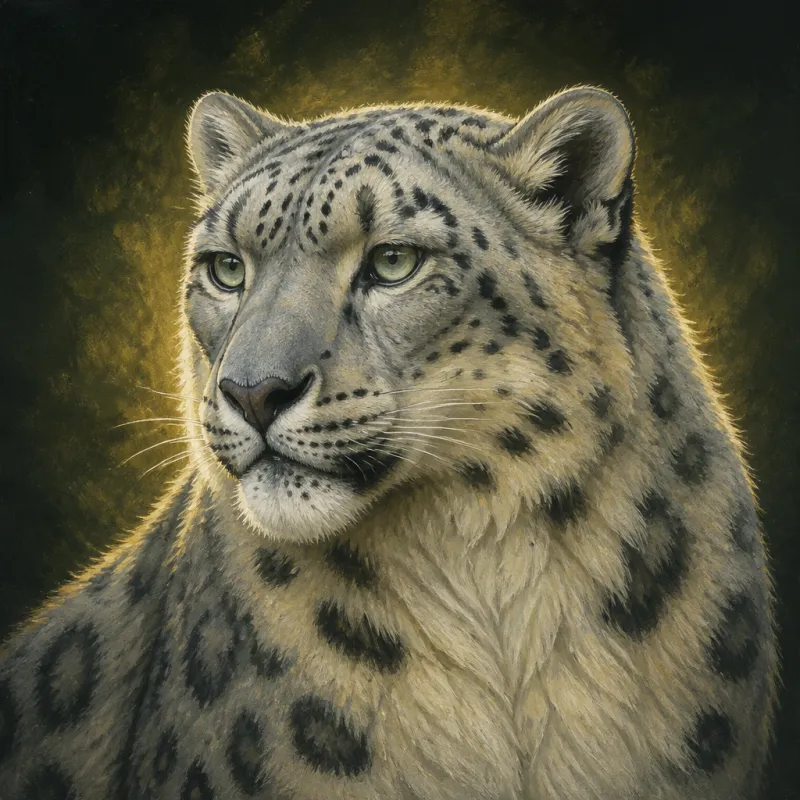
Everything about the snow leopard is tuned to steep, cold, oxygen-poor terrain. Enlarged nasal cavities warm thin air, dense underfur and a smoky rosette pattern provide insulation and concealment on rock, and broad, fur-covered paws spread weight on snow.
The tail is the species' signature: thick, heavily furred and used both as a counterweight on cliff faces and as a wrap for the face when resting in cold wind.
Size and measurements
| Head-body length | 2 ft 10 in – 4 ft 1 in (86–125 cm) |
|---|---|
| Tail length | 2 ft 7 in – 3 ft 5 in (80–105 cm) |
| Shoulder height | 22 in – 2 ft 2 in (55–65 cm) |
| Body weight | 49–121 lb (22–55 kg) — Males average roughly a third heavier than females. |
| Top recorded speed | 34 mph (55 km/h) — Rarely measured in the field; the species relies on terrain, not pursuit. |
| Lifespan in the wild | 10–12 years |
| Lifespan under human care | 18–22 years |
Habitat and range
Broken cliff, ridgeline and alpine meadow, generally between 9,800 and 17,000 feet in the Himalaya, and considerably lower in the northern part of the range where treeline is lower.
Twelve range countries across the Himalaya, Karakoram, Pamir, Tien Shan, Altai and Sayan mountains, including China, Mongolia, India, Nepal, Pakistan, Kyrgyzstan, Kazakhstan and Russia.
Diet and hunting
Blue sheep and Siberian ibex are the staples across most of the range, supplemented by argali, marmots, pikas, hares and gamebirds.
Hunting strategy — Ambush from above on broken ground. The cat uses cliffs and gullies to approach unseen, then charges downhill; leaps of several body lengths across rock are routine.
Behaviour and activity
Solitary. Home ranges are very large, reflecting low prey density; individuals mark travel routes along ridgelines with scrapes and scent. Snow leopards cannot roar.
Crepuscular. Movement peaks at dawn and dusk, matching the activity of mountain ungulates, with resting sites chosen for a view over approach routes.
Climbing and swimming
Climbing — Exceptional. Superb on rock and scree, using the long tail for balance on narrow ledges. Tree climbing is largely irrelevant in its habitat.
Swimming — Very limited. Rarely recorded in water; the species occupies cold, mostly frozen catchments where swimming offers no advantage.
Conservation status
The Snow Leopard is currently listed as Vulnerable on the IUCN Red List, with a population trend recorded as decreasing in the assessment published in 2017.
Reclassified from Endangered to Vulnerable in 2017 after improved survey data, though the assessment stressed that the change reflected better information rather than population recovery.
Documented threats
- Retaliatory killing after livestock loss
- Poaching for pelts and bones
- Prey depletion from competition with livestock
- Mining and linear infrastructure
- Climate-driven treeline shift
Look up the current Red List assessment for Panthera uncia
Notable traits
- Snow leopards lack the specialised vocal anatomy of roaring cats and instead produce a wailing call known as a "yowl".
- Their tails can measure close to ninety per cent of head-body length, proportionally the longest of any big cat.
- Camera-trap and genetic surveys still cover only a fraction of the species' vast, difficult range.
Sources for this profile
- IUCN Red List of Threatened Species Global assessment categories, population trends and documented threats.
- IUCN SSC Cat Specialist Group Species accounts, distribution notes and Cat News reporting for every wild felid.
- Snow Leopard Trust Long-term ecological study of snow leopards and high-mountain prey systems.
- Panthera Field research programmes and species profiles for big and small wild cats.
- World Wildlife Fund Range descriptions, threat summaries and conservation programme reporting.