Species comparison
African Wildcat vs Cheetah
A side-by-side look at Felis lybica and Acinonyx jubatus across body measurements, habitat, diet, behaviour and conservation status.
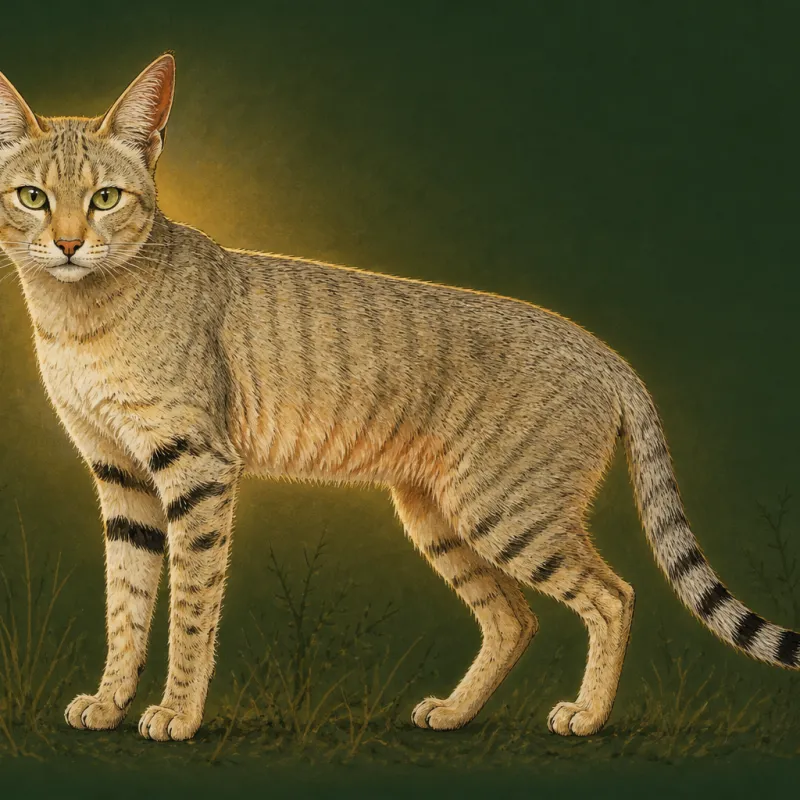
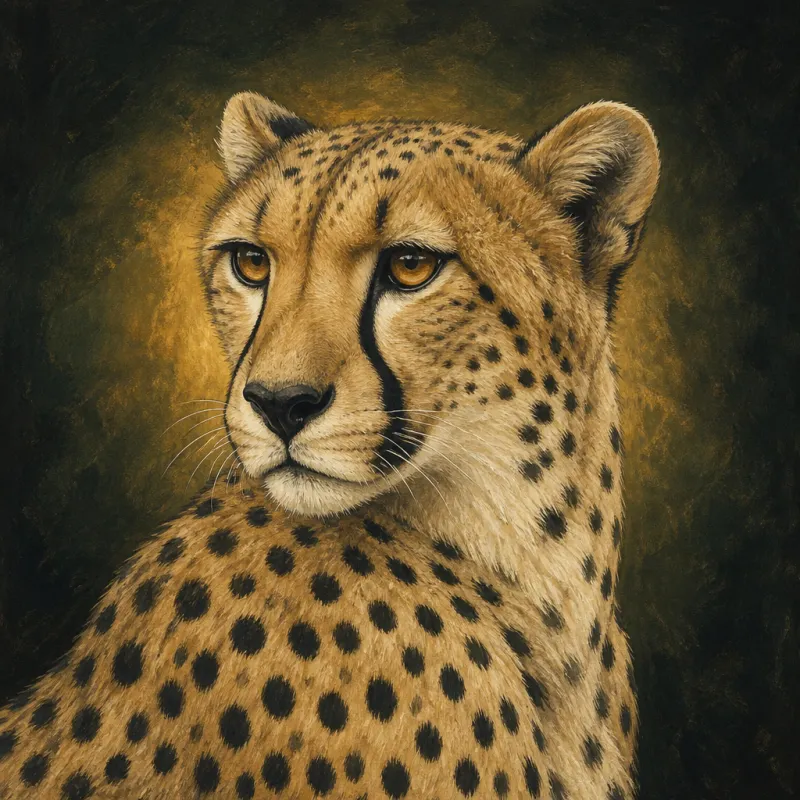
At a glance
- The cheetah averages about 9.8 times the body mass of the african wildcat.
- Both species use savanna and semi-arid scrub.
- Their ranges both include Africa and Asia.
- Red List categories differ: African Wildcat is listed as Least Concern, Cheetah as Vulnerable.
Identification
How each species is named and classified.
African Wildcat
Felis lybica
Cheetah
Acinonyx jubatus
African Wildcat
Felis
Cheetah
Acinonyx
African Wildcat
Domestic cat lineage
Cheetah
Puma lineage
African Wildcat
Small cats
Cheetah
Big cats
African Wildcat
Near Eastern wildcat, Asiatic wildcat
Cheetah
Asiatic cheetah, Hunting leopard
Body and movement
Published field measurements for adults. Ranges cover both sexes unless noted.
African Wildcat
18 in – 2 ft 6 in (45–75 cm)
Cheetah
3 ft 8 in – 4 ft 11 in (112–150 cm) Longer
African Wildcat
10 in – 15 in (25–38 cm)
Cheetah
24 in – 2 ft 9 in (60–84 cm) Longer
African Wildcat
13 in – 15 in (32–38 cm)
Cheetah
2 ft 4 in – 2 ft 11 in (70–90 cm) Taller
African Wildcat
6.6–14 lb (3–6.5 kg)
Males average about a kilogram heavier than females.
Cheetah
46–159 lb (21–72 kg) Heavier
Most adults fall between 34 and 54 kg; males average slightly heavier.
African Wildcat
Not reliably measured
Not measured in the field.
Cheetah
58 mph (93 km/h)
Highest speed recorded on wild hunting cheetahs with GPS collars; captive sprint trials have reached about 98 km/h.
Life span
Typical adult longevity. Figures for managed care come from zoo and sanctuary records.
African Wildcat
8–12 years
Cheetah
8–12 years
African Wildcat
15–17 years Longer
Cheetah
12–17 years
Habitat and range
Where each species lives and the conditions it tolerates.
African Wildcat
savanna, semi-arid scrub, dry forest, grassland, agricultural mosaic
Almost every habitat in Africa except rainforest interior and the driest sand seas, plus scrub and steppe across the Middle East and Central Asia.
Cheetah
savanna, grassland, semi-arid scrub, dry forest
Open and semi-open country with clear sightlines and firm footing. Cheetahs also persist in arid landscapes such as the Sahel and the Iranian desert steppe, where they range enormously to find prey.
African Wildcat
Africa, Asia
Across Africa outside the Congo rainforest, and through the Arabian Peninsula, the Middle East, Central Asia and into western India and China.
Cheetah
Africa, Asia
Fragmented populations in eastern and southern Africa, small remnants in North and West Africa, and a critically small Asiatic population confined to central Iran.
Diet and behaviour
Feeding ecology, social organisation and hunting technique.
African Wildcat
small mammals, birds, reptiles, insects
Rodents form the great majority of the diet, with birds, lizards and insects making up the remainder.
Cheetah
medium ungulates, hares, birds
Thomson's gazelle, springbok, impala, duiker and hares; prey usually weighs less than the cheetah itself, since large animals are too risky to restrain.
African Wildcat
Solitary
Solitary and territorial, though tolerant of human settlement — the same trait that started the domestication process.
Cheetah
Females solitary; males form coalitions
Females raise cubs alone across very large ranges, while related males often hold territory in permanent groups of two or three. Cheetahs do not roar; they chirp, purr and stutter.
African Wildcat
Nocturnal and crepuscular
Mostly active from dusk to dawn, resting by day in burrows, thickets and rock crevices.
Cheetah
Diurnal
Hunting concentrates in the early morning and late afternoon, avoiding both midday heat and the night-time activity of larger competitors.
African Wildcat
Stalk and pounce on rodents
Hunts by walking slowly through cover, freezing at sounds and finishing with a short rush.
Cheetah
High-speed pursuit in the open
The cat approaches to within roughly 200 feet, then sprints, using the tail as a rudder to match the prey's turns before knocking it off balance with a dewclaw and applying a throat bite.
African Wildcat
Strong More developed
Climbs well and uses trees for escape and rest.
Cheetah
Limited
Cheetahs use sloping trunks and termite mounds as lookouts but cannot climb vertical trunks the way leopards do.
African Wildcat
Very limited
Avoids water, in common with most arid-country cats.
Cheetah
Very limited
Avoids water and swims only under compulsion.
Conservation
Red List category, population direction and the pressures documented for each species.
African Wildcat
LC — Least Concern
Assessed 2022
Cheetah
VU — Vulnerable
Assessed 2021
African Wildcat
Decreasing
Cheetah
Decreasing
African Wildcat
Hybridisation with domestic cats, Disease transmitted by domestic cats, Habitat conversion, Persecution near poultry, Road mortality
The species remains widespread, but genetic mixing with free-ranging domestic cats is eroding wild populations, particularly near settlements. Pure wild-type populations are increasingly restricted to remote areas.
Cheetah
Loss of open habitat and prey, Conflict with livestock farming, Illegal live-cub trade, Very large area requirements, Low genetic diversity
The species occupies a small fraction of its historical range, and a large share of the remaining population lives outside protected areas, which makes conflict with livestock owners a central conservation issue.
Notable traits
Details that do not fit neatly into a measurement table.
African Wildcat
- All domestic cats descend from this species, not from the European wildcat.
- Wild individuals sit with a distinctly upright posture that helps separate them from feral tabbies.
- Genetic screening is now a standard part of conservation work, since appearance alone cannot confirm a pure wild animal.
Cheetah
- Acceleration is the more remarkable statistic: cheetahs can add roughly 6 mph per stride during the first three strides.
- Semi-retractable claws work like sprinting spikes and stay blunt from constant ground contact.
- The Asiatic cheetah in Iran is one of the rarest large mammals on Earth, with only a few dozen animals confirmed.
Sources used for this comparison
- IUCN Red List of Threatened Species Global assessment categories, population trends and documented threats.
- IUCN SSC Cat Specialist Group Species accounts, distribution notes and Cat News reporting for every wild felid.
- Small Wild Cat Conservation Foundation Dedicated research and field reporting on the lesser-known felids.
- Animal Diversity Web, University of Michigan Museum of Zoology Reviewed species accounts with morphometric ranges and reproductive data.
- National Geographic — Animals General natural-history reference for behaviour, range and ecology.
- Cheetah Conservation Fund Research on cheetah biology, speed measurement and human-wildlife conflict.
- Panthera Field research programmes and species profiles for big and small wild cats.
- Smithsonian's National Zoo and Conservation Biology Institute Body measurements, longevity records and life-history notes.