Species comparison
Caracal vs Pallas's Cat
A side-by-side look at Caracal caracal and Otocolobus manul across body measurements, habitat, diet, behaviour and conservation status.
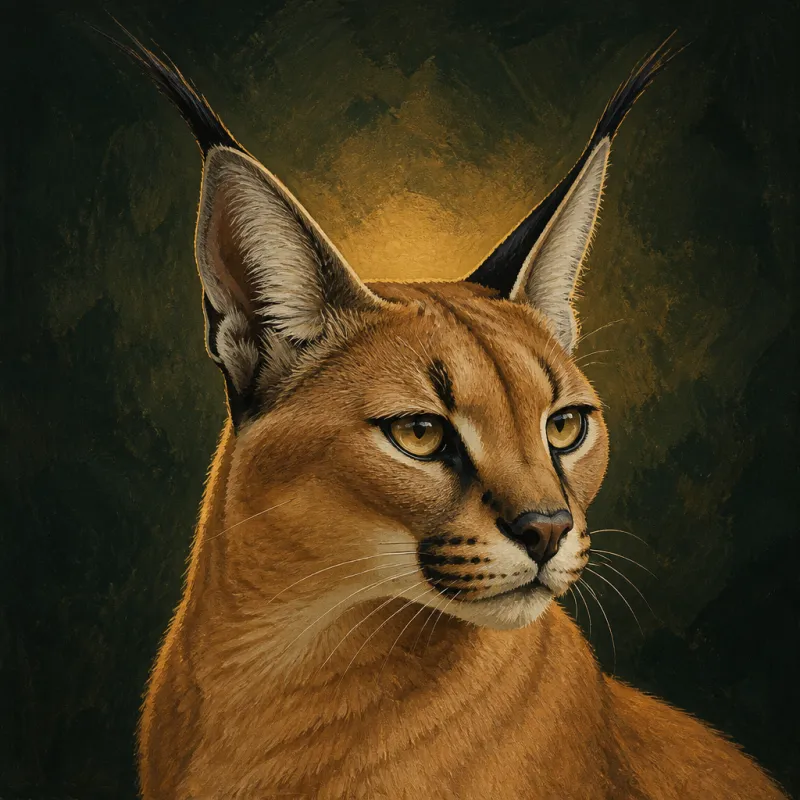
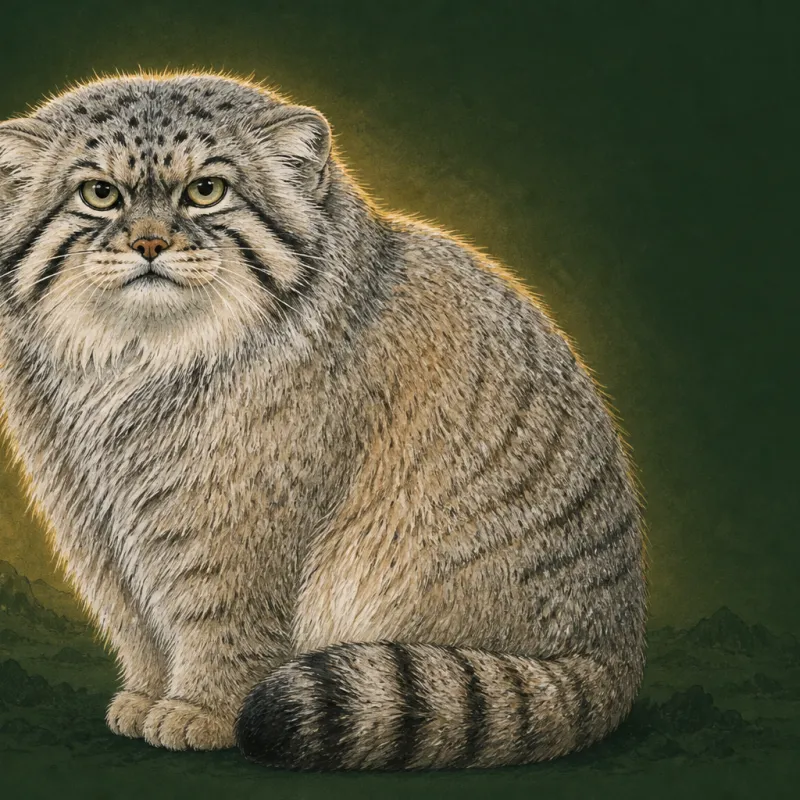
At a glance
- The caracal averages about 3.7 times the body mass of the pallas's cat.
- Both species use semi-arid scrub and desert.
- Their ranges both include Asia.
- Both are currently listed as Least Concern on the Red List.
Identification
How each species is named and classified.
Caracal
Caracal caracal
Pallas's Cat
Otocolobus manul
Caracal
Caracal
Pallas's Cat
Otocolobus
Caracal
Caracal lineage
Pallas's Cat
Leopard cat lineage
Caracal
Medium-sized cats
Pallas's Cat
Small cats
Caracal
Desert lynx, Persian lynx
Pallas's Cat
Manul, Steppe cat
Body and movement
Published field measurements for adults. Ranges cover both sexes unless noted.
Caracal
2 ft – 3 ft (62–91 cm) Longer
Pallas's Cat
18 in – 2 ft 2 in (46–65 cm)
Caracal
7 in – 13 in (18–34 cm)
Pallas's Cat
8 in – 12 in (21–31 cm)
Caracal
16 in – 20 in (40–50 cm) Taller
Pallas's Cat
11 in – 13 in (28–32 cm)
Caracal
15–42 lb (7–19 kg) Heavier
Males average noticeably heavier than females across the range.
Pallas's Cat
5.5–9.9 lb (2.5–4.5 kg)
The heavy coat makes the animal look considerably larger than it is.
Caracal
50 mph (80 km/h)
Short sprints over open ground; the species is better known for vertical leaping than for sustained speed.
Pallas's Cat
Not reliably measured
Not measured; the species relies on concealment rather than escape speed.
Life span
Typical adult longevity. Figures for managed care come from zoo and sanctuary records.
Caracal
10–12 years Longer
Pallas's Cat
8–11 years
Caracal
16–19 years Longer
Pallas's Cat
11–14 years
Habitat and range
Where each species lives and the conditions it tolerates.
Caracal
semi-arid scrub, savanna, dry forest, desert, montane forest
Dry woodland, scrub, semi-desert and rocky hills; caracals avoid true desert interiors and dense equatorial rainforest but do well on farmland margins.
Pallas's Cat
steppe, rocky alpine, semi-arid scrub, desert
Cold, dry grassland, rocky outcrops and mountain steppe up to about 17,000 feet, where winter temperatures fall far below freezing and snow cover stays shallow.
Caracal
Africa, Asia
Widespread across Africa outside the Sahara core and Congo rainforest, and through the Arabian Peninsula, the Middle East, Central Asia and into north-western India.
Pallas's Cat
Asia
Mongolia, China, Russia, Kazakhstan, Kyrgyzstan, Tajikistan, Afghanistan, Pakistan, Iran, and parts of the Caucasus and northern India.
Diet and behaviour
Feeding ecology, social organisation and hunting technique.
Caracal
small mammals, birds, hares, medium ungulates
Hyrax, hares, rodents and gamebirds form the bulk of the diet, with small antelope taken by larger individuals.
Pallas's Cat
small mammals, birds, insects
Pikas and voles form the core of the diet; ground birds, marmots and insects are taken opportunistically.
Caracal
Solitary and territorial
Adults hold large ranges and are rarely seen; they are among the most successful cats at persisting in farmed landscapes, which brings them into conflict with sheep farmers.
Pallas's Cat
Solitary
Shelters in rock crevices and abandoned marmot burrows, and depends on those refuges both for cover and for raising kittens.
Caracal
Nocturnal
Almost entirely night active where persecuted; more crepuscular activity is recorded inside protected areas.
Pallas's Cat
Crepuscular and cathemeral
Most active around dawn and dusk, but activity shifts through the day in cold weather and near pika colonies.
Caracal
Stalk and vertical leap
The caracal creeps close, then launches; birds flushing from cover are struck in mid-air, sometimes several feet above the ground.
Pallas's Cat
Stalk and ambush at burrow entrances
The cat waits beside pika holes or creeps along rock lines, using cover rather than speed to close the distance.
Caracal
Strong More developed
Climbs well and will cache food in trees, though it hunts on the ground.
Pallas's Cat
Limited
Heavy-bodied and short-legged; it scrambles over rock but is not an agile climber.
Caracal
Limited More developed
Occupies dry country and rarely encounters, or enters, deep water.
Pallas's Cat
Very limited
Occupies dry, cold habitats and avoids water.
Conservation
Red List category, population direction and the pressures documented for each species.
Caracal
LC — Least Concern
Assessed 2016
Pallas's Cat
LC — Least Concern
Assessed 2020
Caracal
Stable
Pallas's Cat
Decreasing
Caracal
Killing in response to livestock losses, Habitat conversion in Asia, Road mortality near cities, Trade as exotic pets, Depletion of small-mammal prey
Widespread and reasonably secure in Africa; populations in Central Asia and North Africa are much smaller and are considered at risk locally.
Pallas's Cat
Rodent poisoning campaigns, Loss of marmot burrows used as dens, Killing by herding dogs, Trapping and incidental snaring, Overgrazing of steppe habitat
A wide range keeps the global category low, but the species is naturally sparse everywhere, and the loss of marmots and pikas to poisoning campaigns removes both prey and shelter.
Notable traits
Details that do not fit neatly into a measurement table.
Caracal
- The name derives from a Turkish word meaning "black ear".
- Caracals were historically trained in Persia and India to hunt birds, a practice recorded for centuries.
- Urban caracals on the Cape Peninsula in South Africa are the subject of a long-running research programme.
Pallas's Cat
- It has round pupils rather than the vertical slits typical of small cats.
- Kittens are highly susceptible to toxoplasmosis outside their native range, a long-standing problem in zoos.
- Its coat contains more hairs per square inch than that of any other felid.
Sources used for this comparison
- IUCN Red List of Threatened Species Global assessment categories, population trends and documented threats.
- IUCN SSC Cat Specialist Group Species accounts, distribution notes and Cat News reporting for every wild felid.
- Panthera Field research programmes and species profiles for big and small wild cats.
- Small Wild Cat Conservation Foundation Dedicated research and field reporting on the lesser-known felids.
- Animal Diversity Web, University of Michigan Museum of Zoology Reviewed species accounts with morphometric ranges and reproductive data.
- PICA — Pallas's Cat International Conservation Alliance Range-wide status review and field ecology of the Pallas's cat.