Species comparison
Fishing Cat vs Leopard Cat
A side-by-side look at Prionailurus viverrinus and Prionailurus bengalensis across body measurements, habitat, diet, behaviour and conservation status.
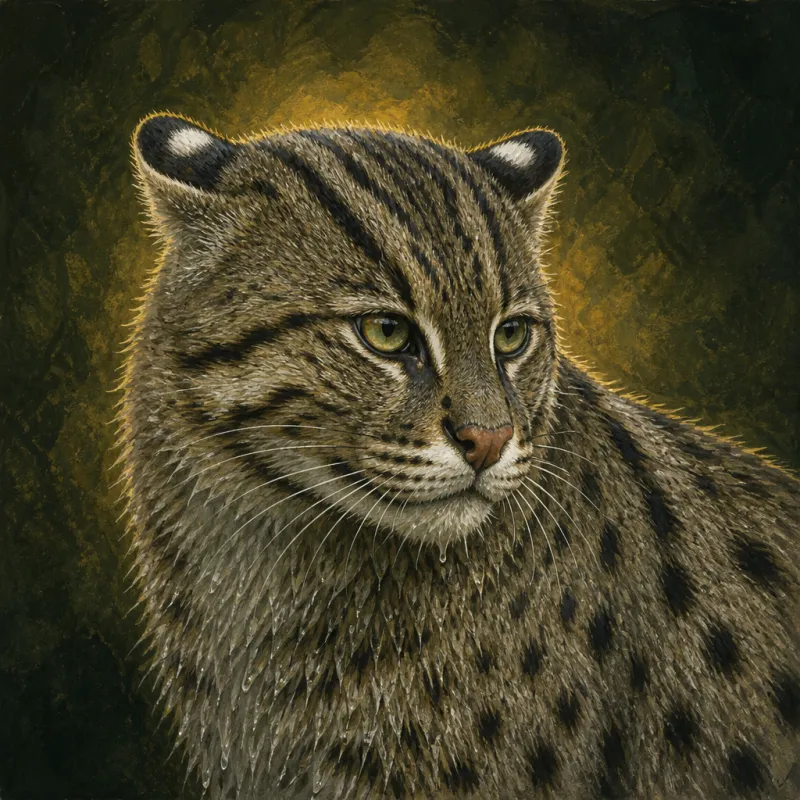
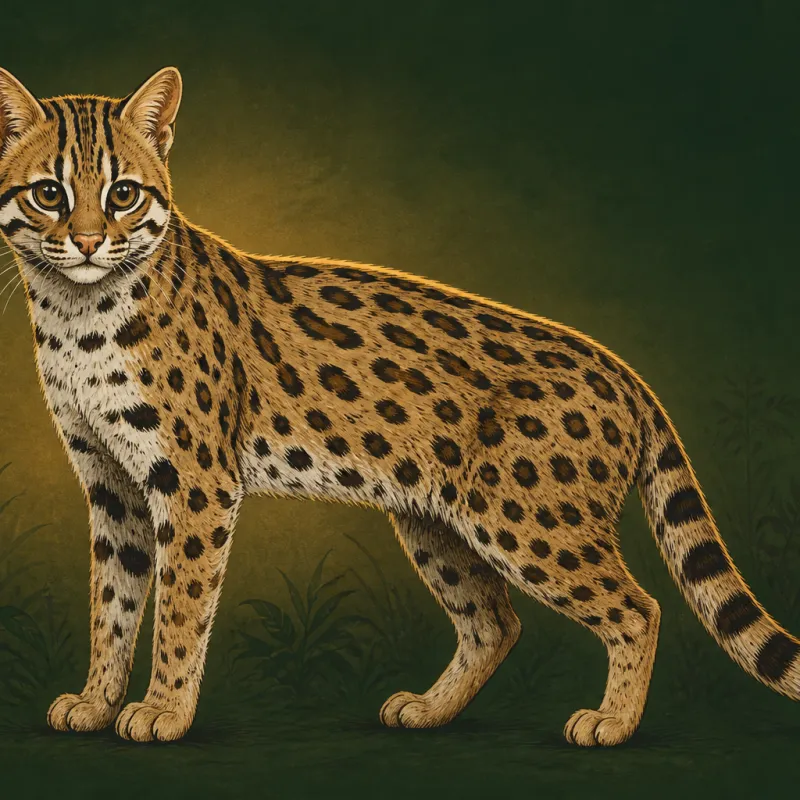
At a glance
- The fishing cat averages about 2.6 times the body mass of the leopard cat.
- Both species use agricultural mosaic and tropical rainforest.
- Their ranges both include Asia.
- Red List categories differ: Fishing Cat is listed as Vulnerable, Leopard Cat as Least Concern.
Identification
How each species is named and classified.
Fishing Cat
Prionailurus viverrinus
Leopard Cat
Prionailurus bengalensis
Fishing Cat
Prionailurus
Leopard Cat
Prionailurus
Fishing Cat
Leopard cat lineage
Leopard Cat
Leopard cat lineage
Fishing Cat
Medium-sized cats
Leopard Cat
Small cats
Fishing Cat
Mach-bagral
Leopard Cat
Mainland leopard cat, Amur leopard cat
Body and movement
Published field measurements for adults. Ranges cover both sexes unless noted.
Fishing Cat
22 in – 2 ft 10 in (57–86 cm) Longer
Leopard Cat
15 in – 2 ft 2 in (38–66 cm)
Fishing Cat
8 in – 12 in (20–30 cm) Longer
Leopard Cat
7 in – 12 in (17–31 cm)
Fishing Cat
15 in – 16 in (38–41 cm) Taller
Leopard Cat
8 in – 11 in (20–28 cm)
Fishing Cat
11–35 lb (5–16 kg) Heavier
Males 8.5–16 kg, females 5–7 kg; a marked size difference between the sexes.
Leopard Cat
2.6–15 lb (1.2–7 kg)
Tropical animals often weigh under 3 kg; northern animals reach 6–7 kg.
Fishing Cat
Not reliably measured
Not measured; the species hunts by patience and swimming, not speed.
Leopard Cat
Not reliably measured
Not measured in the field.
Life span
Typical adult longevity. Figures for managed care come from zoo and sanctuary records.
Fishing Cat
10–12 years Longer
Leopard Cat
8–12 years
Fishing Cat
12–17 years
Leopard Cat
13–17 years Longer
Habitat and range
Where each species lives and the conditions it tolerates.
Fishing Cat
wetland, mangrove, agricultural mosaic, tropical rainforest
Marshes, reedbeds, oxbow lakes, mangrove creeks, tidal channels and flooded rice paddy — always close to permanent water with fish.
Leopard Cat
tropical rainforest, temperate forest, boreal forest, montane forest, agricultural mosaic
Nearly any wooded or shrubby habitat below about 10,000 feet, including secondary forest, plantation edges and farmland with cover.
Fishing Cat
Asia
Scattered wetland populations in India, Nepal, Bangladesh, Sri Lanka, Myanmar, Thailand, Cambodia and Indonesia (Java), with historical records from several other countries.
Leopard Cat
Asia
From the Russian Far East, Korea and eastern China through the Himalaya and South Asia to mainland South East Asia.
Diet and behaviour
Feeding ecology, social organisation and hunting technique.
Fishing Cat
fish, small mammals, birds, reptiles
Fish supply the majority of the diet, along with rodents, waterbirds, snakes, frogs and molluscs.
Leopard Cat
small mammals, birds, reptiles, insects, fish
Rodents make up the bulk of the diet, with birds, lizards, frogs, fish and large insects taken opportunistically.
Fishing Cat
Solitary
Adults hold ranges centred on water bodies. In several countries the species now lives largely inside human-dominated wetland, including aquaculture ponds and paddy landscapes.
Leopard Cat
Solitary
Adaptable and comparatively common; individuals hold modest home ranges and tolerate a good deal of human activity.
Fishing Cat
Nocturnal
Strongly night active, resting during the day in dense reed or scrub near water.
Leopard Cat
Nocturnal and crepuscular
Chiefly night active, with more daytime movement in undisturbed forest and in cold northern winters.
Fishing Cat
Aquatic ambush and diving
Waits at the water's edge and hooks fish with a forepaw, or swims and dives to take prey below the surface.
Leopard Cat
Active search on the ground
Covers ground steadily through cover, pouncing on rodents and flushing birds; it also fishes in shallow streams.
Fishing Cat
Capable
Climbs competently but spends most of its time at ground and water level.
Leopard Cat
Strong More developed
A confident climber that dens in tree hollows.
Fishing Cat
Exceptional More developed
One of the strongest swimmers among cats; it will swim long distances and dive fully underwater.
Leopard Cat
Strong
Swims well and has colonised numerous offshore islands.
Conservation
Red List category, population direction and the pressures documented for each species.
Fishing Cat
VU — Vulnerable
Assessed 2016
Leopard Cat
LC — Least Concern
Assessed 2015
Fishing Cat
Decreasing
Leopard Cat
Stable
Fishing Cat
Wetland drainage and conversion, Aquaculture expansion, Retaliatory killing at fish ponds, Snaring and hunting, Pollution of waterways
Wetland loss is the central problem: drainage, aquaculture conversion, pollution and settlement have removed much of the habitat this species requires, and remaining populations are highly fragmented.
Leopard Cat
Hunting for fur and meat, Road mortality, Intensification of plantation agriculture, Persecution near poultry, Hybridisation pressure from domestic cats
The most secure of the Asian small cats, though hunting for skins, road mortality and intensive plantation agriculture reduce numbers locally.
Notable traits
Details that do not fit neatly into a measurement table.
Fishing Cat
- Partial webbing between the toes of the forefeet helps with swimming and with scooping fish.
- The species is the state animal of West Bengal, India.
- Conservation projects increasingly work with fish farmers, since much remaining habitat lies on private land.
Leopard Cat
- Remains from Neolithic Chinese villages show leopard cats hunting rodents around early grain stores.
- Northern and tropical populations differ so much in size and coat that they were long treated as many subspecies.
- It is one of the few small Asian cats that regularly hunts fish in shallow water.
Sources used for this comparison
- IUCN Red List of Threatened Species Global assessment categories, population trends and documented threats.
- IUCN SSC Cat Specialist Group Species accounts, distribution notes and Cat News reporting for every wild felid.
- Fishing Cat Conservation Alliance Wetland felid research, distribution records and conservation planning.
- Small Wild Cat Conservation Foundation Dedicated research and field reporting on the lesser-known felids.
- World Wildlife Fund Range descriptions, threat summaries and conservation programme reporting.
- Animal Diversity Web, University of Michigan Museum of Zoology Reviewed species accounts with morphometric ranges and reproductive data.
- National Geographic — Animals General natural-history reference for behaviour, range and ecology.