Species comparison
Sunda Leopard Cat vs Rusty-spotted Cat
A side-by-side look at Prionailurus javanensis and Prionailurus rubiginosus across body measurements, habitat, diet, behaviour and conservation status.
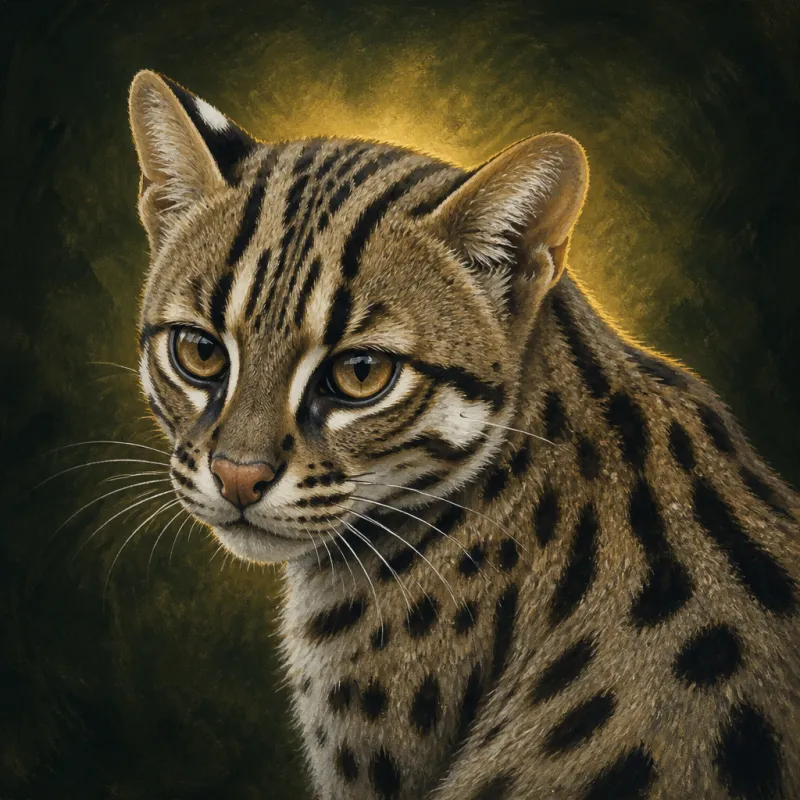
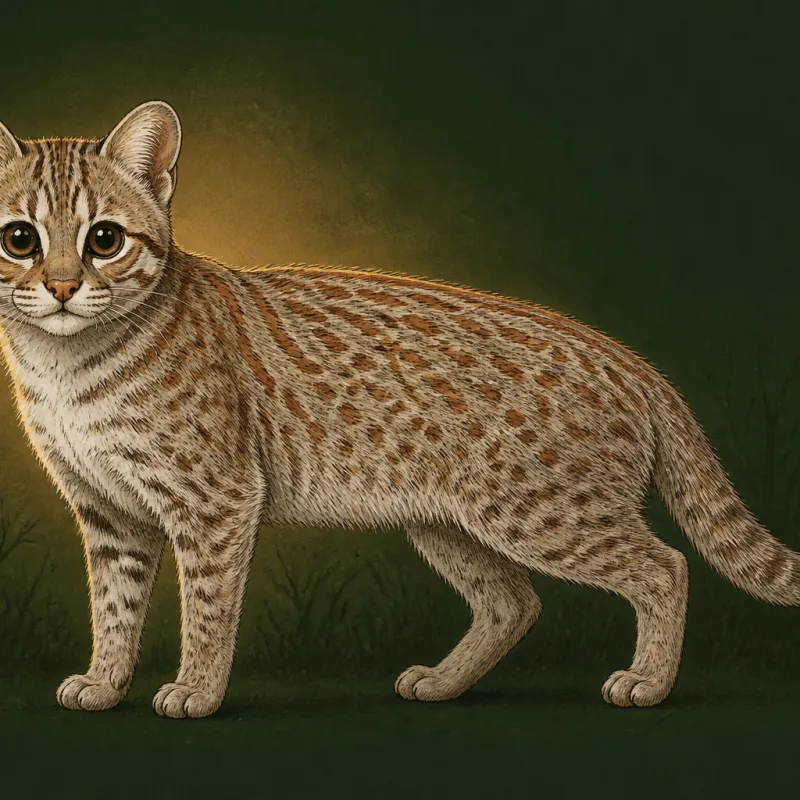
At a glance
- The sunda leopard cat averages about 2.4 times the body mass of the rusty-spotted cat.
- Both species use tropical rainforest and agricultural mosaic.
- Their ranges both include Asia.
- Red List categories differ: Sunda Leopard Cat is listed as Least Concern, Rusty-spotted Cat as Near Threatened.
Identification
How each species is named and classified.
Sunda Leopard Cat
Prionailurus javanensis
Rusty-spotted Cat
Prionailurus rubiginosus
Sunda Leopard Cat
Prionailurus
Rusty-spotted Cat
Prionailurus
Sunda Leopard Cat
Leopard cat lineage
Rusty-spotted Cat
Leopard cat lineage
Sunda Leopard Cat
Small cats
Rusty-spotted Cat
Small cats
Sunda Leopard Cat
Javan leopard cat
Rusty-spotted Cat
Hummingbird cat
Body and movement
Published field measurements for adults. Ranges cover both sexes unless noted.
Sunda Leopard Cat
16 in – 24 in (40–60 cm) Longer
Rusty-spotted Cat
14 in – 19 in (35–48 cm)
Sunda Leopard Cat
7 in – 12 in (17–30 cm) Longer
Rusty-spotted Cat
6 in – 12 in (15–30 cm)
Sunda Leopard Cat
8 in – 10 in (20–26 cm) Taller
Rusty-spotted Cat
7 in – 9 in (17–22 cm)
Sunda Leopard Cat
3.3–9.9 lb (1.5–4.5 kg) Heavier
Consistently lighter than northern mainland leopard cats.
Rusty-spotted Cat
2–3.5 lb (0.9–1.6 kg)
Among the lightest of all wild cats.
Sunda Leopard Cat
Not reliably measured
Not measured in the field.
Rusty-spotted Cat
Not reliably measured
Not measured in the field.
Life span
Typical adult longevity. Figures for managed care come from zoo and sanctuary records.
Sunda Leopard Cat
8–12 years Longer
Rusty-spotted Cat
8–10 years
Sunda Leopard Cat
13–16 years Longer
Rusty-spotted Cat
12–14 years
Habitat and range
Where each species lives and the conditions it tolerates.
Sunda Leopard Cat
tropical rainforest, montane forest, agricultural mosaic, mangrove
Lowland and hill forest, secondary growth, plantation edges and farmland; the species uses oil-palm landscapes where rodents are abundant and cover remains.
Rusty-spotted Cat
dry forest, tropical rainforest, semi-arid scrub, agricultural mosaic
Deciduous forest, scrub, grassland with rock cover, bamboo and cultivated land; it is not restricted to dense forest as was once believed.
Sunda Leopard Cat
Asia
Java, Bali, Borneo, Sumatra, Palawan and other Philippine islands, and smaller islands across the Sunda Shelf.
Rusty-spotted Cat
Asia
Most of India, plus Sri Lanka and the Nepalese terai, with scattered records extending the known range in recent decades.
Diet and behaviour
Feeding ecology, social organisation and hunting technique.
Sunda Leopard Cat
small mammals, birds, reptiles, insects
Rats and mice dominate, along with birds, lizards, frogs and invertebrates.
Rusty-spotted Cat
small mammals, birds, reptiles, insects
Rodents and small birds dominate, with lizards, frogs and insects taken regularly.
Sunda Leopard Cat
Solitary
Common in many surveys and comparatively tolerant of modified landscapes, provided some cover and rodent prey persist.
Rusty-spotted Cat
Solitary
Nocturnal and secretive; most records come from camera traps, road surveys and occasional rescues of kittens from farmland.
Sunda Leopard Cat
Nocturnal
Strongly night active, with camera-trap records clustering well after dark.
Rusty-spotted Cat
Nocturnal
Almost entirely night active, sheltering by day in tree hollows, rock crevices and abandoned structures.
Sunda Leopard Cat
Active ground search
Patrols plantation rows, forest edge and stream banks, hunting rodents and ground-nesting birds.
Rusty-spotted Cat
Rapid ground and tree hunting
Hunts small prey with quick rushes, and readily follows rodents and birds into trees.
Sunda Leopard Cat
Strong
Climbs and dens in trees, though most hunting is terrestrial.
Rusty-spotted Cat
Exceptional More developed
Extremely agile in trees for its size, using branches for both hunting and shelter.
Sunda Leopard Cat
Strong More developed
Swims capably, which has helped the species reach numerous islands.
Rusty-spotted Cat
Very limited
Little recorded association with water.
Conservation
Red List category, population direction and the pressures documented for each species.
Sunda Leopard Cat
LC — Least Concern
Assessed 2021
Rusty-spotted Cat
NT — Near Threatened
Assessed 2016
Sunda Leopard Cat
Decreasing
Rusty-spotted Cat
Decreasing
Sunda Leopard Cat
Forest conversion to plantation, Snaring and hunting for skins, Rodenticide use in plantations, Road mortality, Pet trade
Still widespread and locally common, but hunting for skins, snaring and the conversion of forest to plantation reduce numbers in parts of the range.
Rusty-spotted Cat
Conversion of scrub and forest to cropland, Road mortality, Killing near poultry, Trapping and pet trade, Predation by domestic dogs
Assessed as Near Threatened. Habitat conversion is the leading pressure, though records from farmland suggest more tolerance of modified landscapes than previously assumed.
Notable traits
Details that do not fit neatly into a measurement table.
Sunda Leopard Cat
- The species was separated from the mainland leopard cat in 2017 on genetic and morphological evidence.
- It is one of the few wild cats that appears to benefit, at least temporarily, from rodent booms in plantation landscapes.
- Island populations vary enough in size and markings that further taxonomic work is likely.
Rusty-spotted Cat
- It competes with the black-footed cat for the title of the world's smallest wild cat.
- Kittens are often mistaken for domestic kittens when found near villages.
- Its known range has expanded considerably as camera trapping has spread across India.
Sources used for this comparison
- IUCN Red List of Threatened Species Global assessment categories, population trends and documented threats.
- IUCN SSC Cat Specialist Group Species accounts, distribution notes and Cat News reporting for every wild felid.
- Small Wild Cat Conservation Foundation Dedicated research and field reporting on the lesser-known felids.
- World Wildlife Fund Range descriptions, threat summaries and conservation programme reporting.
- Animal Diversity Web, University of Michigan Museum of Zoology Reviewed species accounts with morphometric ranges and reproductive data.
- National Geographic — Animals General natural-history reference for behaviour, range and ecology.