Species comparison
African Wildcat vs Serval
A side-by-side look at Felis lybica and Leptailurus serval across body measurements, habitat, diet, behaviour and conservation status.
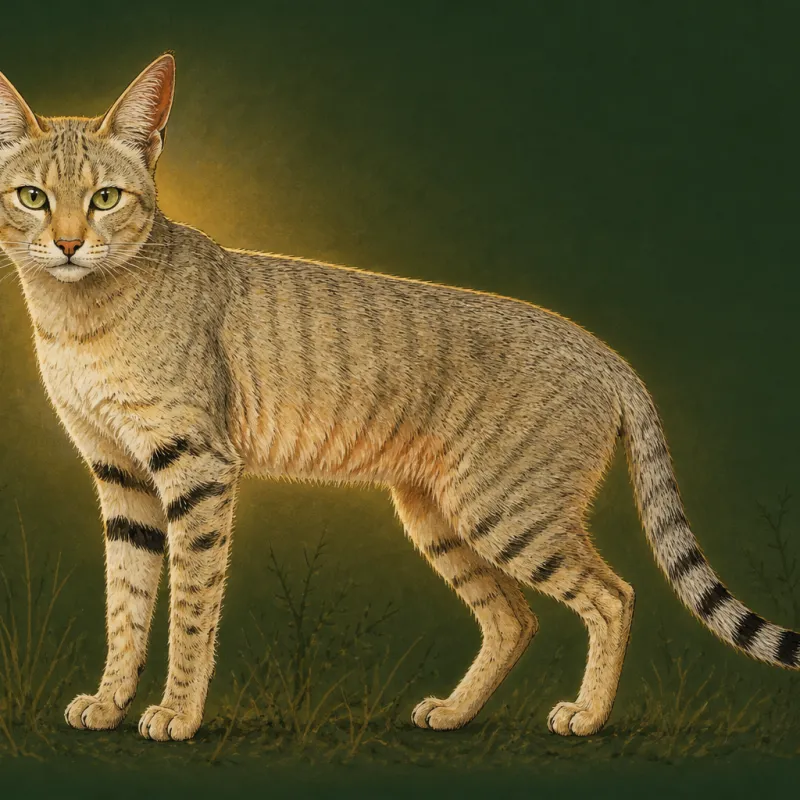
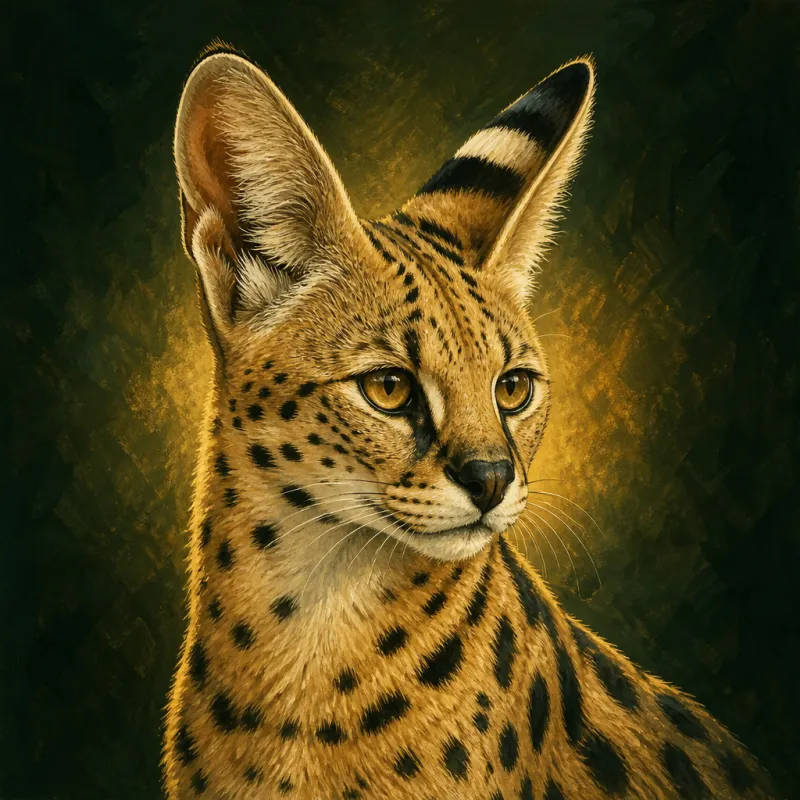
At a glance
- The serval averages about 2.6 times the body mass of the african wildcat.
- Both species use savanna and grassland.
- Their ranges both include Africa.
- Both are currently listed as Least Concern on the Red List.
Identification
How each species is named and classified.
African Wildcat
Felis lybica
Serval
Leptailurus serval
African Wildcat
Felis
Serval
Leptailurus
African Wildcat
Domestic cat lineage
Serval
Caracal lineage
African Wildcat
Small cats
Serval
Medium-sized cats
African Wildcat
Near Eastern wildcat, Asiatic wildcat
Serval
Tierboskat
Body and movement
Published field measurements for adults. Ranges cover both sexes unless noted.
African Wildcat
18 in – 2 ft 6 in (45–75 cm)
Serval
2 ft 2 in – 3 ft 3 in (67–100 cm) Longer
African Wildcat
10 in – 15 in (25–38 cm)
Serval
9 in – 18 in (24–45 cm) Longer
African Wildcat
13 in – 15 in (32–38 cm)
Serval
21 in – 2 ft 2 in (54–66 cm) Taller
African Wildcat
6.6–14 lb (3–6.5 kg)
Males average about a kilogram heavier than females.
Serval
15–40 lb (7–18 kg) Heavier
Males average about 11 kg, females about 9.7 kg.
African Wildcat
Not reliably measured
Not measured in the field.
Serval
Not reliably measured
Rarely measured; the serval is known for leaping rather than for sprinting.
Life span
Typical adult longevity. Figures for managed care come from zoo and sanctuary records.
African Wildcat
8–12 years
Serval
10–12 years Longer
African Wildcat
15–17 years
Serval
20–23 years Longer
Habitat and range
Where each species lives and the conditions it tolerates.
African Wildcat
savanna, semi-arid scrub, dry forest, grassland, agricultural mosaic
Almost every habitat in Africa except rainforest interior and the driest sand seas, plus scrub and steppe across the Middle East and Central Asia.
Serval
wetland, grassland, savanna, montane forest
Well-watered grassland, reedbeds, marsh edges and moist savanna. The species depends on tall vegetation and permanent water, and avoids dry open plains.
African Wildcat
Africa, Asia
Across Africa outside the Congo rainforest, and through the Arabian Peninsula, the Middle East, Central Asia and into western India and China.
Serval
Africa
Widespread across sub-Saharan Africa, with a small and threatened remnant in Morocco and Algeria in the north.
Diet and behaviour
Feeding ecology, social organisation and hunting technique.
African Wildcat
small mammals, birds, reptiles, insects
Rodents form the great majority of the diet, with birds, lizards and insects making up the remainder.
Serval
small mammals, birds, reptiles, insects, amphibians
Vlei rats and other rodents supply most of the diet, along with frogs, lizards, insects and birds taken in flight.
African Wildcat
Solitary
Solitary and territorial, though tolerant of human settlement — the same trait that started the domestication process.
Serval
Solitary
Adults hold overlapping ranges centred on wetland; individuals are more tolerant of one another than most solitary cats where prey is abundant.
African Wildcat
Nocturnal and crepuscular
Mostly active from dusk to dawn, resting by day in burrows, thickets and rock crevices.
Serval
Crepuscular and nocturnal
Two clear activity peaks around dawn and dusk, with additional night-time hunting; servals rest in dense grass during the heat of the day.
African Wildcat
Stalk and pounce on rodents
Hunts by walking slowly through cover, freezing at sounds and finishing with a short rush.
Serval
Acoustic location and vertical pounce
The cat stands still, rotates its ears to pinpoint rustling, then leaps up and forward, striking downward with both forepaws.
African Wildcat
Strong More developed
Climbs well and uses trees for escape and rest.
Serval
Capable
Climbs competently but spends almost all its time on the ground.
African Wildcat
Very limited
Avoids water, in common with most arid-country cats.
Serval
Capable More developed
Comfortable in shallow water and marsh, wading through flooded grassland while hunting.
Conservation
Red List category, population direction and the pressures documented for each species.
African Wildcat
LC — Least Concern
Assessed 2022
Serval
LC — Least Concern
Assessed 2015
African Wildcat
Decreasing
Serval
Stable
African Wildcat
Hybridisation with domestic cats, Disease transmitted by domestic cats, Habitat conversion, Persecution near poultry, Road mortality
The species remains widespread, but genetic mixing with free-ranging domestic cats is eroding wild populations, particularly near settlements. Pure wild-type populations are increasingly restricted to remote areas.
Serval
Wetland drainage and conversion, Grassland burning regimes, Killing for skins used in ceremonial dress, Trade as exotic pets and for hybrid breeding, Loss of North African populations
Secure across much of sub-Saharan Africa, though wetland drainage removes the habitat it depends on, and the North African population is critically small.
Notable traits
Details that do not fit neatly into a measurement table.
African Wildcat
- All domestic cats descend from this species, not from the European wildcat.
- Wild individuals sit with a distinctly upright posture that helps separate them from feral tabbies.
- Genetic screening is now a standard part of conservation work, since appearance alone cannot confirm a pure wild animal.
Serval
- A serval can leap roughly ten feet in a single bound to catch a bird taking off.
- Its legs are proportionally the longest of any cat, an adaptation to seeing over tall grass.
- Recorded hunting success rates in some studies approach one kill for every two attempts, unusually high for a felid.
Sources used for this comparison
- IUCN Red List of Threatened Species Global assessment categories, population trends and documented threats.
- IUCN SSC Cat Specialist Group Species accounts, distribution notes and Cat News reporting for every wild felid.
- Small Wild Cat Conservation Foundation Dedicated research and field reporting on the lesser-known felids.
- Animal Diversity Web, University of Michigan Museum of Zoology Reviewed species accounts with morphometric ranges and reproductive data.
- National Geographic — Animals General natural-history reference for behaviour, range and ecology.
- Smithsonian's National Zoo and Conservation Biology Institute Body measurements, longevity records and life-history notes.